
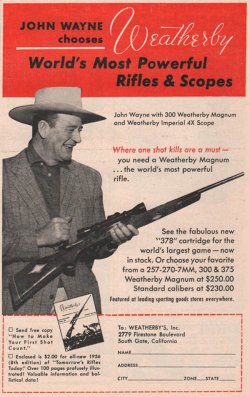
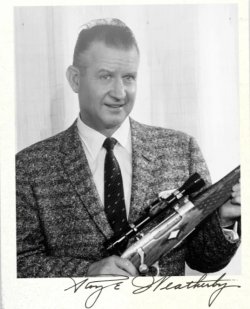
Roy Edward Weatherby (4 September 1910 – 4 April 1988), a farmer's boy from Kansas, moved to Hunting Park in California at the age of 35 and founded Weatherby, Inc. in 1945. The businessman and "wildcatter" (i.e. a reloader who develops his own cartridge creations) strived for top performance in the realm of rifle calibers and thus for maximum bullet velocity and energy. In 2019, the current company boss Adam Weatherby moved the company to Sheridan, in Wyoming.
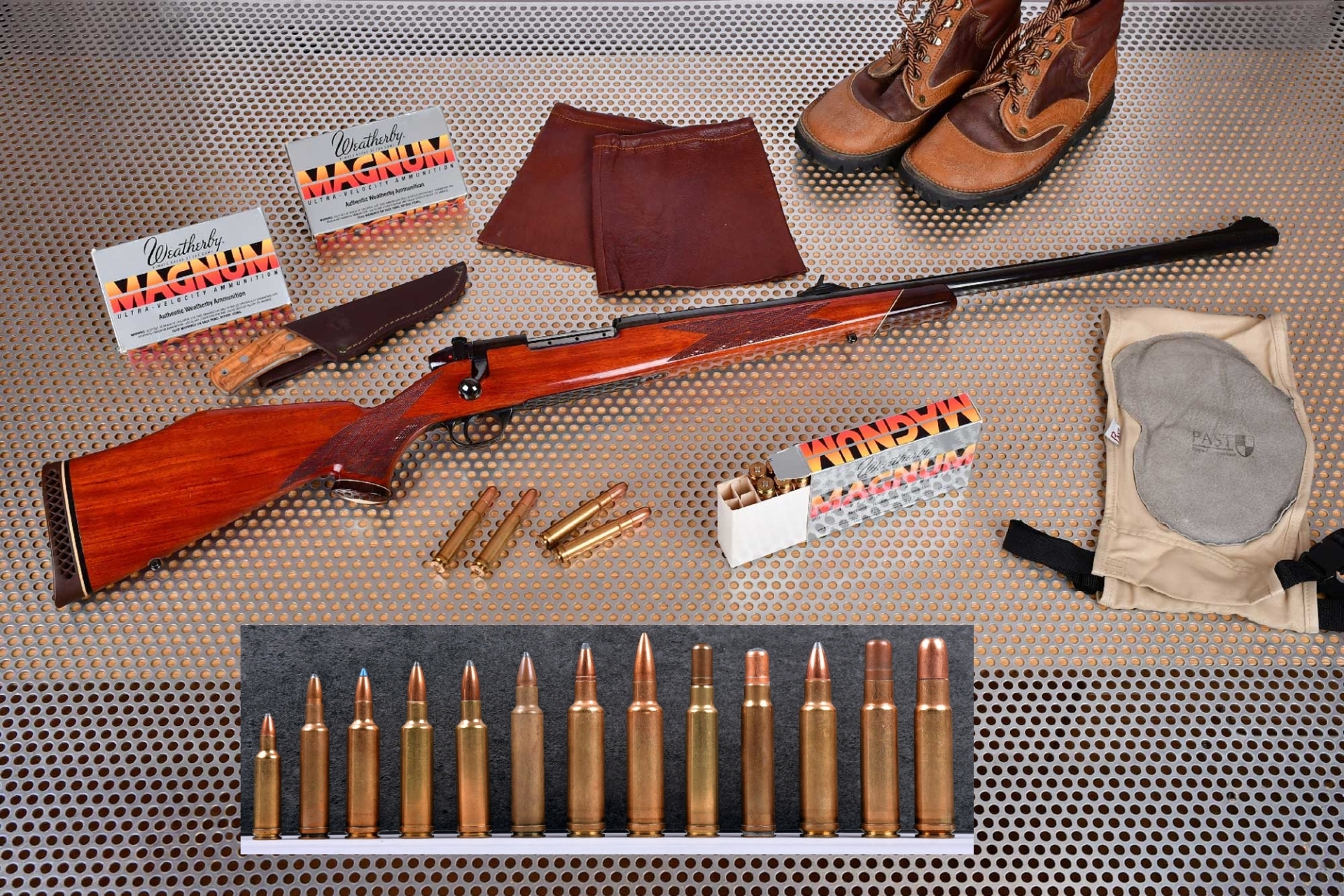
Weatherby products include the Weatherby Magnum (WM) cartridges in chronological order: 7mm WM (1944), .270 and .375 WM (1945), .257 and .300 WM (1948), .378 WM (1953), .460 WM (1958), .340 WM (1962) and .224 and .240 WM (1963). His son Ed Weatherby added the .416 WM to this prominent series in 1989. The double-radius shoulder found on all Weatherby cartridges is intended to increase the flow velocity of the powder gases and thus the ballistic performance through the so-called "Venturi effect". The .300 Weatherby Magnum only had to cede the title of the world's most powerful .30 factory cartridge to the .30-378 from Weatherby in 1996. The rifles from Weatherby and other manufacturers for high-performance calibers have a long, flat transition from the chamber to the rifled bore profile. This long freebore is intended to delay the short-term gas-pressurized bullet entry into the rifled section in order to give the projectile more start-up time without friction loss in the barrel profile. The latest Weatherby cartridges, such as the 6.5 Weatherby Rebated Precision Magnum (RPM) from 2019 and .338 Weatherby RPM from 2022, do not have the typical trademarks such as a belt or double radius shoulder, and the rifles do not have to be fitted with long freebore.
The .460 Weatherby Magnum cartridge in detail
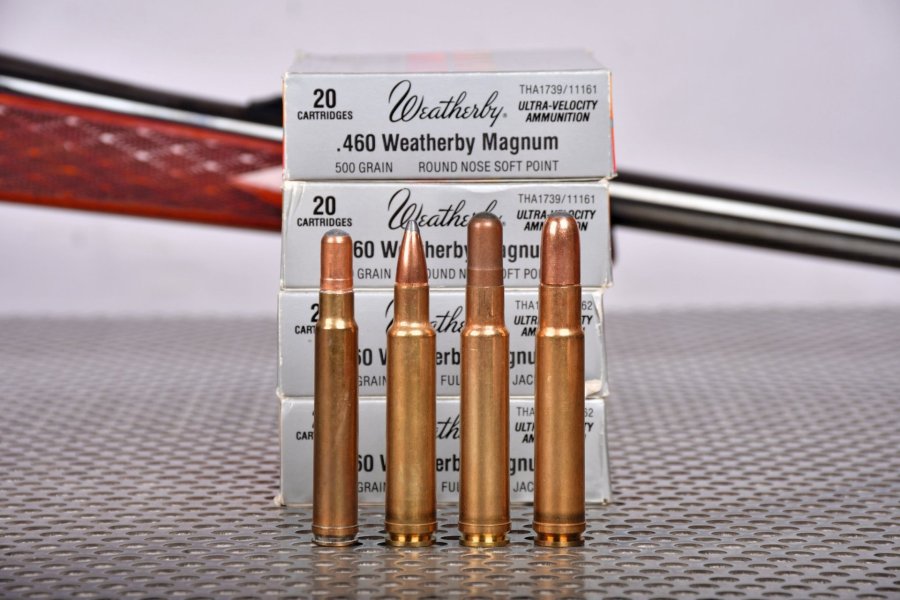
Although the .460 Weatherby Magnum is now 67 years old and in its prime, it has lost none of its enormous performance and its brutal shooting behavior pushes even experienced shooters to their limits. With the .460 WM, which is a .378 WM widened to a bullet diameter of .458"/11.6 mm and fitted with a 500-grain bullet, Weatherby ascended to the throne of the most powerful cartridge ever to be mass-produced. It relegated the .600 Nitro Express, which dates back to 1903, to second place. The .460 WM (11.6x74 mm) with a maximum chamber pressure of 4,400 bar accelerates a projectile, usually weighing 450 grains/29 grams to 500 grains/32 grams, to an initial velocity of around 800 m/s and produces energy values of around 9,000 to 10,000 joules. As with the .378 WM released five years earlier, the full or partially jacketed bullets available at the time of market launch could not withstand the loads and bent or burst when hitting hard-to-shoot game, which was not exactly conducive to its reputation.
Reloading the .460 Weatherby Magnum cartridge
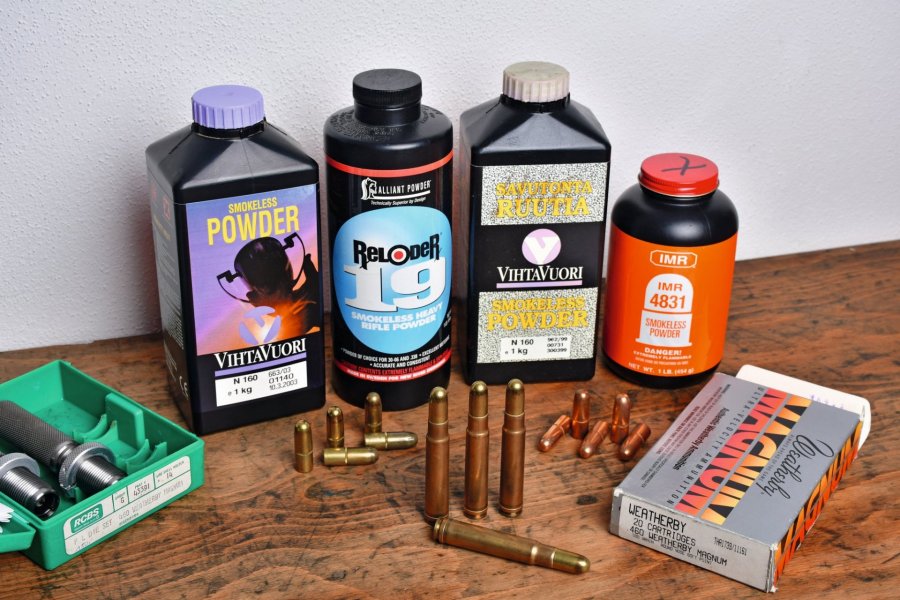
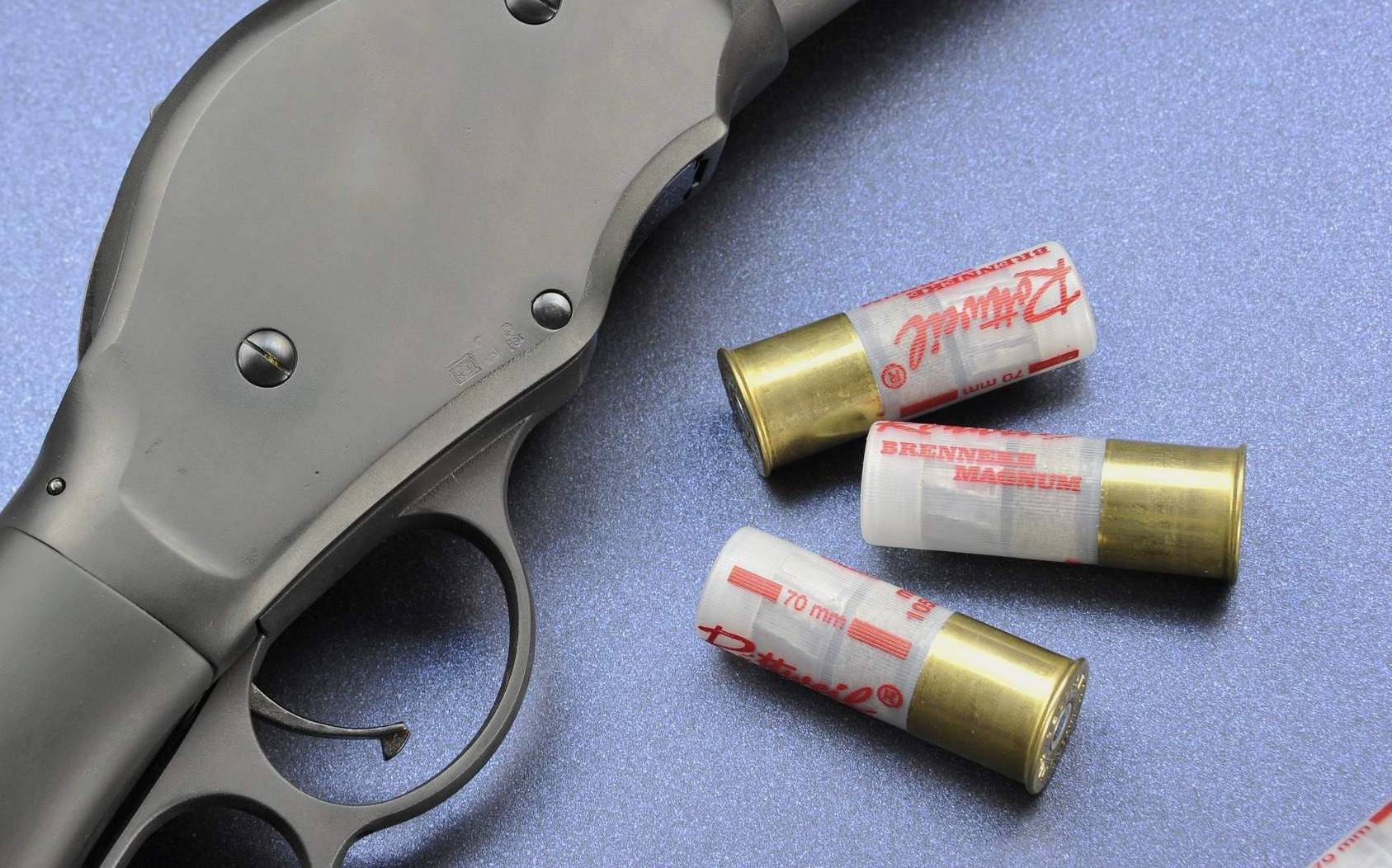
There is not much factory ammunition with Hornady full and partial metal jacket bullets, mainly from Norma in Sweden. According to reports, every "factory cartridge" is hand-loaded because the annual production rate is simply too low for machine production. Weatherby also offers three .460 loads on its website, one with a 450 grs Barnes bullet and two 500 grs Hornady projectiles, but all three are currently not available. The original labelled Weatherby cases are available from the German Weatherby importer Helmut Hofmann, for example.
Due to the cartridge length of 94.5 mm, a loading press with a corresponding clearance height within the frame is required for reloading. Our Lee Classic Cast performed well here. But the Big Boss or Ultramag models from Redding are also well suited for this purpose. Die sets from the usual suspects (Lee, Hornady, RCBS, Redding) range in price from 126 to 157 euros. A case from Norma costs a hefty 6.80 euros. Due to the common diameter of .458", a large number of premium bullets are available: Barnes, Degol, Federal, Hornady, Nosler, Swift and Woodleigh are to be mentioned here. Propellants include Hodgdon H4831, H4350 and H380, IMR 4831, Norma 203 and 204, Reloader RL 19 and Vihtavuori N150 and N160. The recommended primer is the Federal 215 M. A long funnel ensures that the high powder charges fill the case well.
The Weatherby Mark V big game rifle in detail
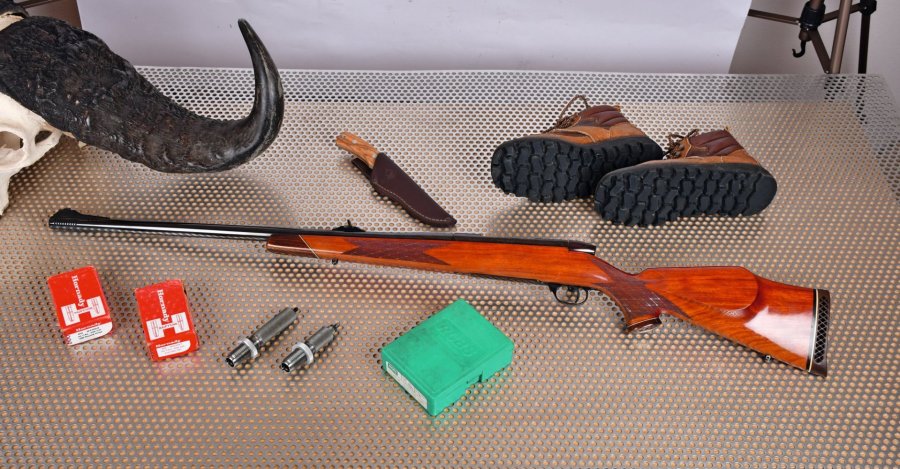
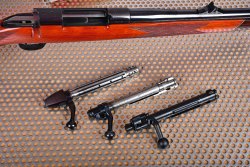
It is known that Weatherby rifles or main components were made by different manufacturers. Initially, Roy Weatherby built custom rifles based on Mauser 98 actions from various manufacturers according to customer specifications. In 1956 he entered into a co-operation with Schultz & Larsen from Denmark and used the Model 54 action as the basis for his rifles in .378 Weatherby Magnum. Two years later, after years of development work, he was able to present his own robust Mark V bolt action, which was capable of withstanding gas pressures of up to 7,000 bar. The Mark-V action was initially manufactured by the supplier Pacific Founders, Inc. in the USA. Due to the increasing demand for complete Mark V rifles, he joined forces with J. P. Sauer & Sohn in Germany, where the rifles were then manufactured. Due to rising manufacturing costs, Weatherby moved production to Japan in the early 1970s. There, at Howa, the low-cost Weatherby Vanguard rifle series was created on the basis of the simpler Howa 1500 bolt action.
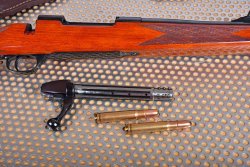
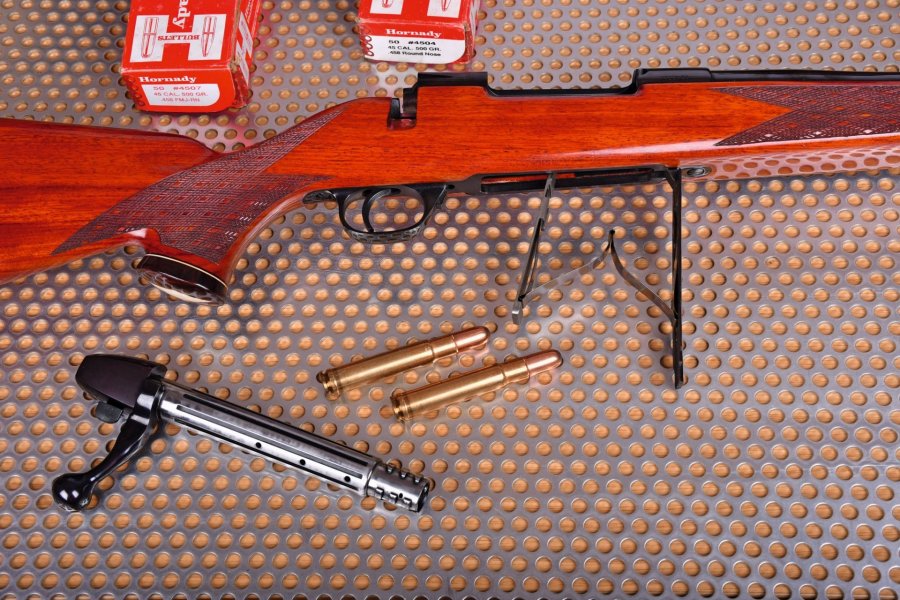
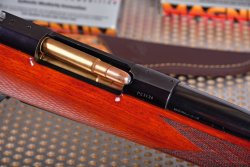
The Mark V action with its short bolt throw and three gas relief holes, has nine locking lugs for the powerful cartridges such as .378 Weatherby Magnum, and six locking lugs in a smaller version for Varmint cartridges such as .224 Weatherby Magnum. The Howa 1500/Weatherby Vanguard bolt, on the other hand, has only two locking lugs. Eight years ago, Weatherby relocated from Paso Robles, California, to Sheridan, Wyoming.
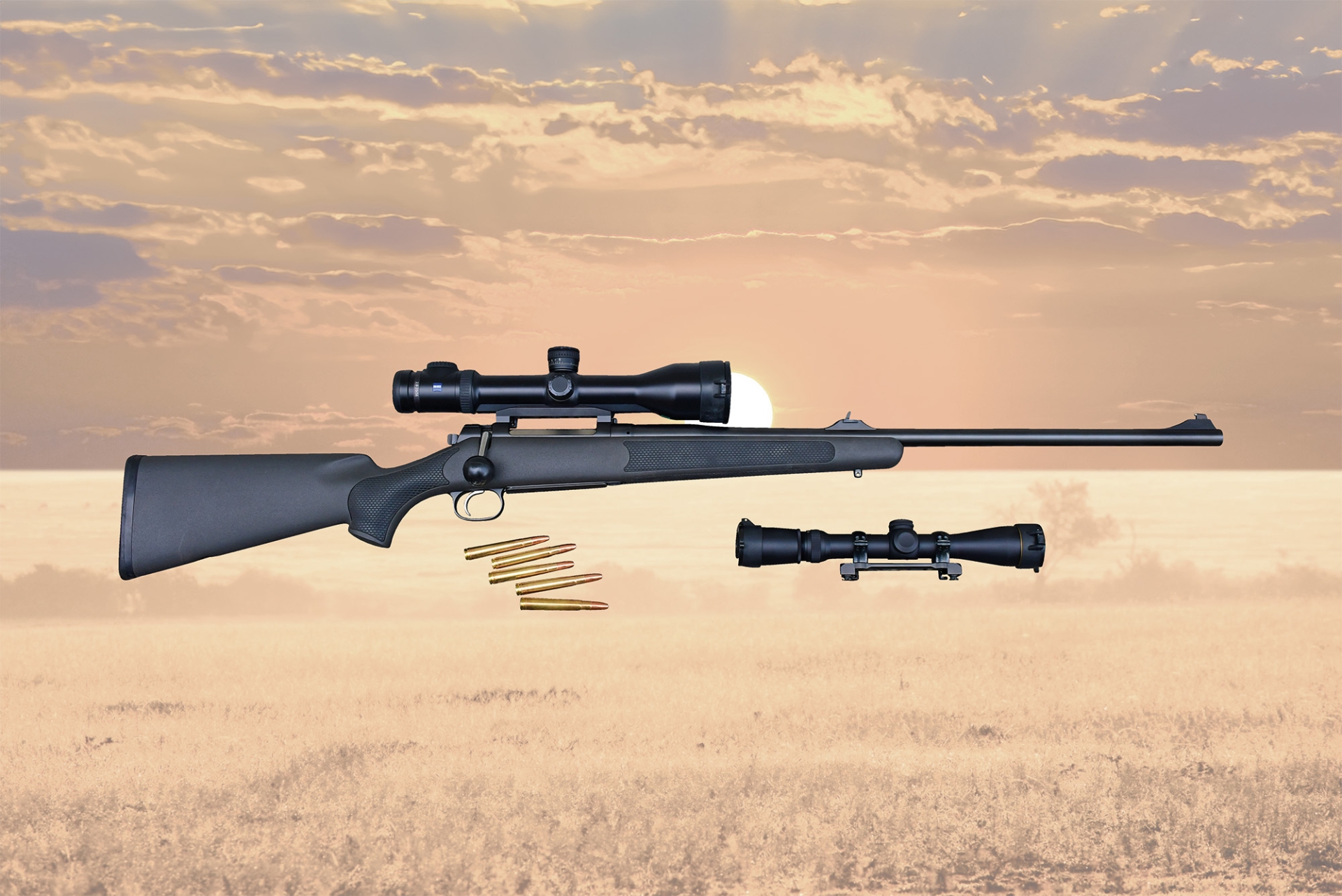
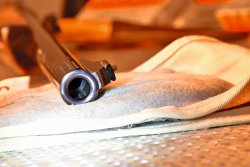
Although the barrel of our test gun in the form of a Weatherby Mark V in .460 WM has a length of 660 mm in order to be able to convert the power and keep the muzzle flash within limits, the length of the effective, rifled bore profile is only 615 mm. This is because the rest of the barrel was bored out to an internal diameter of 12.15 mm at the muzzle and back-bored to create even more volume for the integral compensator on these 45 mm. The compensator has 30 ports per side, each with three rows of 10 ports with a diameter of 2.2 mm. In addition, there are three ports on both sides in front of the front sight base. All in all, a total of 66 ports, which provide baffle surfaces for the abundant hot powder gases. In inspected compensators from the 1980s, the port diameters were still 1.3 mm. Obviously, improvements have been made here and more venting has been provided. Nevertheless, the big cat is still no pussycat. Typical for Weatherby rifles is the Monte Carlo stock with the obligatory white insert on the fore-end and the diamond pattern on the underside of the pistol grip.
Shooting the .460 Weatherby Magnum
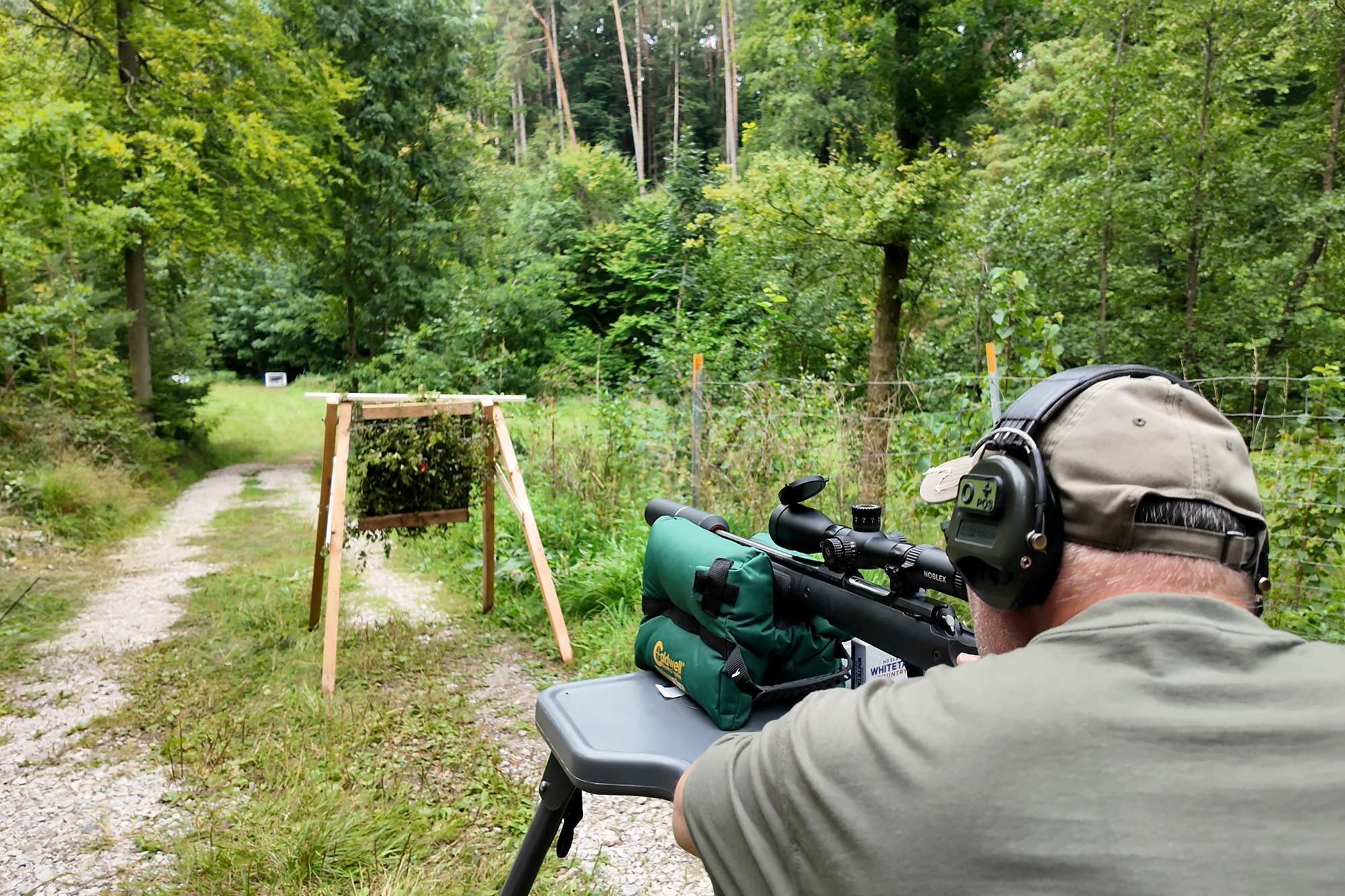
Shooting with original Weatherby rifles in .460 WM is an ordeal, whereby you need a thick jacket, a lot of experience and courage when shooting standing freehand. Shooting from a sitting position should be avoided as a matter of principle. The Monte Carlo stock has a short distance between the butt plate and trigger (LOP, Length of Pull) of only 355 mm, which is 20 mm too little for us. Instead of putting the front sling swivel base over the barrel with a ring, the Mark V has a screw simply and conveniently placed in the fore-end. Anyone who does not carry their rifle with a sling would do well to remove the screw to protect themselves from painful contact when firing. The mechanical sights, which are not always available on standard rifles, depending on the production location and year, are suitable for target shooting with their wide, matte black blued rear sight and front sight, but less so for hunting. For riflescopes, you should only use optics with increased eye relief such as the Leupold 2.8-8x32 EER (Extended Eye Relief) , which is only available on the second-hand market. Due to the enormous recoil, it is not exactly easy to fire every shot cleanly and accurately. Three-shot groups instead of the usual five-shot groups are completely sufficient here. Concentration is lost quite quickly under these loads. When hunting big game, the cartridge still delivers more power at 100 meters than many other big game cartridges at the muzzle.
- The previous parts of the series on all4hunters.com:
- Big game hunting cartridges – Part 1: .375 Holland & Holland Magnum, a British classic with belted case
- Big game hunting cartridges – Part 2: .416 Rigby, a universal cartridge
- Big game hunting cartridges – Part 3: .416 Remington Magnum, from the Wildcat to the factory cartridge