
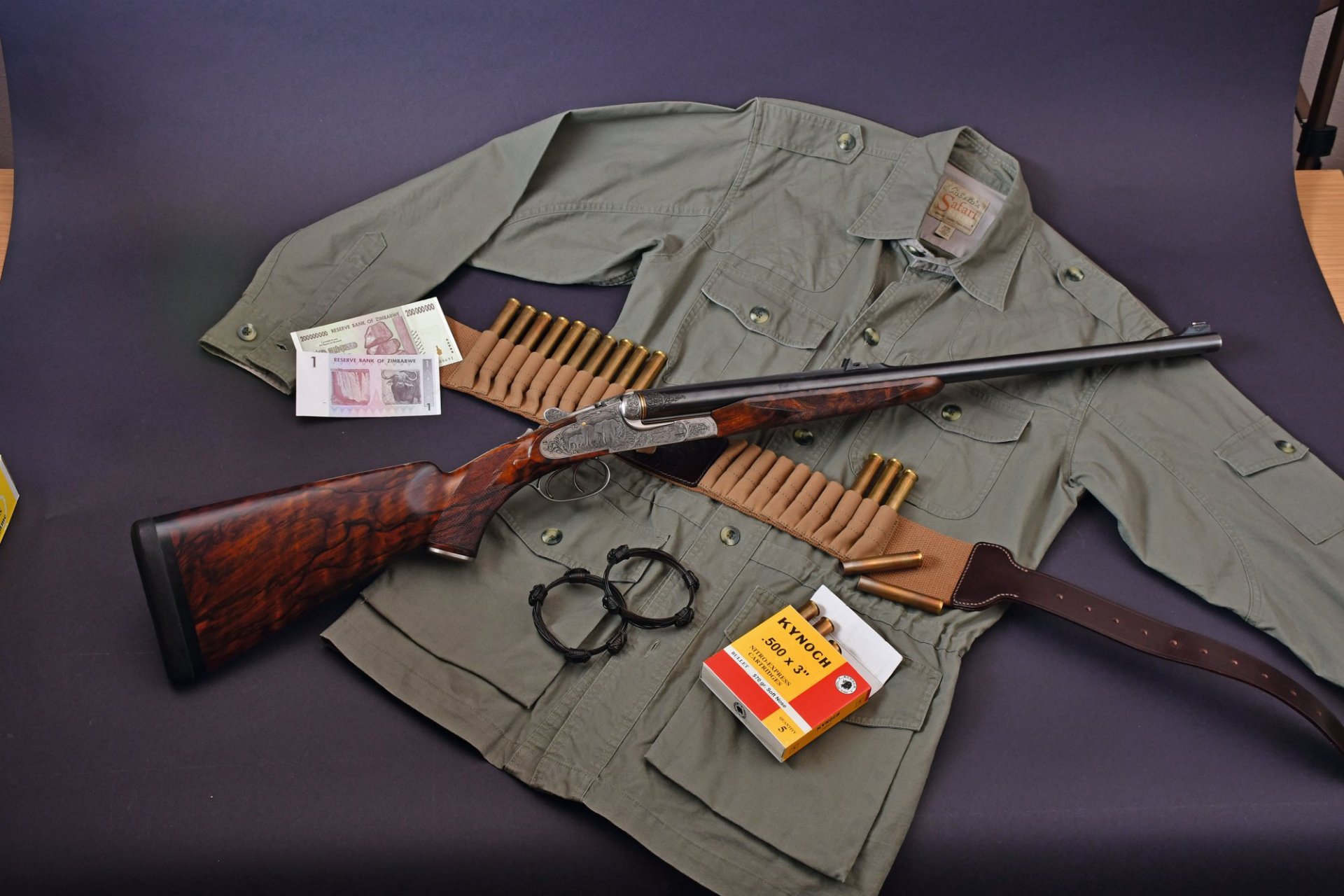
The story of the .500 began in 1880 with the introduction of the .500 2¾-inch Black Powder Express. It was later followed by the longer 3-inch version, which remains the
standard case length today and is commonly referred to as the .500 Black Powder Express. The cartridge's evolution did not stop there, however. A 3¼-inch .500 Nitro Express was also introduced.
From a ballistic standpoint, both Nitro Express versions are virtually identical, firing a 570-grain (36.9 g) bullet at the same performance level. The longer 3¼-inch case offers only a marginal advantage, reducing maximum chamber pressure from approximately 2,800 bar to 2,700 bar. Nevertheless, the 3-inch (76 mm) .500 Nitro Express has become the universally accepted standard, while rifles chambered for the 3¼-inch version remain exceptionally rare.
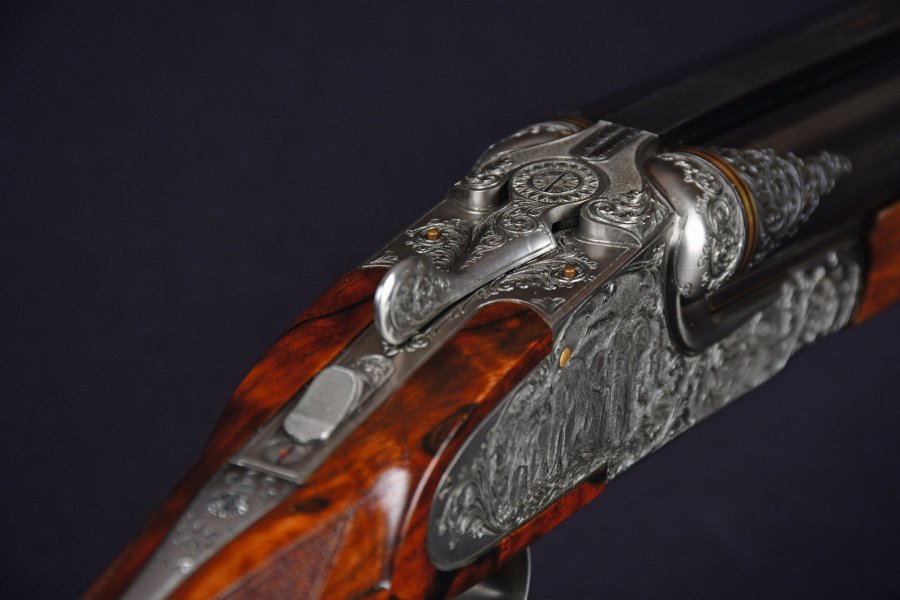
During the black powder era, the .500 caliber never gained widespread popularity. Rifles chambered for it were simply too heavy for the ballistic performance they offered. Hunters generally preferred lighter rifles in smaller calibers or, for truly dangerous encounters, the powerful .577-class rifles.
Loaded with soft lead bullets, the .500 Black Powder Express earned an excellent reputation for hunting the great cats—lion, tiger and leopard. Few hunters, however, considered it suitable for dangerous game such as elephant, hippopotamus or rhinoceros, largely because the bullets available at the time offered only modest penetration.
The rifles themselves also contributed to the problem. Typical barrel lengths of 68 to 70 cm (27 to 28 inches) combined with overall weights between 6.0 and 6.5 kilograms
made them cumbersome companions in the African bush. Many hunters simply preferred carrying a .577, which weighed little more yet had already established its legendary reputation as the definitive stopping rifle.
By the standards of its day, the .500 Black Powder Express was almost regarded as a "small-bore" dangerous game cartridge. While entirely adequate for antelope and the great cats, its terminal performance on the largest African game was considered marginal, despite offering sufficient penetration for lighter quarry.
The Modern .500 Nitro Express
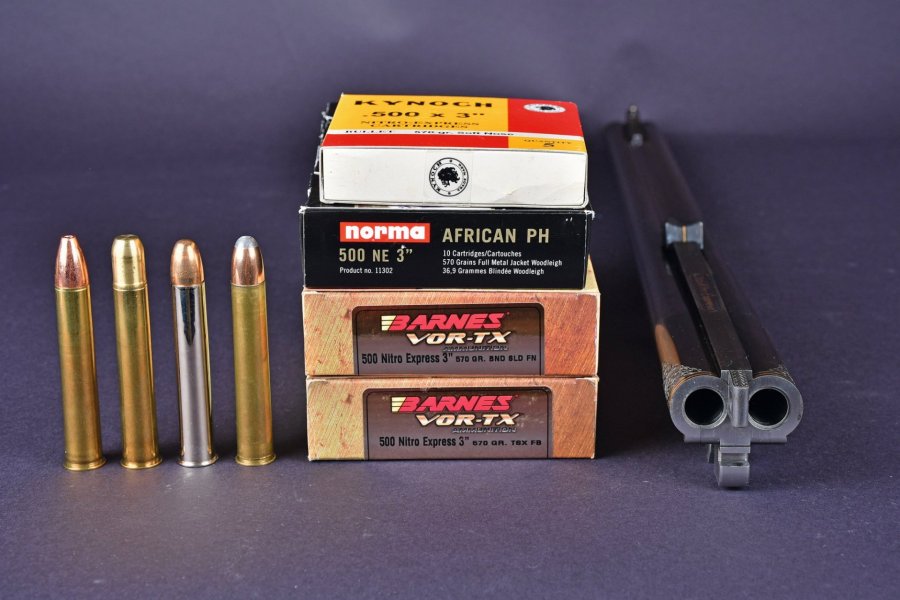
Today's .500 Nitro Express shooters can choose from factory ammunition offered by Barnes, Federal, Hornady, Kynoch, LFB, Norma and Swift. Those who handload, however, should be prepared for a considerable investment, as components for this classic dangerous game cartridge are quite expensive. A box of twenty Norma cases costs around €148, or €7.40 per case, while reloading dies retail for approximately €181 from Hornady and €283 from RCBS.
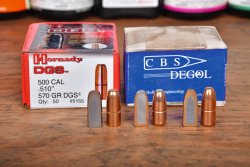
Reliable 570-grain bullets in .510-inch (12.95 mm) diameter are available from manufacturers including Barnes, Degol, Hornady, Swift and Woodleigh. North Fork Technologies also offers monolithic 570-grain flat-nose bullets renowned for their exceptional penetration. To minimize barrel friction and avoid unnecessary pressure increases, these projectiles feature driving bands that reduce the bearing surface in contact with the bore.
Because the maximum cartridge overall length is 95.25 mm (3.75 inches), reloading requires a press with a frame opening of at least 100 mm. Models such as the Lee Classic Cast or any capable of reloading .50BMG are particularly well suited to handling cartridges of this size. Smaller presses can still be used, although they often require removing and reinstalling the dies for every operation unless equipped with quick-change bushings such as those offered by Hornady.
Finding the Right Smokeless Powder
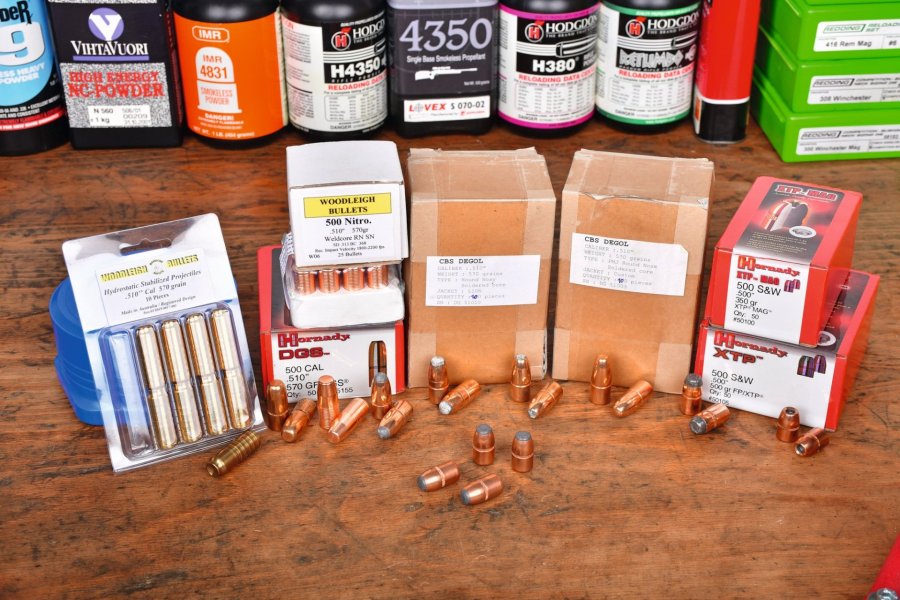
While case preparation presents few challenges, selecting the right powder is a far more demanding task. Even major ammunition manufacturers acknowledge the complexity of loading the .500 Nitro Express. Norma, for example, confirmed to us that this cartridge proved the most difficult to develop within its entire Professional Hunter (PH) ammunition line.
Most loading manuals list muzzle velocities of 2,100 fps (640 m/s) as the minimum standard, while many sources simply quote 2,150 fps (655 m/s) without further verification. Although these figures appear modest compared to modern high-performance rifle cartridges, the .500 Nitro Express still delivers muzzle energies approaching 8,000 joules.
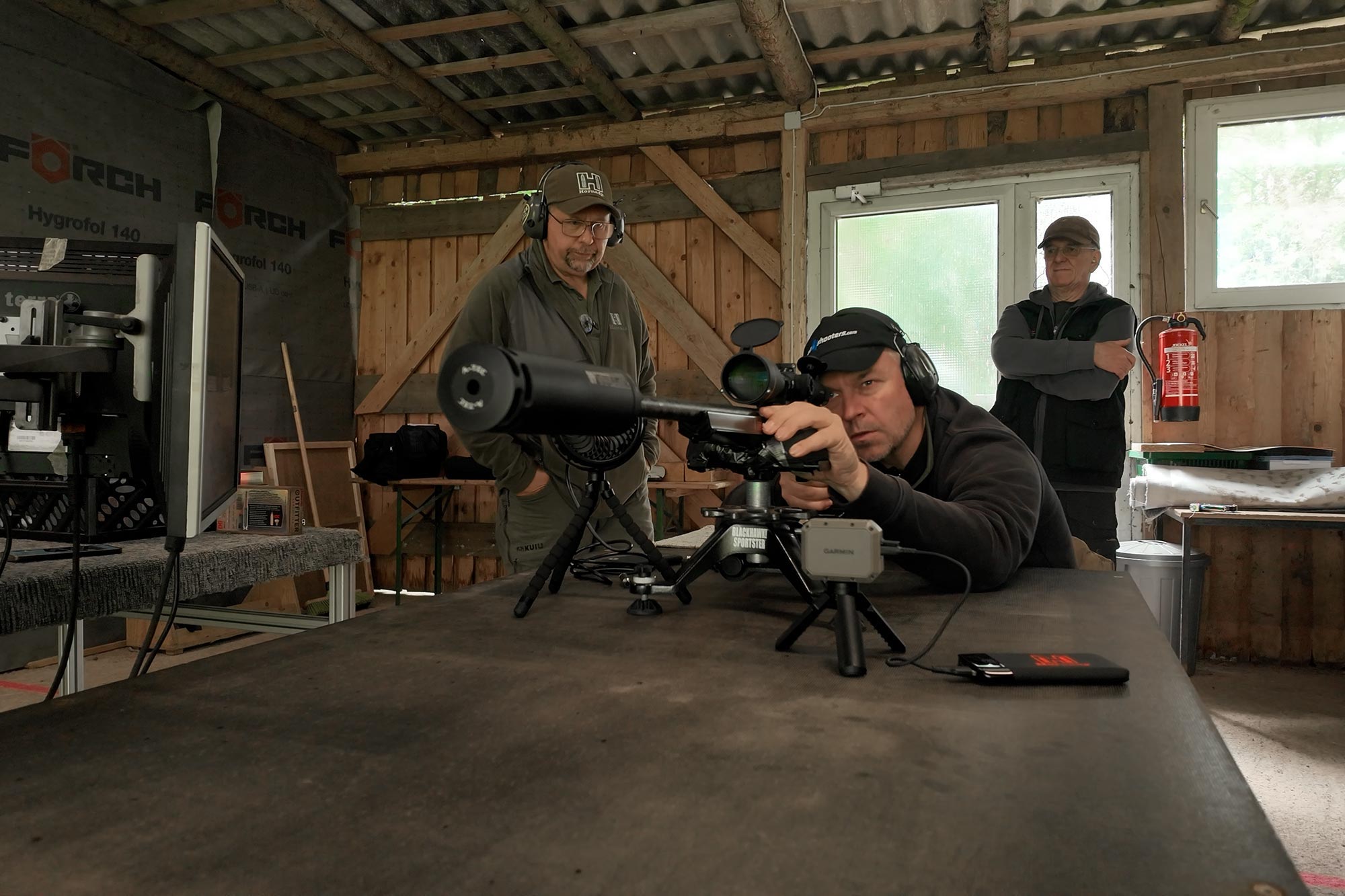
Reality, however, often differs from published ballistic data. Historically, manufacturers established official velocities using exceptionally long 71- to 76-centimetre (28- to 30-inch) pressure barrels, maximizing velocity figures under laboratory conditions. In our own testing, using rifles fitted with 60, 61 and 65 cm barrels, results varied considerably. One well-known factory load delivered only 587 m/s from the shortest barrel.
With powder charges ranging between 100 and 115 grains (6.4–7.4 g), every centimeter of barrel length has a measurable influence on performance. While rifles fitted with 65 cm barrels generally achieve the expected 655 m/s, shortening the barrel by only four centimeters typically reduces velocity to around 630–640 m/s.
The Challenge of Finding the Right Powder
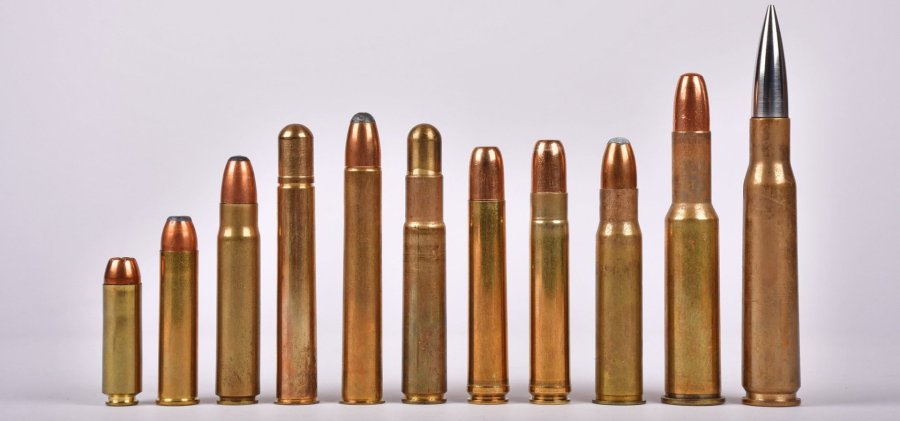
During extensive testing involving several hundred rounds, we evaluated a wide range of propellants, including Accurate Arms 4350, Alliant Reloader 17 and 19, Hodgdon H-380 and H-4350, IMR 4831, Norma 203-B, URP and MRP, Swiss Reload RS60, and Vihtavuori N550 and N560. While every powder tested delivered excellent accuracy, only three consistently combined precision with the desired ballistic performance, producing muzzle velocities between 640 and 655 m/s: Hodgdon H-4350, Norma MRP and Swiss Reload RS60. All test ammunition was assembled using Federal 215M Magnum primers.
Reaching the target velocity of 655 m/s is certainly possible with many different powders. Unfortunately, higher velocity inevitably brings increased chamber pressure. Our pressure measurements showed values between 3,200 and 3,400 bar, well above acceptable operating limits.
We also experimented with pressure-relief grooves machined into the bullets in an attempt to lower chamber pressure while maintaining performance. The results were disappointing. The grooves neither reduced pressure nor produced any measurable increase in velocity, proving to be a dead end
The Rifle Matters Too: Weight Is Essential with the .500 Nitro Express
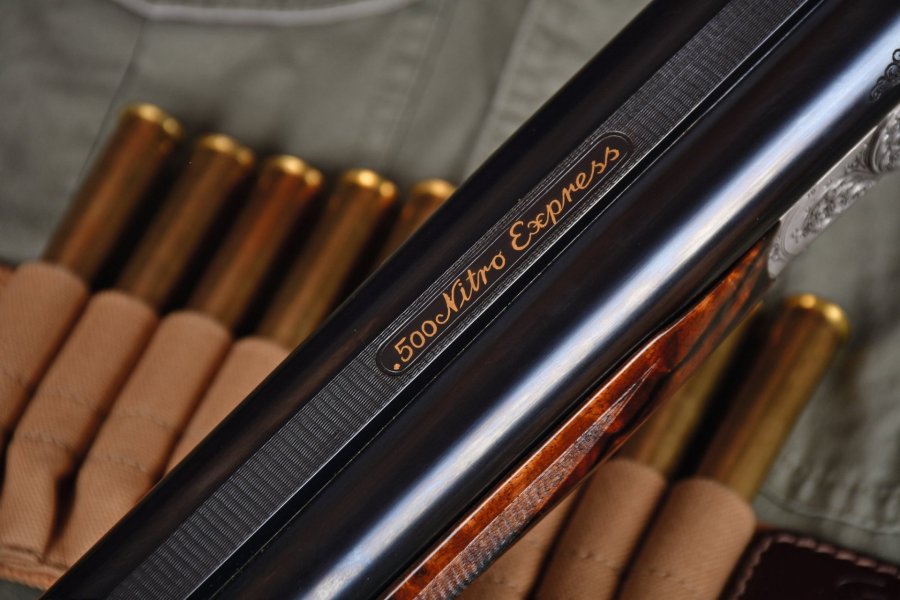
To control a double rifle chambered in this class of cartridge and deliver a rapid, accurate second shot, the rifle should weigh at least 5 kilograms. The standard offerings from German manufacturers such as Heym, Merkel and Krieghoff, at around 4.5 kilograms, are simply too light.
For the professional hunter who spends long days carrying the rifle through the bush and only fires it occasionally, that reduced weight certainly has its advantages. For the hunter who intends to train regularly, however, shooting a rifle this light quickly becomes an exhausting experience. Put simply, a 4.5 kg .500 Nitro Express double rifle is for the truly tough, fit and built.
We spent considerable time shooting both a Krieghoff Classic, equipped with its manual cocking system, and a Heym Model 88. The Krieghoff's stock geometry—better suited to a scoped sporting rifle than a traditional dangerous game double—does little to improve shooting comfort. The pronounced schnabel fore-end, relatively low comb and, above all, the negative pitch make recoil management more difficult than necessary. Had the designers taken greater inspiration from classic British doubles such as the 1930 Halliday or the 1929 Jeffery, the result would have been significantly more comfortable.
It also took Krieghoff many years before finally introducing ejectors on the Classic. By comparison, the original Anson & Deely ejector patent (No. 14,526) was granted on 3 November 1884, and the original documents remain preserved at Westley Richards in Birmingham. Some manufacturers simply take a little longer to embrace tradition.
The Heym Model 88, with its Anson locks and cold hammer-forged barrels, leaves a far more convincing impression. The only criticism concerns the standard 61 cm barrel length, which could ideally be increased to 65 or even 66 cm. Heym will supply longer barrels on request, and there are clear advantages in doing so. The additional weight at the muzzle helps reduce muzzle rise, while the longer barrels allow the substantial powder charge to burn more efficiently.
Stock design, balance and overall handling of the Heym are outstanding, while the ejectors operate flawlessly. Naturally, premium manufacturers such as Barthold, Max Ern, Hausmann & Co., Holland & Holland, Purdey, Rigby, Westley Richards and Ziegenhahn also produce bespoke .500 Nitro Express double rifles tailored to individual customer requirements.
The Big Question: .470 Nitro Express or .500 Nitro Express?
For the average hunter planning a once-in-a-lifetime—or perhaps only occasional—African safari, the .470 Nitro Express remains an outstanding choice. Rifles and factory ammunition are readily available, and, with rifles of comparable weight and stock dimensions, the .470 is noticeably more comfortable to shoot than the .500.
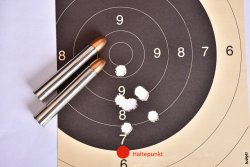
It may seem surprising, but the additional 70 grains of bullet weight, combined with the larger powder charge, make a significant difference at the shoulder. Anyone fortunate enough to shoot both cartridges back-to-back will immediately appreciate the contrast. When it comes to terminal performance, however, drawing meaningful comparisons in the field is far more difficult..
During our research we located a Professional Hunter who had spent many years carrying both cartridges while hunting dangerous game.
His opinion was unequivocal:
"The stopping power of the .500 at close range is tremendous. Whether it's an elephant or a hippo, the impact is enough to stop virtually anything. For the visiting hunter, the .470 Nitro Express is an excellent choice. And if things really go wrong, there's always the Professional Hunter carrying a .500 Nitro Express to sort things out."
Even the highly experienced Zimbabwean elephant hunter Buzz Charlton eventually retired his trusted .416 Rigby in favour of a Heym Model 88 chambered in .500 Nitro Express.
When we asked him why he had made the switch, his answer was simple:
"We hunt at extremely close range, often in very poor visibility. There simply isn't always enough time to cycle the bolt."
Our Verdict on the .500 Nitro Express
Over the past few years, the .500 Nitro Express has enjoyed a genuine resurgence. For many Professional Hunters it has become a form of life insurance when following wounded dangerous game through dense cover. Today, a growing number of guides rely on the cartridge with complete confidence.
We know of two Professional Hunters who even carry the .500 Nitro Express when pursuing the great cats. Both independently reached the same conclusion:
"I've seen shotgun slugs bounce off the skull of a leopard."
That experience explains why they prefer the reassurance offered by a true stopping rifle.
Field experience also supports the cartridge's formidable reputation. Using Degol solid bullets, complete pass-through penetration has been documented on elephants standing broadside.
It is no coincidence that the .500 Nitro Express was also one of John "Pondoro" Taylor's favourite dangerous game cartridges. His philosophy was simple:
"Anything below .50 calibre has no place in dangerous game hunting."
Or, to borrow another famous maxim from the great African hunters:
"Walk slowly and carry a big stick."
There is little more that needs to be said.
Previous articles in the series:
- Part 1: Dangerous Game Cartridges – The .375 Holland & Holland Magnum: Africa's All-Round Hunting Cartridge
- Part 2: Dangerous Game Cartridges – The .416 Rigby: A Versatile Cartridge for Heavy Game
- Part 3: Dangerous Game Cartridges – The .416 Remington Magnum: From Wildcat to Factory Cartridge
- Part 4: Dangerous Game Cartridges – The .460 Weatherby Magnum