
The .416 Remington Magnum is essentially the industrialized version of an American wildcat: the .416 Hoffman. In the 1970s, George L. Hoffman, a professional safari hunter from Texas, was looking for a fast, deeply effective big game cartridge that would bring 400-grain bullets in .416 caliber (10.57 mm) up to the performance level of the classic .416 Rigby (read our article on the .416 Rigby on all4hunters here). Their effectiveness was undisputed, but Rigby rifles and suitable ammunition were rare, expensive and tied to correspondingly large magnum actions. Hoffman wanted to achieve such performance with much more easily available bolt-action rifles in the .375 H&H class (more on the .375 H&H here). To this end, he enlarged the belted case of the .375 H&H Magnum to the .416 bullet diameter, reduced the taper, and thus created a gunsmith's cartridge that was initially not standardized industrially – a wildcat. With 400-grain bullets, the .416 Hoffman achieved a velocity of around 2,400 to 2,450 fps (around 740 m/s) in practice and was thus ballistically at the level expected of a modern cartridge for strong and powerful game.
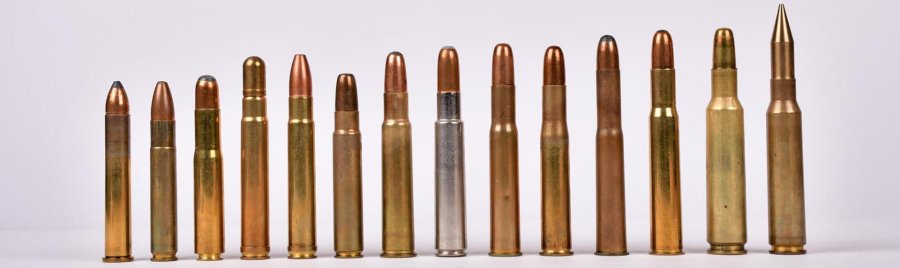
On numerous safaris, Hoffman proved that his design had what it took to be an all-rounder for heavy big game. The practical advantage over the .416 Rigby lay less in a completely new ballistic idea than in the action issue: the Hoffman cartridge fitted bolt-action rifles chambered in .375 H&H. This meant that existing guns could be converted comparatively easily and new rifles could be built more cheaply. Remington took up this concept and introduced the .416 Remington Magnum as a factory cartridge in 1988. It was not an exact copy of the .416 Hoffman, but Remington's standardized interpretation of the same basic idea, technically based on the 8mm Remington Magnum, which itself originated from the .375 H&H family. The successful wildcat thus became a regular factory cartridge with widely available ammunition, clearly defined loading data and a place in the international big game segment.
Late answer to the .416 Remington Magnum
Holland & Holland's parent company, it took a long 92 years before finally offering customers something comparable in the .416 caliber class in 2004: the .400 Holland & Holland Magnum. The .416 Taylor, based on the 63.5-mm long .458 Winchester Magnum, which has been necked down to a .416 caliber bullet diameter, also belongs in the same performance class. This pioneering cartridge heralded the later wave of "short magnums" as early as 1973 and, with an overall length (OAL for short) of 84.4 mm, fits even more comfortably into a standard action. Compared to the .416 Remington Magnum with 4,300 bar, the Taylor was standardized at 4,400 bar gas pressure. Short magnum developments such as the 300 Remington Short Action Ultra Magnum (SAUM) or .270, .300 and .325 Winchester Short Magnum (WSM) did not follow until 15 years later. The young .416 Ruger (10.6 x 65.5 mm), which was developed in 2008 through a collaboration between Hornady and Ruger, should also not be forgotten. It delivers the ballistics of a .416 Rigby or Remington Magnum and fits into a standard action designed for the .30-06 Springfield.
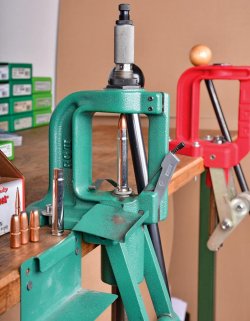
Reloading the .416 Rem. Mag.
Factory ammunition in .416 Rem. Mag. is available from Barnes, Federal, Hornady, LFB (Laboratory for Ballistics), Norma and Swift. For reloaders, bullets from Barnes, Degol, Federal, Hornady, Nosler Swift and Woodleigh are recommended. Generally, this isn't a cheap pursuit, as a single Norma case, for example, costs around €5.40. When it comes to propellants, Hodgdon H380, Norma 203-B or Vihtavuori N550 are the first choice. Die sets from Hornady, RCBS or Redding range from around 130 to 160 euros. Please adhere strictly to the manufacturer's loading recommendations and do not make any unauthorized changes to components. We only changed the 400-grain full metal jacket bullet from Hornady to a Swift A-frame bullet during a load test. Gas pressure measurements at the proof house revealed that the load with the Hornady projectile, at 3,946 bar, was perfectly within the upper third of the permissible range, but the gas pressure with the significantly harder Swift A-Frame bullet rose by almost 1,000 bar to 4,806 bar, far exceeding the permissible operating pressure! The versatility of the cartridge allows it to be used on antelopes, brown bears, big cats, buffalo and even stronger big game.
Production rifles in .416 Remington Magnum
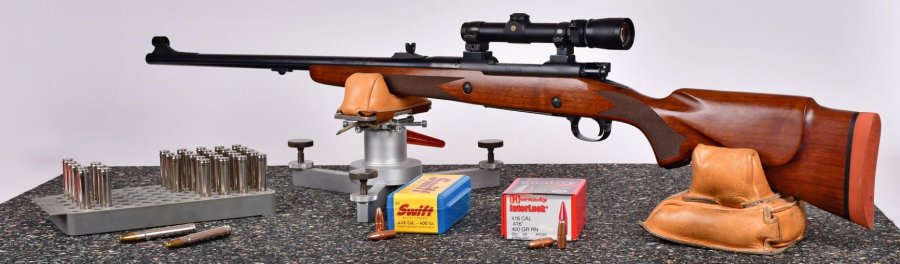
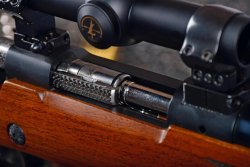
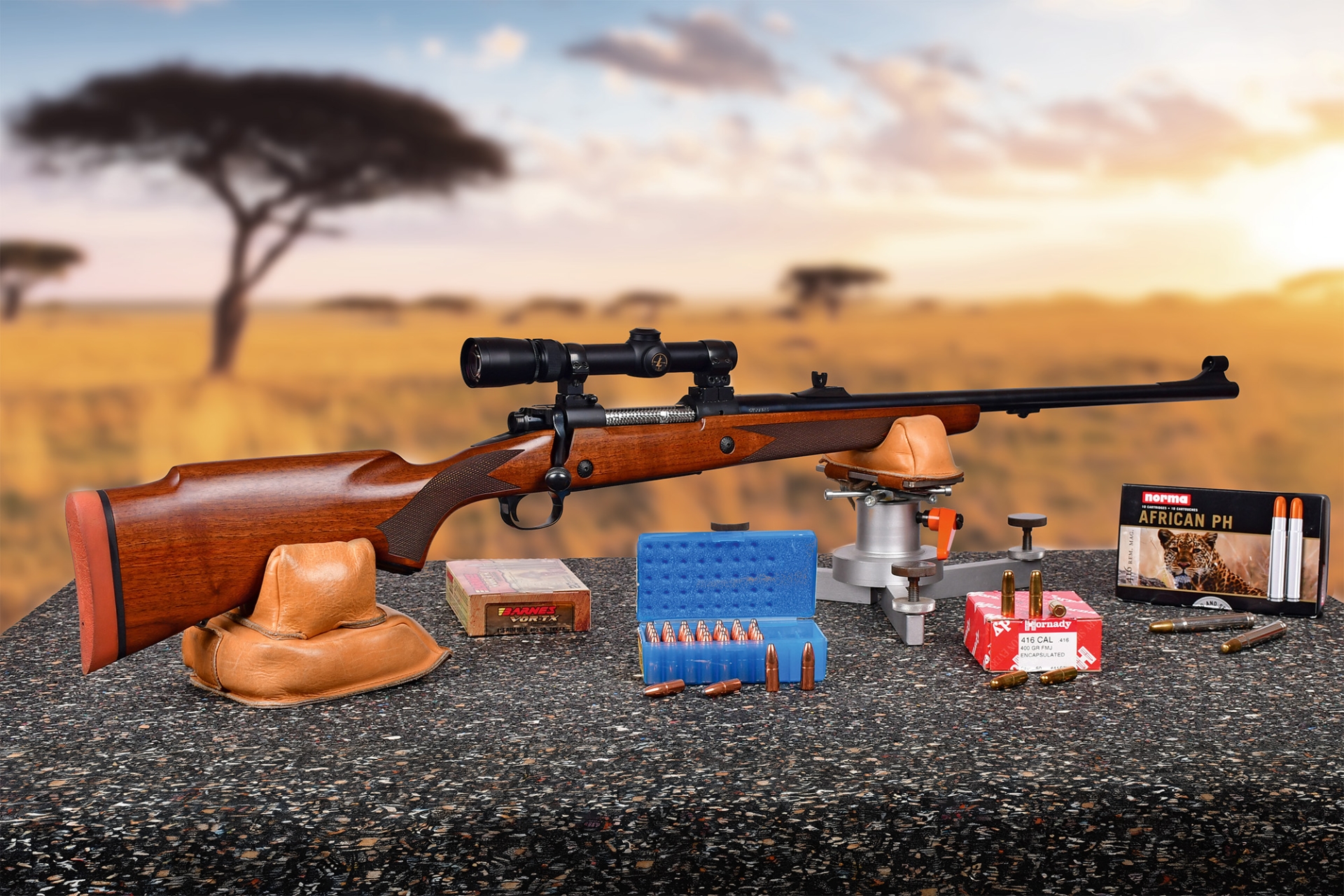
When it comes to firearms, it is always worth searching the crowded used gun market. Some manufacturers have rifles in this caliber in their range, such as Winchester with the Model 70, which offers an excellent price/performance ratio. Ruger naturally offers its Hawkeye African model in the comparable in-house .416 Ruger chambering. There were also the Blaser R93, Mauser M03 and Sauer 202 in .416 Rem. Mag., although nowadays only the R8 Safari Kilombero is still chambered for this cartridge. Our test gun in the form of a Winchester 70 from our own stocks was manufactured with a long extractor as a "controlled feed" system, based on the original Mauser Magnum action used until 1964. Winchester then switched to the "push-feed system" due to cost-cutting measures, in which the bolt pushes the cartridge from the magazine into the chamber, and a spring-loaded, short extractor slips over the cartridge groove. This didn't win Winchester any friends. Customers demanded the return of the familiar, proven Pre-64 action. Nowadays, the action with a long extractor is available again. Our test gun in the pre-1964 version with jewelled finish on the bolt and dark wooden stock, the end of which is adorned with a red, closed rubber recoil pad, makes a very pleasing overall impression.
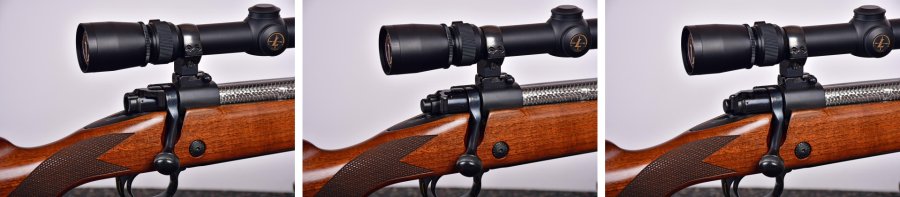
The horizontal three-position safety allows low scope mounting. In the center position, it enables safe unloading because the firing pin is locked. In the rear position, the firing pin is also locked and the chamber is locked as well. A ring was fitted over the barrel to attach the sling. The counterpart was recessed in the buttstock. The magazine, which sits flush with the underside of the stock, holds three cartridges in a staggered arrangement. The bolt action and feeding function perfectly. Two cross bolts reinforce the stock area. A brass bead front sight, protected by a removable hood, sits atop a front sight base. The shortcoming: at 4,080 grams, the sleek rifle with 60-cm barrel is a real lightweight. The missing weight is due to the buttstock being too short. A good 25 to 35 mm of wood is missing here. The rear sight can be folded down. Instead of an express rear sight, a fully adjustable buckhorn rear sight was fitted. The following modifications are therefore necessary for the ideal safari rifle: lengthening the stock and fitting an express rear sight. Both can be obtained from a gunsmith for little money. In contrast to the Ruger M77 MK II in .416 Rigby, which is exactly 800 grams heavier, it was noticeable that the lightweight Winchester has considerable recoil. it was straight into the shoulder but still crisp. However, the rifle was easy to control in the standing position. When shooting from a seated, supported position, the rifle delivers a significant kick. Regardless of whether the bolt handle was moved gently and slowly or forcefully and quickly, feeding and ejection of the cases worked reliably. We did not experience a single jam. In terms of the bullets used, the test gun proved to be very forgiving. We were pleased to find that, despite the different hardness of the projectiles and the different velocities, the hits grouped, overall, withing circles of 50 to 70 mm.
The previous parts of the series on all4hunters.com: