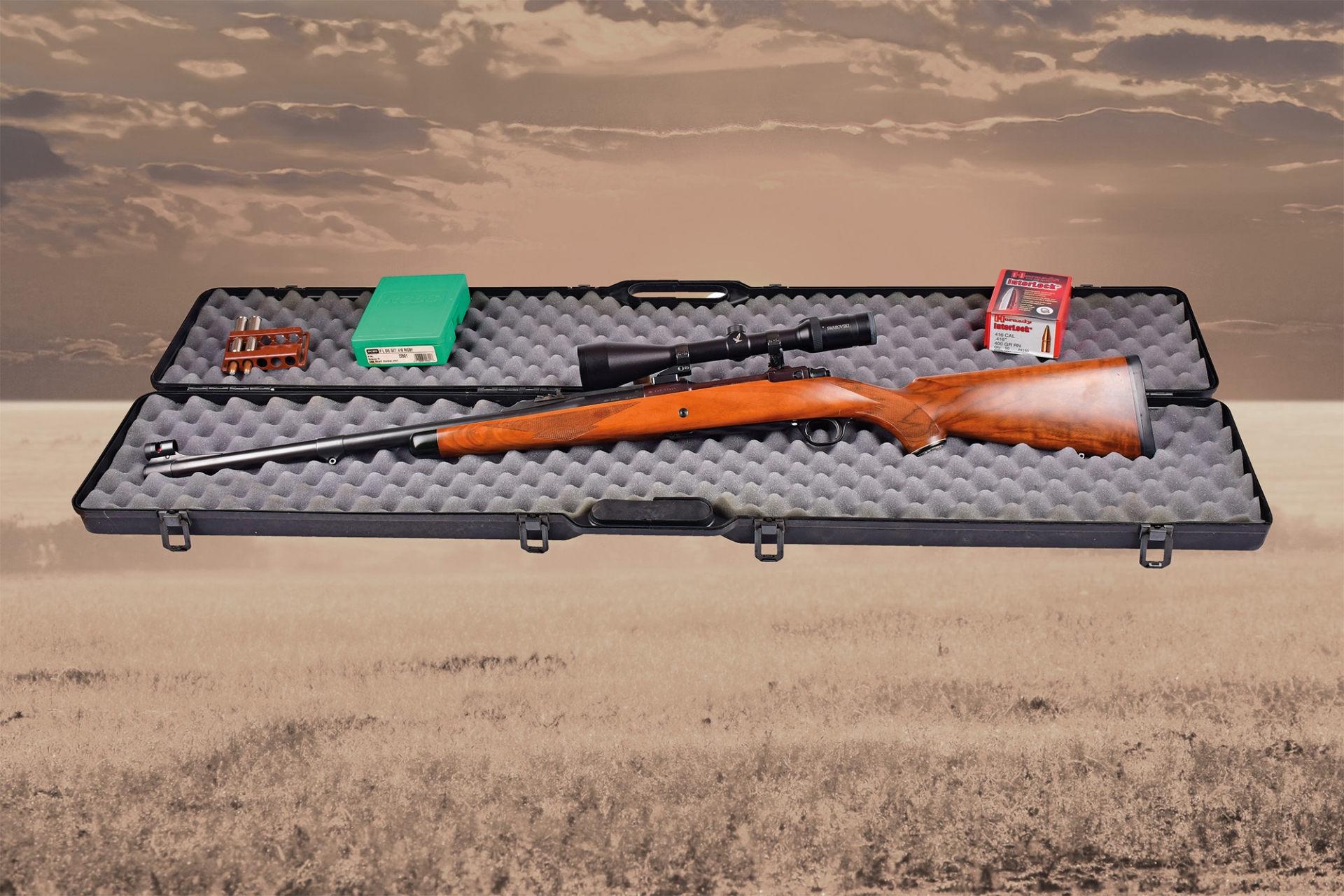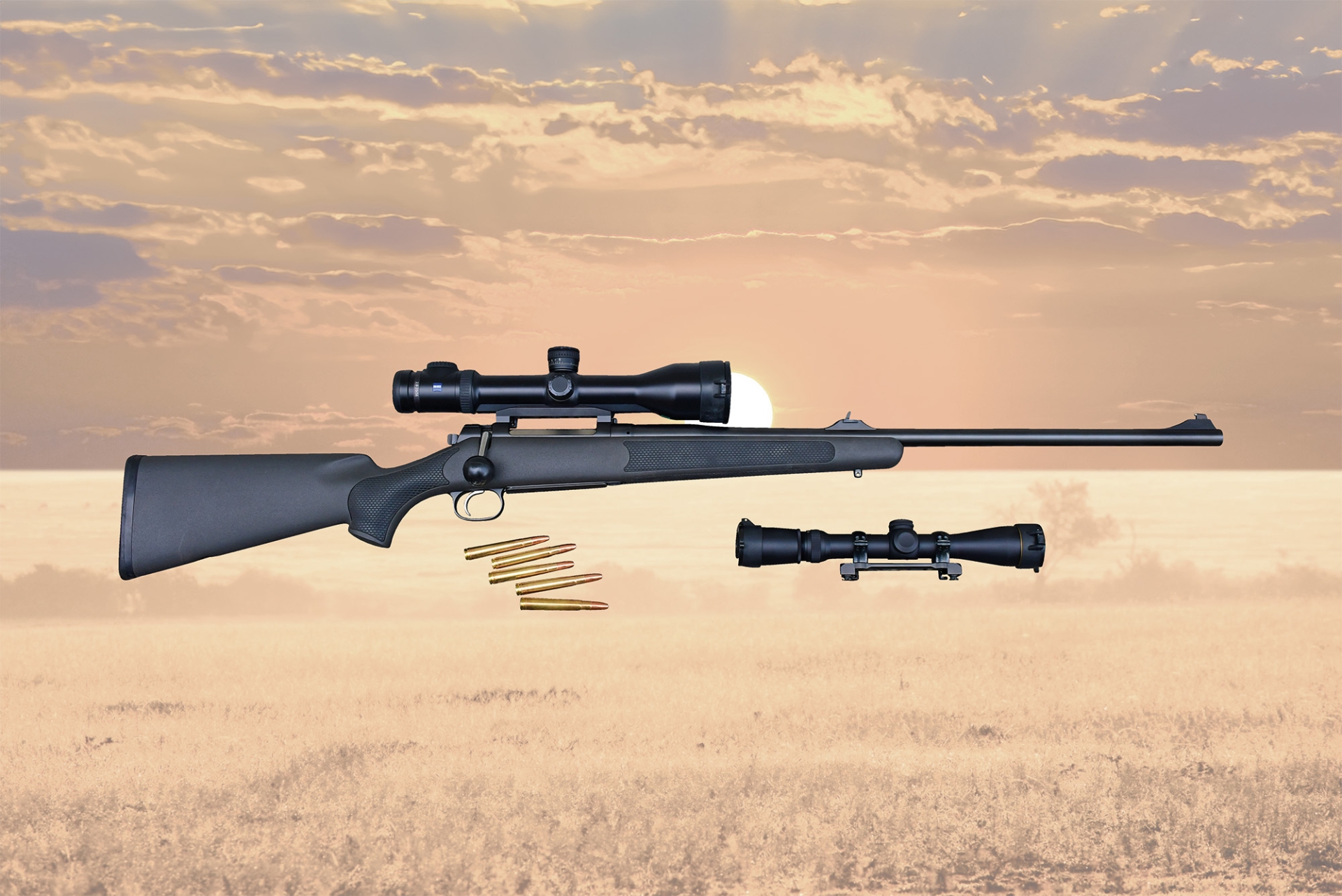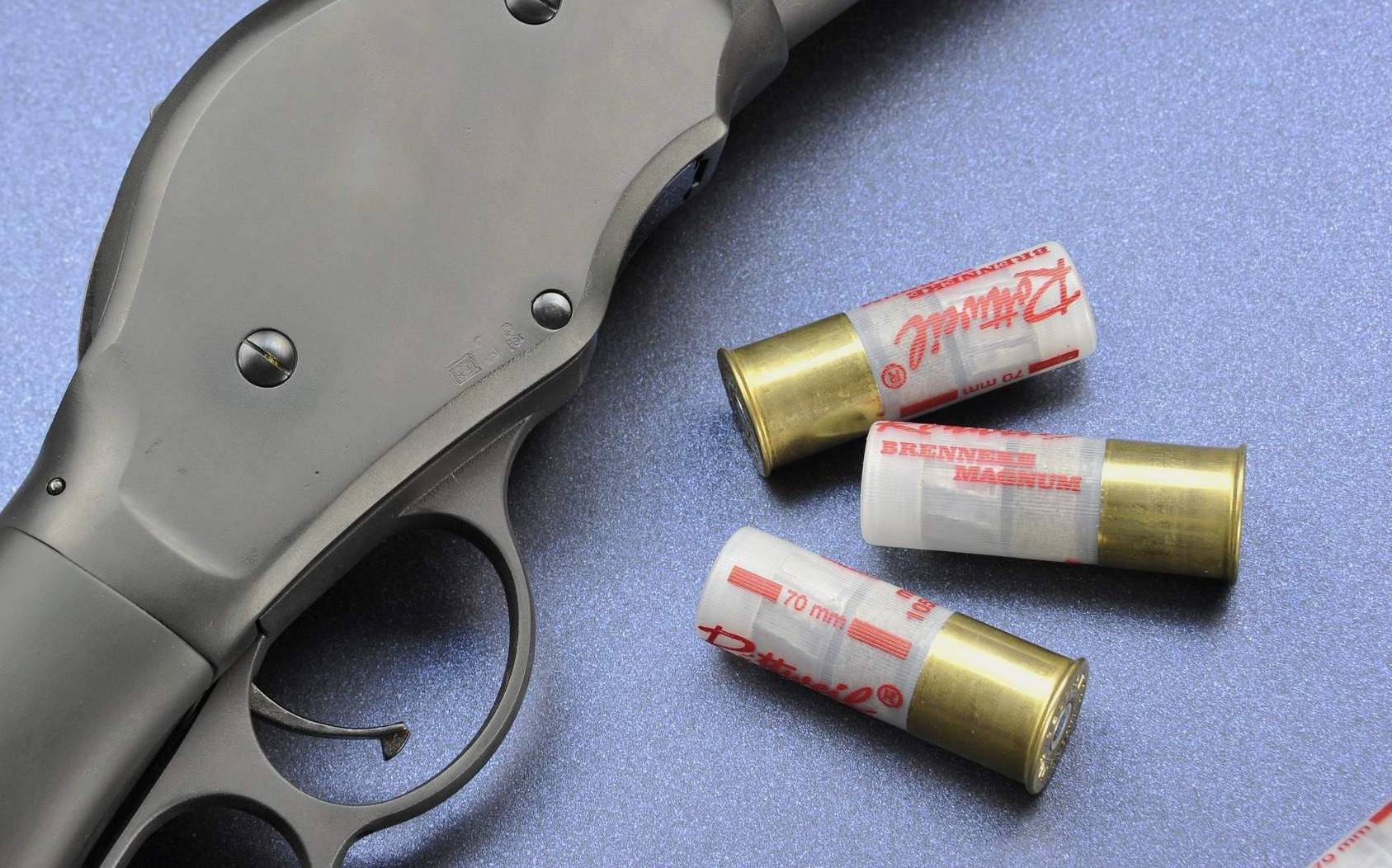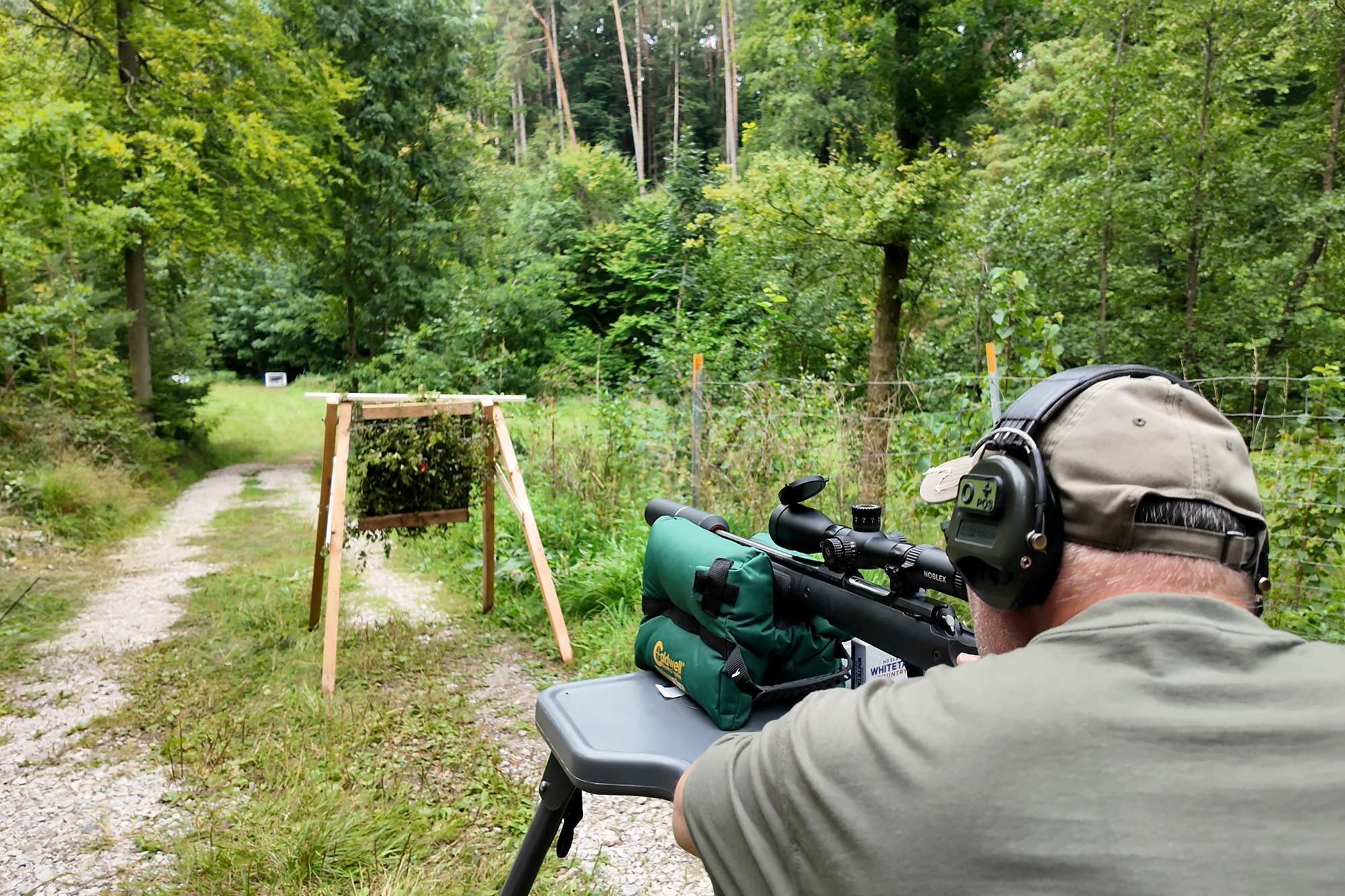

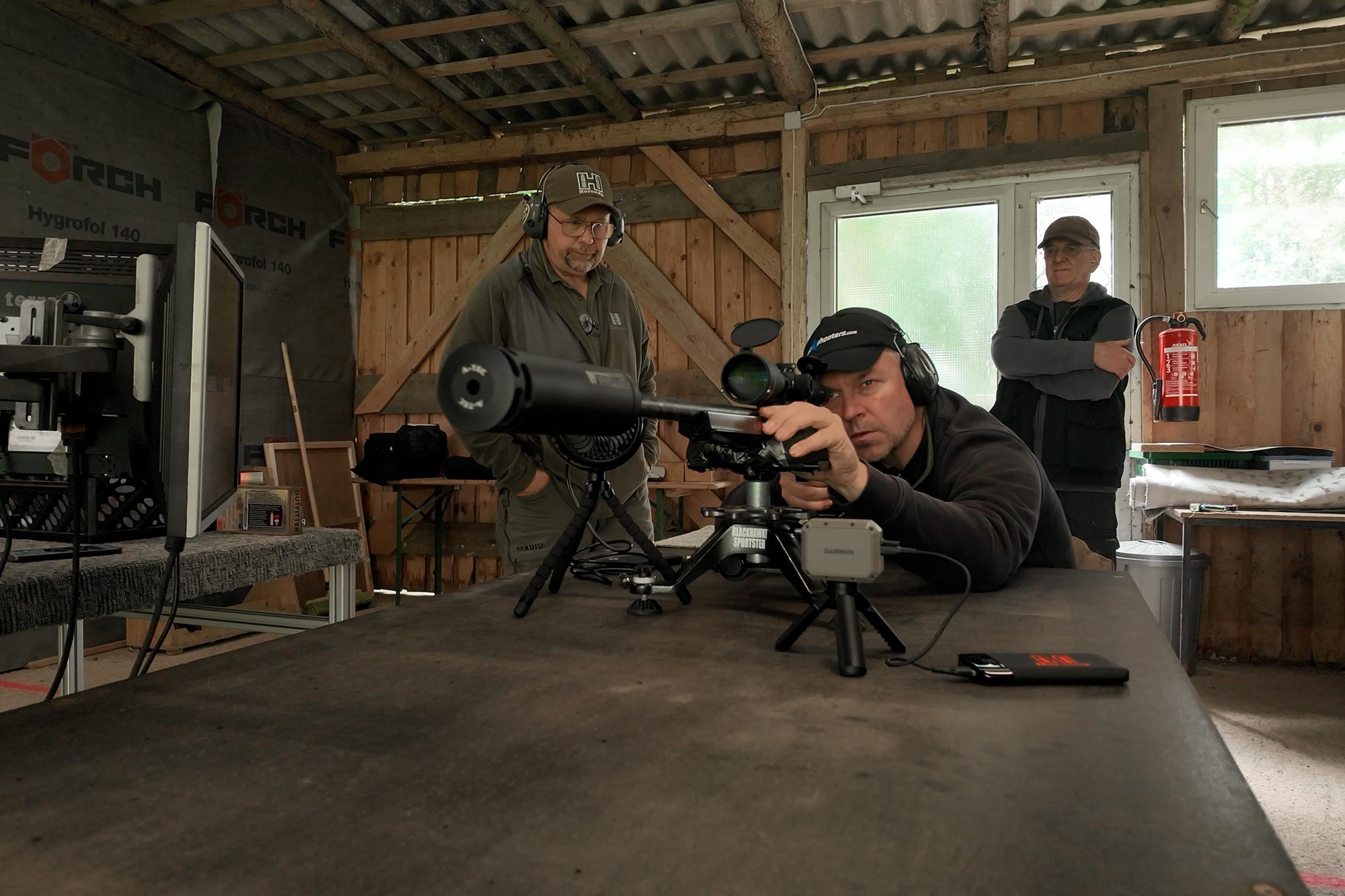
Two modern hunting rifles with scopes from Leupold served as test platforms. We were supported by ballistics expert Jens Tigges, who not only fired the shots but also provided ballistic analysis. The 300-meter range was intended to show how the 8.5x55 Blaser and the 7mm PRC Outfitter performed in a direct comparison. The focus was not only on the raw performance data but, above all, on how both loads performed in practice on the target. Before the actual comparison at 300 meters began, both combos were first zeroed at 100 meters under controlled conditions.
The hunting rifles field-tested at 300 meters: Sauer 505 and Savage Impulse Klym
Sauer 505 – A precision platform for the 8.5x55 Blaser
The Sauer 505 was used as a test rifle for the 8.5x55 Blaser ECX. The action stands for high manufacturing quality, clean trigger characteristics and hunting accuracy. The optic we used was a Leupold VX-6HD Generation 2 (3-18x56), a riflescope that is consistently designed for long-range hunting and variable distances.
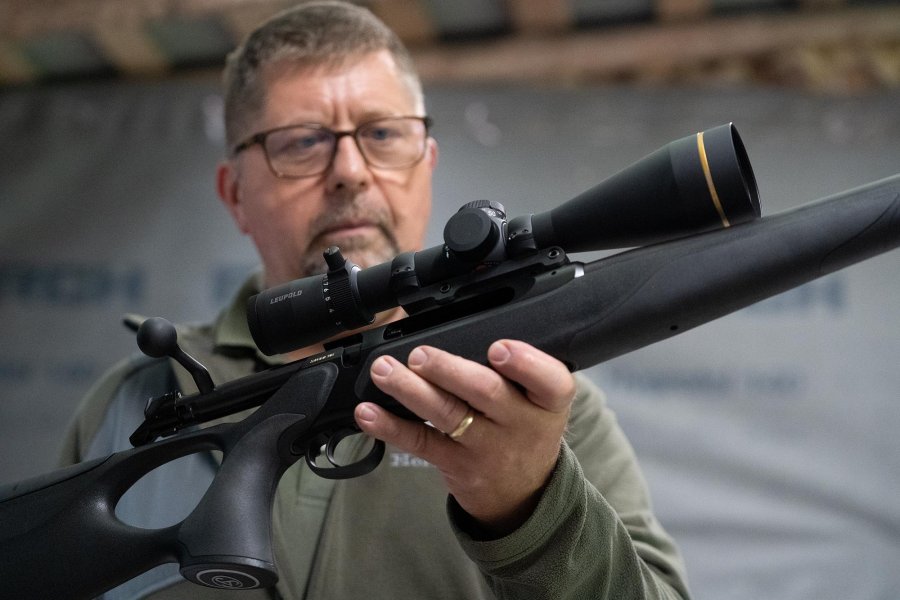
Savage Impulse Klym – Lightweight for the 7mm PRC
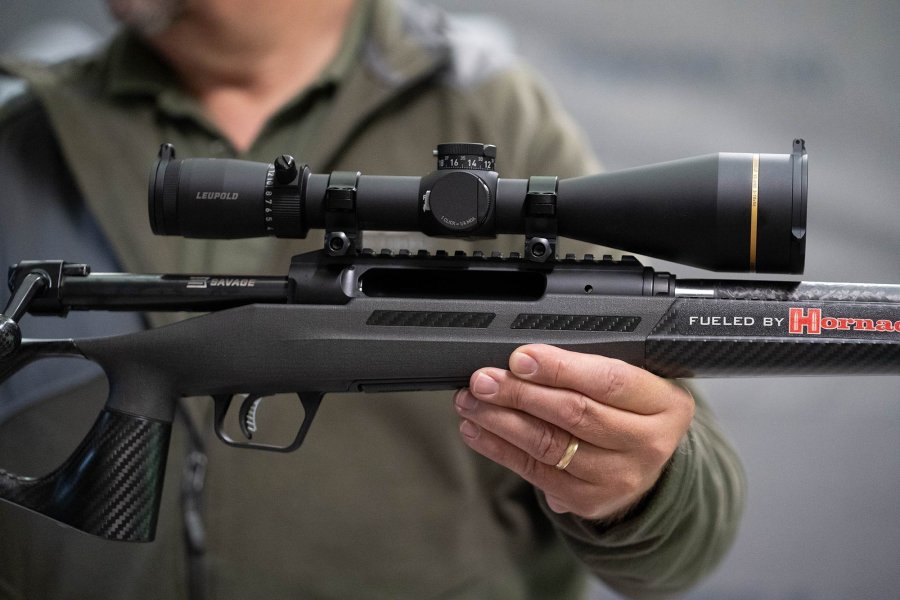
For the 7mm PRC Outfitter from Hornady, we used the Savage Impulse Klym, a straight-pull rifle of the latest generation. The combination of carbon fiber stock and carbon-wrapped Proof Research barrel makes the rifle extremely light – ideal for stalking, mountain hunting and long walks. Here, too, we relied on a Leupold scope: a VX-5HD Generation 2 (3-15x56).
The cartridges: Two concepts, one goal
Hornady ECX in 8.5x55 Blaser – The cartridge in detail
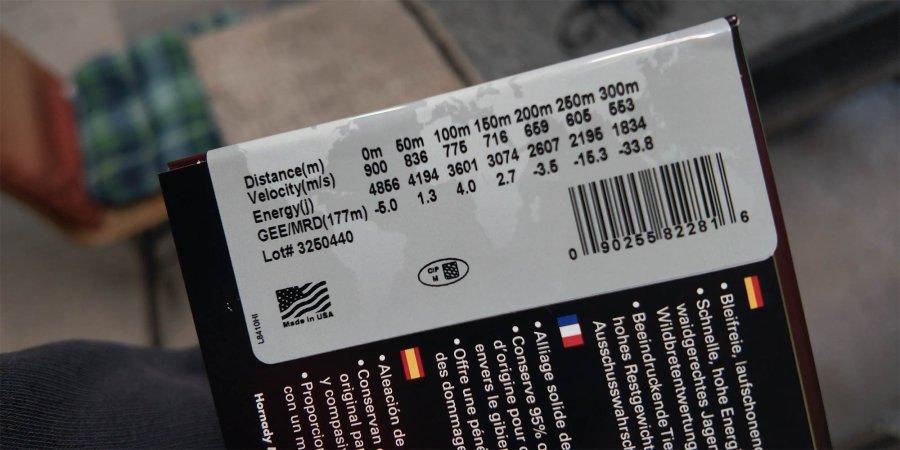
The 8.5x55 Blaser cartridge, tested here, embodies the concept of a larger bullet diameter, increased mass, and versatility for hunting. The cartridge was presented for the first time in 2025 and has already become very popular. The 185-grain (12-g) bullet leaves the barrel at around 900 m/s and delivers around 4,856 joules at the muzzle. At 300 meters, this translates to roughly 1,834 joules and a muzzle velocity of 553 m/s, with a ballistic coefficient of 0.377.
Hornady 7mm PRC Outfitter – All details about the cartridge
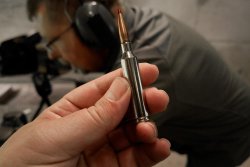
The 7mm PRC from the Outfitter line takes a different approach. The focus is on speed, efficiency and external ballistics, that are paramount here. It delivers 910 m/s and 4,292 joules at the muzzle. At 300 meters, the values are still 2,968 joules and 757 m/s, with a ballistic coefficient (BC) of 0.596. These performance figures refer to a standard test barrel and must therefore always be considered in relation to the actual barrel length of the user's firearm. Purely on paper, the 7mm PRC initially appears to have an advantage at 300 meters, especially regarding energy retention and aerodynamic efficiency.
Accuracy test at 300 meters: 8.5x55 Blaser vs. 7mm PRC
Before the actual comparison at 300 meters began, both setups were first zeroed at 100 meters and the velocities measured. This is because only with the actual measured values can ballistic data be accurately transferred to the respective setup. Crucial factors included not only bullet weight and ballistic coefficient, but also the measured muzzle velocity (V₀), the height of the scope above the barrel bore, the defined zeroing distance, and the correct implementation of the click values. For the 8.5x55 Blaser, the TBR function of the Leupold rangefinder was used, while the CDS system was employed for the 7mm PRC. Such details become immediately apparent at 300 meters, as even small deviations in calculation or adjustment become visible on the target.
Result: surprisingly close to each other
On paper, the 7mm PRC Outfitter boasts superior ballistic performance at 300 meters. However, on the shooting range, another factor came to the fore: actual accuracy. In a direct comparison, the two cartridges were much closer to each other than the pure performance data would initially suggest. The 8.5x55 Blaser performed strongly at 300 meters, while the 7mm PRC also delivered a convincing performance, though it required slightly more adjustments as the comparison progressed. This also showed that calculations and turret adjustments always need to be checked in real-world conditions. In addition, the very light Savage setup was given a cool-down break after several shots in order to continue the comparison under the same conditions.
In the end, both setups were very close to each other in terms of accuracy at 300 meters. Groups of 25 to 30 millimeters were achieved for the 8.5x55, while the 7mm PRC ranged from 30 to 40 millimeters. In practice, this also showed that both cartridges achieve a very high level of accuracy at this distance. At the same time, the ballistic difference between the two cartridges remains interesting: the 8.5x55 Blaser relies more heavily on bullet diameter and mass, while the 7mm PRC relies more on efficiency and velocity.
Leupold optics – The riflescopes used in the test
Leupold VX-6HD Gen 2
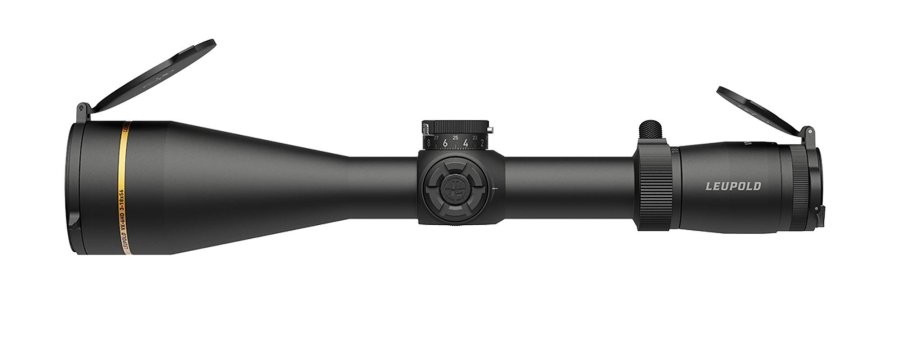
A Leupold VX-6HD Gen 2 in 3-18x56 was used on the Sauer 505. The riflescope is designed for variable distances and was part of the overall setup in the test with its tool-free removable SpeedSet ballistic turret and ZeroLock function for elevation and windage adjustment. For the comparison, it was particularly important that the scope could be precisely adjusted to the 8.5x55 Blaser and that the correction values determined could be precisely implemented at 300 meters.
Leupold VX-5HD Gen 2
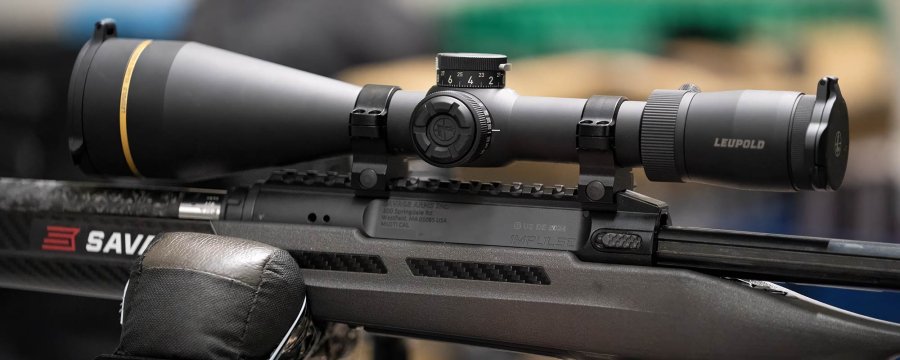
The Savage Impulse Klym was fitted with a Leupold VX-5HD Gen 2 in 3-15x56. In the German version, this riflescope works with a metric click system, i.e. 0.1 MRAD per click. The CDS system, with which the distance can be converted directly via the turret, played a particularly important role in the comparison. This scope was therefore also an important part of the setup for shooting at 300 meters.
Conclusion: Two cartridges, two philosophies – both convincing
The comparison at 300 meters shows two different cartridge concepts that are much closer to each other in practice than the pure ballistics data would initially suggest. In terms of accuracy, the 8.5x55 Blaser ECX and the 7mm PRC Outfitter are hardly any different at this range. The main differences lie in how each cartridge delivers its power: one relies more heavily on mass and diameter, the other on velocity and ballistic efficiency. Ultimately, both approaches demonstrated convincing performance in the test.
Further information on the ammunition used can be found on the Hornady website.