
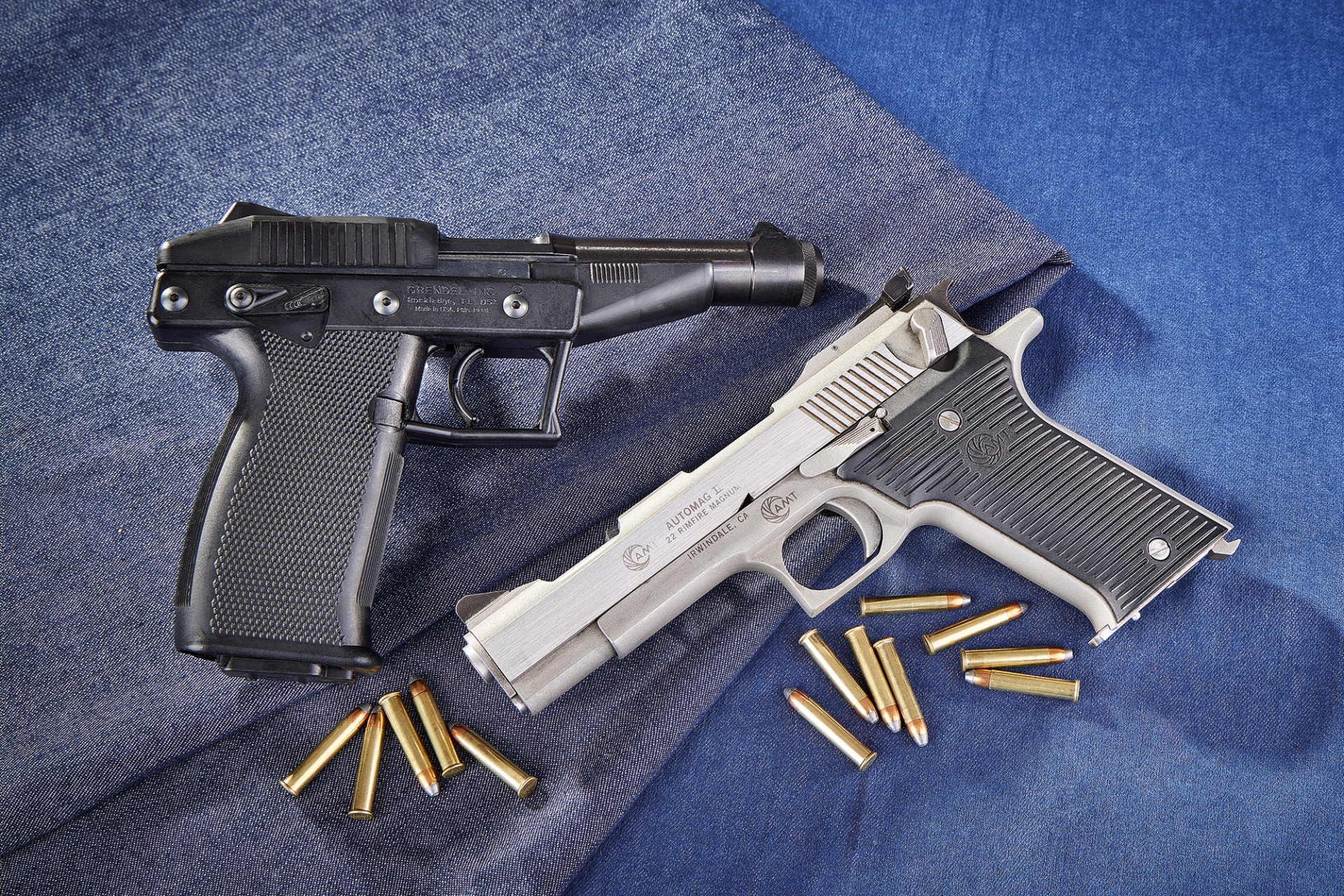
At first glance, the .22 Winchester Magnum may appear simply to be the larger and more powerful brother of the .22 Long Rifle. In the United States, it also occupies a particular niche in defensive ammunition, since rimfire cartridges and firearms are classified differently from their centerfire counterparts.
Before the .22 Hornet became established in the early 1980s, the .22 Winchester Magnum was a popular cartridge for hunting small game, from foxes and hares to, in earlier times, crows and birds of prey. Today its role is more marginal, partly because the .22 Hornet has displaced it, particularly for hunting where such use is permitted.
Compared with the ubiquitous .22 Long Rifle, however, the .22 WMR uses a longer case and delivers substantially greater performance. In semi-automatic firearms, and especially in pistols, those differences have a significant effect on how the action operates.
The .22 Winchester Magnum uses a relatively slow-burning powder, producing a more progressive pressure rise than the .22 LR. In a combination gun or manually operated repeating rifle, this presents no particular problem because case extraction and feeding of the next round are not dependent on the timing of an automatic operating cycle.
In a semi-automatic firearm, things are more complicated. The cylindrical .22 WMR case, which is considerably longer than that of the .22 LR, must have released much of its chamber pressure and contracted sufficiently before extraction begins. At the same time, enough energy must remain to cycle the action reliably.
The rim containing the priming compound adds another complication. Compared with a case using an extractor groove, the protruding rim makes both feeding from the magazine into the chamber and subsequent extraction less straightforward.
The AMT AutoMag II semi-automatic pistol in .22 WMR
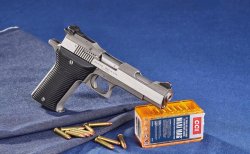
The AutoMag name immediately recalls the famous .44 AM pistol with its rotating bolt head. After gaining considerable notoriety, not least through its appearance in the Dirty Harry film series, AMT went through several corporate changes and the AutoMag family expanded to include a number of different variants. The AMT AutoMag II was produced by Arcadia Machine & Tool in Pasadena, California, from 1987 to 1999, and later by High Standard in Houston, Texas, until 2018.
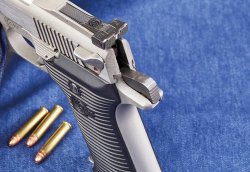
The pistol is built entirely from stainless steel and shows a notably high standard of machining. The grip panels are synthetic, while the magazine catch is located at the base of the grip. The trigger system is single action with an exposed hammer. Beyond that, however, the similarities with the larger original AutoMag largely end.
The AutoMag II uses different solutions in several key areas. Instead of the frame-mounted safety of the original, which acts on the hammer and trigger, the AutoMag II has a firing-pin safety operated by a lever on the left side of the slide. Its slide is also partially skeletonized, but otherwise much more conventional in shape than that of the original AutoMag. Overall, the pistol clearly reflects its 1980s design origins.
A look inside the AMT AutoMag II
To manage the pressure characteristics of the .22 WMR, AMT drilled 18 ports into the chamber, arranged at 90 degrees in front of and alongside the cartridge case. A sleeve surrounding the chamber seals the system. When the pistol is fired, part of the propellant gas enters the space between the sleeve and the outside wall of the chamber. Through the longitudinal ports, this pressure acts around the cartridge case, counteracting its tendency to adhere to the chamber walls and thereby assisting extraction.
From the outside, almost none of this complexity is visible thanks to the quality of the machining. You have to look directly into the chamber to appreciate how elaborate the solution actually is.
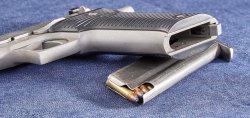
AMT addressed the feeding issue by using a single-stack magazine holding nine rounds, or seven in the compact version. This keeps the cartridge rims positioned one ahead of the next, much as they are in most .22 LR pistols. The slide is also extensively lightened and open, leaving plenty of space for case ejection while also improving cooling.
The AutoMag II proves both accurate and reliable, although a capacity of seven and nine rounds, depending on the model, combined with a single-action trigger does not make it particularly convincing as a defensive handgun. One positive feature is the firing-pin safety, which allows the hammer to be lowered with a greater margin of safety and is therefore an advantage during handling.
Technical data: AMT AutoMag II
Model: | AMT AutoMag II |
Original MSRP: | approximately $295 (1987) |
Caliber: | .22 Win. Mag. |
Capacity | 9 rounds; 7 in the compact version |
Overall length: | 197 mm (7.76 in) |
Trigger pull: | 910 g (2.0 lb) |
Weight: | 850 g (30.0 oz) |
Barrel length: | 110 mm / 4.5 in; also produced with a 6-inch barrel |
Features: | Simple blowback action with gas-relief ports in the chamber; stainless-steel construction; synthetic grip panels; manual firing-pin safety. |
And now, the Grendel P30
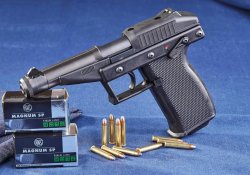
During the years in which the AutoMag II was in production, Grendel Inc., active from 1987 to 1994, also introduced its own pistol chambered in .22 Winchester Magnum. Grendel was one of two firearms companies founded by George Lars Magnus Kellgren, born Göran Kellgren in Sweden. Before moving to the United States in 1979, Kellgren had worked as a firearms designer for Husqvarna and Swedish Interdynamics.
In the U.S., Kellgren initially joined Interdynamic USA, the American subsidiary of the Swedish company, which produced interesting firearms, including the TEC-9 and TEC-22. These designs originally operated from an open bolt, which attracted the attention of the ATF, then the Bureau of Alcohol, Tobacco & Firearms, because of the relative ease with which they could be converted to fully automatic fire. The notoriety of such full-auto conversions, which also appeared in the television series Miami Vice, added further pressure to remove those versions from the market. With the TEC-DC9, Intratec therefore switched to a closed-bolt design. Alongside his work with Grendel, Kellgren established KelTec in Florida in 1991. The company remains active today and began firearms production four years later.
During its relatively short existence, Grendel Inc. produced three pistol models. The first was the Grendel P10, introduced in 1988: a subcompact .380 ACP pistol with a double-action-only trigger and simple blowback operation. The P10 was loaded from the top using AR-15-type stripper clips. The Grendel P12 followed in 1991, using a detachable magazine with a capacity of between nine and 12 rounds. Both models employed a frame made from Zytel, a glass-fiber-reinforced polymer that was not ideal for some of the more highly stressed components. The same material was also used for the magazines. From 1990 to 1994, Grendel also produced the P30, designed by Kellgren with a strong emphasis on low weight. The pistol uses a simple blowback action and addresses the pressure characteristics of the .22 WMR with a fluted chamber, allowing propellant gases to flow partially around the cartridge case before extraction. Kellgren may have drawn some inspiration from the Colt Gold Cup in .38 Wadcutter and, more probably, from the fluted-chamber system used in the Heckler & Koch G3 and MP5. He would certainly have been familiar with the G3 from his military service in Sweden, where the rifle was produced under license by Husqvarna as the Automatkarbin 4, or Ak4.
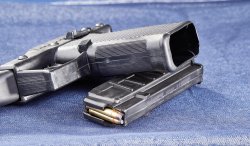
Despite its fluted chamber, the P30 remains fairly sensitive to ammunition. In our test, a Winchester load with a semi-jacketed bullet proved suitable. The pistol’s most striking feature, however, is its 30-round magazine. The .22 Magnum cartridges are arranged in a staggered configuration and feeding works reliably, at least until the delicate magazine feed lips begin to fail.
Replacement parts for the Grendel P30 are difficult to find today, so its Zytel magazines need to be treated with particular care. Impacts or forcing them can easily damage the feed lips. Ergonomics, meanwhile, do not appear to have been a major design priority. There is no slide stop, and with the safety in the fire position, one edge of the lever can press uncomfortably against the shooter’s hand.
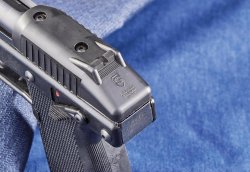
Unlike the AutoMag II, whose general layout is relatively reminiscent of the Colt M1911, the P30 follows its own path mechanically as well. It uses an internal hammer, conceptually similar to that of the Sauer & Sohn M38, together with an ambidextrous manual safety acting on the fire-control mechanism. The trigger operates in single action only, while the magazine release button is located on the grip. Disassembly is somewhat reminiscent of the Astra 600. The muzzle cap must first be unscrewed; after removing the recoil spring and its guide rod from the front of the frame, the rear of the slide can be lifted and the slide drawn forward off the pistol. The Grendel P30 was offered with either a five- or eight-inch barrel, as well as in a carbine version. The pistol shown here is the five-inch model.
Technical data: Grendel P30
Model: | Grendel Inc. P 30 |
Original MSRP: | approximately $400 (1994) |
Caliber: | .22 Win. Mag. |
Capacity: | 30 rounds |
Overall length: | 216 mm (8.50 in) |
Weight, including empty magazine: | 850 g (30.0 oz) |
Barrel length: | 5 in (125 mm) |
Features: | Simple blowback action; fluted chamber; Zytel frame; internal hammer; manual safety; single-action trigger; double-stack magazine. |
AMT AutoMag II and Grendel P30 at the range
The AMT AutoMag II offers good ergonomics and satisfactory accuracy. Reliability is solid, and at 25 meters (27.3 yd), keeping shots inside the black of the target presents no particular difficulty. The trigger breaks cleanly and predictably.
The Grendel P30 is somewhat less accurate and comes with a few operating quirks. The safety lever tends to press against the base of the shooter’s thumb, the pistol shows a preference for certain types of ammunition, and it requires regular lubrication. During our test, however, we did not encounter the extraction problems reported in some online forums. The trigger feel is rather spongy.
Both pistols produce a substantial muzzle flash, which is hardly surprising considering that the .22 Winchester Magnum was originally developed as a rifle cartridge.
Conclusions: AMT AutoMag II and Grendel P30 in .22 Winchester Magnum
When properly lubricated, both pistols prove reliable, sufficiently accurate and enjoyable to shoot at the range. The now-discontinued AutoMag II is an extremely robust pistol that may appeal both to enthusiasts of the AutoMag design and to shooters looking for something more energetic than the .22 LR. Practicality is not its strongest point, however, and today the model is primarily of historical and collector interest. The Grendel P30 is even more delicate. Much like the buffer in the Heckler & Koch P9S, it has a clearly identifiable weak point: the synthetic magazine feed lips. On the other hand, its 30-round capacity, relatively low weight and compact dimensions remain interesting features. The real problem is that any damaged component can now be extremely difficult to replace. The P30 should therefore also be regarded mainly as an interesting piece of firearms history to be taken to the range only occasionally. Since 2010, the basic concept behind the Grendel P30 has lived on in the KelTec PMR-30, which introduced significant improvements in materials and ergonomics while dispensing with the P30’s gas-relief fluted chamber.
Text: Karsten Stern
Editor: Hamza Malalla