
Most of our readers are familiar with thermal imaging and digital night vision devices.
But today we are going to test the Pulsar Symbion LRF DXT50 and LRF DXR50 multispectral binoculars, and I believe a rapid recap may be useful.
Digital day and night vision offers immense detail, thanks to 4K sensors, and even color down to very low light levels. When no ambient light is available, an invisible IR illuminator can provide excellent B/W images.
However, the IR source is visible to other NVD users, and digital night vision shares some of the limitations of daytime optics: still, camouflaged, or partially concealed living beings can escape detection.
Thermal imaging, instead, detects the infrared heat emitted by people, animals, and objects, making conventional visual camouflage far less effective. Since the thermal channel requires no external illumination, it is also passive and therefore harder to detect. The tradeoff is that thermal systems display temperature differences rather than the natural appearance and contours of objects, while their sensors generally have a much lower pixel resolution.
Multispectral optics combine daytime and night digital vision with thermal imaging in a single device, allowing the user to see both visible and invisible portions of the spectrum—sometimes at the same time. Switching from one wavelength channel to the other, or displaying them together in the same field of view through Picture-in-Picture, provides greater confidence and a higher level of identification of what is being observed.
This class of optoelectronic device is a force multiplier in search and rescue, law enforcement, aviation, and hunting, where users need to clearly identify the environment and rapidly locate people or moving animals using thermal vision, and also providing true 24/7 use. However, hunters are still a prime customer, because of the sheer convenience and value a multispectral optic can offer in the field – and in the case of the Pulsar Symbion binoculars, 4K daytime and night digital vision, thermal imaging, built-in laser rangefinder, and an IR illuminator are all rolled into one single hand-held optical observation device.
Video: The Pulsar Symbion LRF DXT50 and LRF DXR50 multispectral binoculars
The Pulsar Symbion LRF DXT50 and LRF DXR50 multispectral binoculars
The Symbion multispectral binoculars are available in two models, the LRF DXT50 and LRF DXR50; both models share the same Magnesium alloy housing, ergonomic control interface, IR illuminator, LRF and 4k CMOS Digital day/night channel with 6.5 – 26x digital zoom.
The difference is in the Thermal Imaging module, the DXT50 is based around a high resolution 1280x1024/12µm uncooled microbolometer with a system NETD sensitivity of < 20 mK, while the DXR50 uses a highly sensitive, better than 18mK system NETD 640x480/12µm sensor. All thermal imaging engines offer full frame rate at 50hz.
Being both the pixel pitch and the objective lens – a F1.0 50mm Germanium element – the same, due to image sensor cropping the fixed native magnification is different, 2x for the DXT50 and 4x for the DXR50; also, zoom ratio is different, therefore thermal digital magnification is 2 - 24x and 4 - 32x respectively.
Shared features also include AV and photo recording (on an integrated 64GB memory), computer connectivity and recharging via USB-C port, smartdevice connectivity via WiFi and free Stream Vision 2 and Stream Vision Ballistics mobile apps, the mentioned built-in laser rangefinder and the IR illuminator with an efficient and powerful 850nm IR LED.
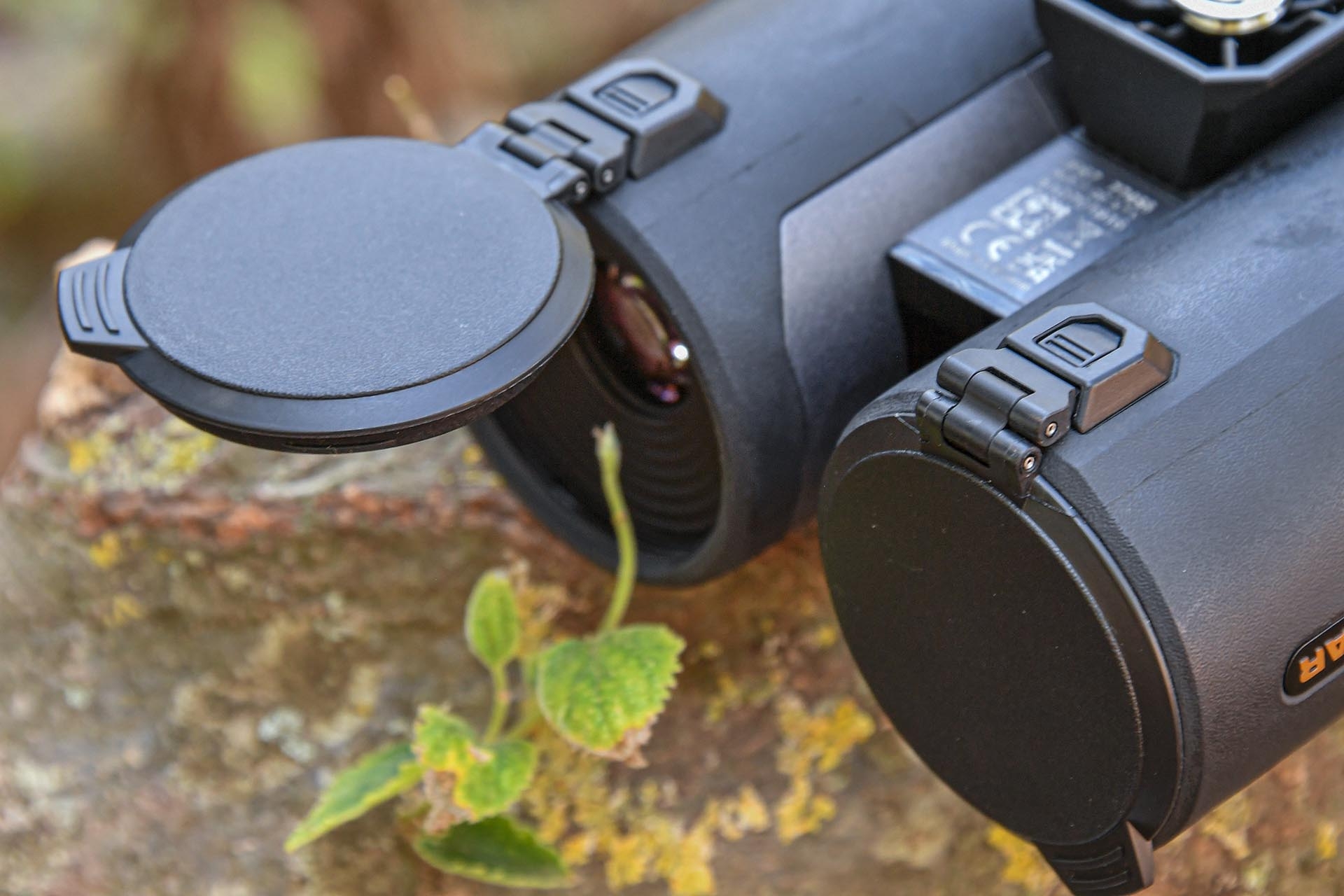
Last but not least, the compact, rugged and lightweight rubberized housing is IPX67 waterproof certified.
The Pulsar Symbion uses one APS5 proprietary battery (two are provided), with battery life that Pulsar claims lasts 10 hours continuous use on the DXR50 and 8 hours on the DXT50.
Handling the Pulsar Symbion multispectral binoculars
Picking up the Symbion immediately transmits an impression of quality and craftmanship, with excellent materials and heft that does not feels heavy but simply solid, although the weight, including the battery, is about one kilogram, slightly heavier than your ‘average’ 8×42 roof prism premium bino set.
The Symbion features a very ergonomic human interface, designed to be fully operated with one hand, with two coaxial focus knobs (one for thermal, one for digital), a top scroll wheel with seven multi-function buttons – three of which in the middle of the wheel.The number of functions, menus and controls may seem overwhelming at first.
Every time a control is used, there’s haptic feedback for confirmation. The interface is very intuitive: each button has two related functions, depending on long or short press, and it takes really an afternoon with the manual to figure out everything and be able to concentrate on what I’m seeing in the eyepieces rather than what I am doing on the Symbion’s controls.
The three-position discrete power on lever is on the belly of the housing, and the IR illuminator beam control is a slider just in front of the scroll wheel. Gripping the optic, the thumb naturally falls over it for instant operation.

Interpupillary distance is easily adjusted, and each eyepiece has independent diopter adjustment. The 1920x1080 AMOLED microdisplay in the eyepieces has a novel form factor with rounded corners that’s somehow more pleasant to use than the more common sharp rectangle. But it can be returned to full round shape using the Screen Shape control, if preferred.
As usual for Pulsar electro optical binos, a proximity sensor allows instant switch-on of the display when it is brought to the user’s eyes, and switch-off as it is moved away or not used, as a power saving feature.
Both thermal and day/night digital channels focusing knobs are a pleasure to use, easy to move and adjust with one finger, and at the same time dampened enough to not move accidentally while using the binoculars.
Changing the battery will make the device vibrate even when turned off, confirming even in pitch dark that the battery has been successfully connected.
Testing the Pulsar Symbion: Digital channel

I mentioned that both available models of the Pulsar Symbion multispectral binoculars were sent to me: the LRF DXT50 and the LRF DXR50. As only the Thermal Imaging channel differs between the two, lets first take a look at the quite impressive 4K CMOS daytime and twilight full color digital channel, that switches to B/W (or green) when set to night vision.

First off, since the sensor has 4K resolution and the eyepiece display is FHD, image detail remains virtually unchanged from the native 6.5× magnification up to 13× (where incidentally, cropped sensor image and display resolution are the same!), with only a slight loss of definition becoming noticeable as you approach the maximum 26× setting. The zoom is easily adjusted using the scroll wheel.
In dusk or low light, choosing color – even in twilight mode – obviously produces grainy images due to noise, but switching to full night vision mode in B/W instantly turns definition and sharpness back to daytime levels. The Symbion uses EIS (Electronic Image Stabilization) to stabilize viewing when cranking up the magnification; at high magnification it’s very effective. It can be turned off and on and is disabled when using the LRF module. Speaking of which, the range is now 1500 meters, and it works very well in the field, even in adverse conditions such as light mist, haze and rain. The LRF features spot and continuous measure modes, measures the target angle and THD (True Horizontal Distance) and its reticle can be changed. Interestingly, the beam is perfectly visible using night mode.
The IR illuminator is powerful, can be adjusted on three different output levels and the clever slider zoom control to adjust the beam from wide to spot is very intuitive.
Thermal Imaging performance: LRF DXT50 and LRF DXR50
The Thermal imaging channels of the two Symbion binoculars have a very interesting set of features each, there’s no one better than the other; rather, each have a specific purpose. The DXR50 uses a 640x480 sensor but has a higher digital zoom magnification ratio starting from native 4x, and also features a better <18 mK system sensitivity.
The DXT50 has a very high-definition 1280x1024 sensor, on the other hand it is slightly less sensitive at < 20 mK, and also features a lower overall top magnification starting from native 2x. Pulsar markets the DXT50 as a solution for mid-range complex and cluttered field observation and scanning, such as forest and heavy vegetation, where its wide angle and lower thermal magnification combined with its extreme definition helps to pick up subtle motion in dense brush.
Higher sensitivity means better detection, and Pulsar recommends the DXR50 for longer range observation on open fields and ridgeline overwatch of distant targets; detection of a deer or human sized target in optimal conditions is 2300m, and the higher 32x digital zoom will help identify it – although in this case the displayed image is built from just 80x60 of the original sensor pixels. Compare this with the DXT50 that at 24x will display 107×85 pixels of original sensor detail. Consider that at 26x, the digital channel of the Symbion displays 960 × 540 pixels.
The thermal imaging channel features many filters, image enhancements, selectable color palettes and modes to increase quality and performance in every situation and field condition, increasing detection range and identification in low temperature contrasted scenes, such as fog, precipitation or high humidity; in this case, a specific and very interesting image enhancement offered by Pulsar’s software algorithm is sensitivity amplification, that can be set in three modes, to increase the quality of detection and object recognition. To reduce digital distortion introduced by amplification levels other than Normal, the Smoothing filter can be used.
Testing the Pulsar Symbion: Thermal imaging channel

During use, I was impressed by the quality of the thermal image displayed by the Pulsar Symbion DXR50 – easily the best image I’ve ever seen from a 640 wide resolution sensor, way outperforming the previous device I had considered best previously – the Merger, again from Pulsar.

Risking repeating myself, the image exhibits contrast, detail, greyscale smoothness and overall dynamic range that is really in a class of its own. Sincerely, while still perfectly useable, the 32x thermal magnification is, in my opinion, a bit too high; I personally found myself stopping at about 20x, and rarely ever going to 26-28x in actual use.
But it’s there if needed, and there are use cases in which it’s a must have. Coincidentally, I have the same opinion of the 24x of the DXT50. And talking about the “bigger brother”, what does the high-resolution sensor bring to the table? Well, the image is incredibly detailed for a Thermal imaging device, perfect for immediate positive identification, and a hugely wider field of view at lower base magnification, as mentioned. This means it allows a level of speed in scanning that’s insane: due to its wide FOV and four times the resolution, you get basically four times the scanning efficiency, sweeping across large fields or hillsides to spot movement quickly, even when animals or people are partially covered and hidden in intense vegetation.
Pulsar Symbion multispectral binoculars DUO mode
Let’s not forget that the Pulsar Symbion is a multispectral optical device; and that while switching from one channel and the other is really cool, having both thermal imaging and 4K digital imaging at the same time in the field of view is the epitome of cool. The Symbion features DUO Mode, which uses the Picture in Picture function to display one channel in the main field of view and the other in the PiP window; the channels can be switched at will with the same DUO control (short press once enabled). It’s fast and easy to use, and immensely useful in most end use scenarios -and of course, hunting. I like to use Thermal as the main channel and have the PiP window with digital: fast and easy detection, and immediate confirmation/ID of what I am looking at with the twilight or night vision channel, which I can also magnify when needed.
Wrapping up
So, which of the two models of the Pulsar Symbion multispectral binoculars is for you? According to Pulsar’s specs, “choose the DXT50 for forest scanning, faster sweeps, and broader FOV. Go with the DXR50 for long-distance observation and extended runtime.”
I must admit I was blown away by the ultra-definition and performance of the DXT50. The image quality of the native 2x magnification with the full 1280x1024 pixel sensor is incredible. Clean, crisp, and so smooth. In short - amazing. But, in my humble opinion, it all boils down to the fact that the DXR50 has higher magnification, longer battery life, and a lower price. By quite a margin; MSRP of the DXR50 is exactly $2000 less than the listed MSRP of the DXT50, which is 8,199.97 USD. Let that add up… and either money’s no object, or a decision must be made with a budget in mind at the same time of the use case scenarios.
The price is justified, though; the performance is still almost unbeatable. I believe these are among the best 24/7 commercial multispectral binoculars currently on the market – if not the best.
The box includes a lot of accessories, two batteries, a very nice black nylon carry case, wall charger and ultra fast charge adapter for two batteries, and USB C cable.
Technical table
| Manufacturer: | Pulsar – Yukon Advanced Optics (www.pulsar-nv.com) | |
| Model: | SYMBION LRF DXT50 | SYMBION LRF DXR50 |
| Type: | Binocular thermal vision device with laser range finder | |
| Thermal sensor: | 1280 × 1024, 12 µm | 640 × 480, 12 µm |
| Thermal sensor type: | Uncooled microbolometer | |
| System NETD: | <20 mK | <18 mK |
| Digital sensor: | 4K CMOS, 3840 × 2160 | |
| Frame rate: | 50 Hz | |
| Objective: | Thermal F50 / 1.0; digital F50 / 1.8 | |
| Thermal magnification: | 2-24× | 4-32× |
| Digital magnification: | 6,5-26× | |
| Diopter adjustment: | -5 to +5 D | |
| Eye relief: | 13 mm | |
| Interpupillary adjustment: | 62.5–74 mm | |
| Display type: | 1920 × 1080, MicroLED (AMOLED) | |
| Thermal detection range: | 2300 m | |
| LRF Maximum range: | 1,500 m, accuracy ±1 m | |
| IR illuminator: | Focusable LED, 850 nm, with three adjustable power levels | |
| A/V recording: | 1440 × 1080 videos and photos on internal 64 GB | |
| Connectivity: | Wi-Fi 2.4 / 5 GHz ; USB-C (power and data) | |
| Battery system: | 2 × external APS5, 3.7 V, 4900 mAh | |
| Operating time at 22 °C: | 8 h with 2 × APS5 | 10 h with 2 × APS5 |
| Body material: | Magnesium alloy | |
| Dimensions: | 207 × 132 × 72 mm | |
| Weight: | 1.0 kg, battery including | |
| Ingress protection: | IP67 waterproof | |
| Tripod interface: | 1/4" socket and ARCA-SWISS | |
| MSRP, USA: | $8,199.97 | $6,199.97 |