

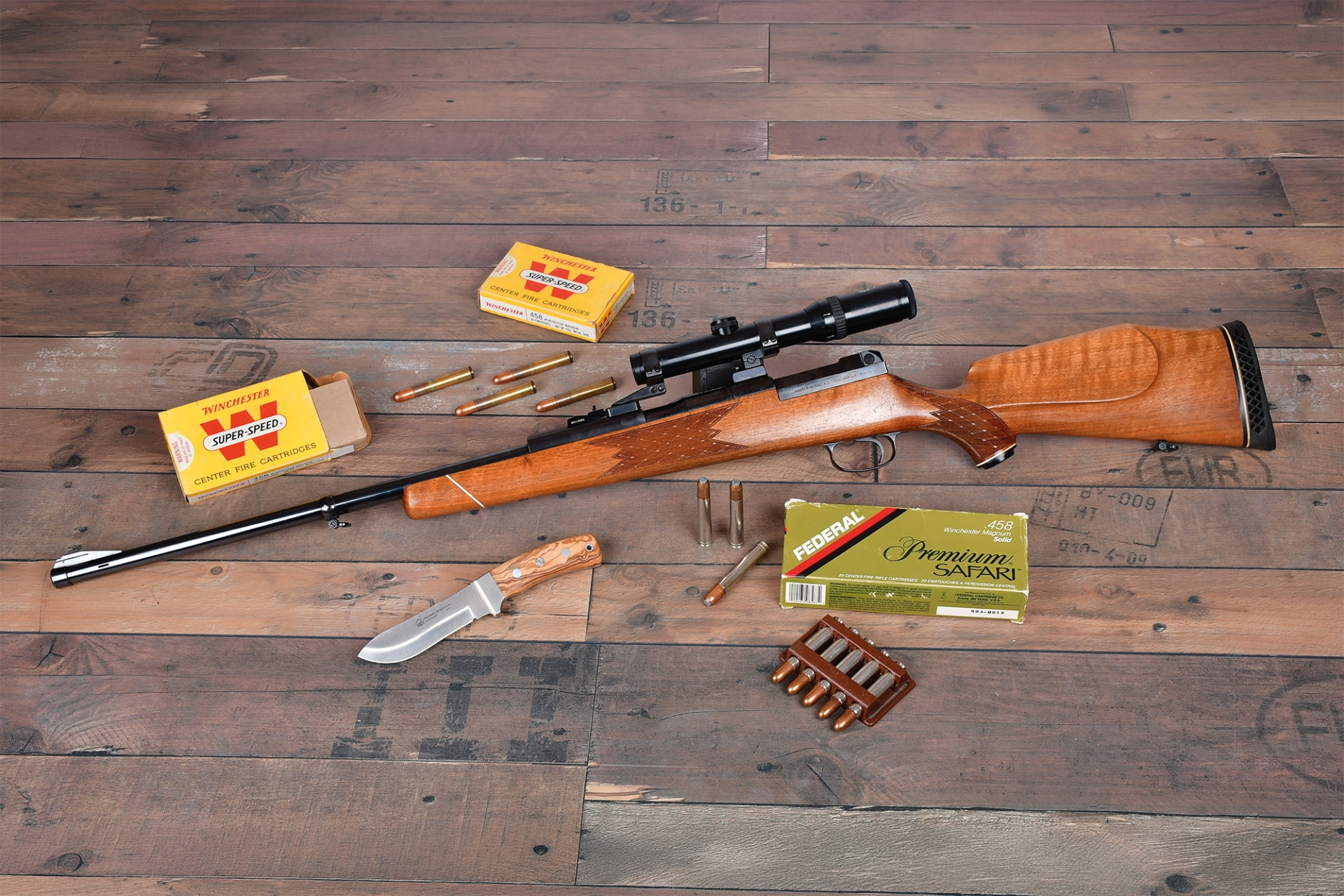
Seventy years ago, Winchester unveiled the .458 Winchester Magnum alongside the Model 70 African bolt-action rifle. Much like William Jackman Jeffery had done 45 years earlier with the .404 Jeffery (a cartridge we'll cover in a future article of this series), Winchester set out to develop a modern replacement for the increasingly scarce, expensive and soon-to-disappear, British dangerous-game cartridges.
The goal was to leave behind the old British tradition of very expensive double rifles and increasingly hard-to-find ammunition. The new generation of hunters heading to Africa would carry a bolt-action rifle, the cartridge had to bear the name "Magnum," and, just like its user, the case had to wear a belt. Simple as that.
The recipe was straightforward: start with the .375 H&H Magnum case, neck it up to accept a .458” (11.6 mm) bullet, then shorten the case until the finished cartridge fit a standard-length action. Ballistically, Winchester intended it to duplicate the legendary .450 Rigby Nitro Express. The original factory loads used a 500gr (32.4 g) full metal jacket bullet and an even heavier 510gr (33 g) soft-point projectile.
Because such long bullets occupied a considerable amount of case capacity, the relatively short 63.5 mm (2.50 in.) case required a very fast-burning propellant. Winchester initially loaded the cartridge with a fine spherical powder that met velocity targets and earned glowing reviews in the firearms press. The stronger bolt-action rifle also handled the higher operating pressures far better than traditional double rifles.
Strong Performer or Disappointment? The .458 Winchester Magnum Up Close
According to Winchester's original specifications, the heavy 500gr bullets of the .458 Winchester Magnum (11.6x63.5 mm) were supposed to leave a 24” (610 mm) barrel at 622 m/s (2,041 fps), producing 6,090 joules (4,492 ft-lbs) of muzzle energy. In reality, however, velocities averaged only 579 m/s (1,900 fps).
Unfortunately, Winchester had overlooked one important factor: African hunting conditions. In the intense heat, chamber pressures increased significantly, causing the cartridge's nearly cylindrical case to stick stubbornly in the chamber and making extraction difficult at precisely the wrong moment.
That was only the beginning. Factory ammunition used heavily compressed powder charges, and over time the bullets gradually crept forward out of their cases. Worse still, the compressed powder columns eventually began to cake together, reducing ignition efficiency. The primers often failed to ignite the powder charge consistently, resulting in delayed ignition, weak shots and, in the worst cases, inadequate penetration on dangerous game.
Winchester simply couldn't solve these issues quickly enough. The highly praised .458 Winchester Magnum rapidly lost its reputation, and rifles chambered for it became notoriously difficult to sell.
The first corrective measure was to reduce bullet weight, increasing usable powder capacity inside the belted case. Manufacturers eventually returned to the original 480gr (31 g) bullet weight of the .450 Nitro Express. It then took several years before more modern propellants became available, finally eliminating the three major shortcomings that had plagued the cartridge since its introduction.
Today, every commercially loaded .458 Winchester Magnum cartridge from manufacturers such as Barnes, Federal, Hornady, Kynoch, LFB, Norma and Swift performs reliably, even under African hunting conditions. Norma alone offers the cartridge with a 500gr monolithic brass full metal jacket bullet, a 500gr Swift A-Frame bullet, and even a 550gr Woodleigh soft-point projectile.
As an emergency measure, .458 Winchester Magnum ammunition can also be safely fired in rifles chambered for the .458 Lott and .450 Ackley Magnum should ammunition become unavailable in the field. Whether this practice causes accelerated chamber wear, however, is something we have no intention of testing.
Handloading the .458 Winchester Magnum
Reloading the .458 Winchester Magnum, with its straight-walled case and overall cartridge length of 84.8 mm (3.34 in.), requires no specialized equipment. A sturdy single-stage press such as the RCBS Rock Chucker is perfectly adequate, while high-volume reloaders can even purchase a dedicated caliber conversion kit for the Dillon RL550 progressive press.
Standard three-die sets are readily available from RCBS, Redding and Hornady, while brass can be obtained from manufacturers such as Hornady and Norma. Premium bullets are offered by Barnes, Degol, Nosler, Hornady, Federal, Swift and Woodleigh.
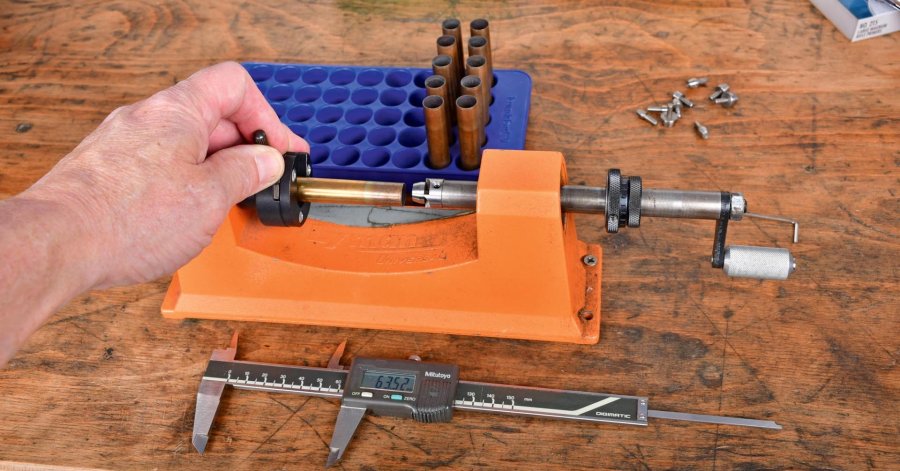
Suitable powders include relatively fast-burning rifle propellants such as Norma 201 and 202, Vihtavuori N130 and N133, or Hodgdon H335. Standard loading tools—including Lyman's inexpensive case trimmer, whose adjustable collet securely grips belted magnum cases, together with a conventional powder funnel—are all that is required to assemble reliable ammunition.
Factory Rifles Chambered in .458 Winchester Magnum
To the best of our knowledge, the only current-production bolt-action rifles chambered in .458 Winchester Magnum are the Blaser R8 Safari Kilombero and the Winchester Model 70, while the long-awaited CZ Classic II series has yet to reach the market. The situation is quite different on the used gun market, where rifles from Mauser, Remington and Ruger, can still be found with some regularity. Anyone planning to hunt dangerous game with one of these rifles should spend plenty of time practicing at the range beforehand. During our training courses for international hunters, as well as competitions designed to prepare participants for African dangerous game hunts using life-size "Big Five" paper targets, we repeatedly encounter the same shortcomings from the same manufacturers. The problems are usually familiar ones: unreliable feeding, inconsistent extraction or ejection, and scope mounts that loosen under heavy recoil. Fortunately, these are all issues that can generally be corrected by a competent gunsmith.
Test Rifle: Mauser 66 in .458 Winchester Magnum
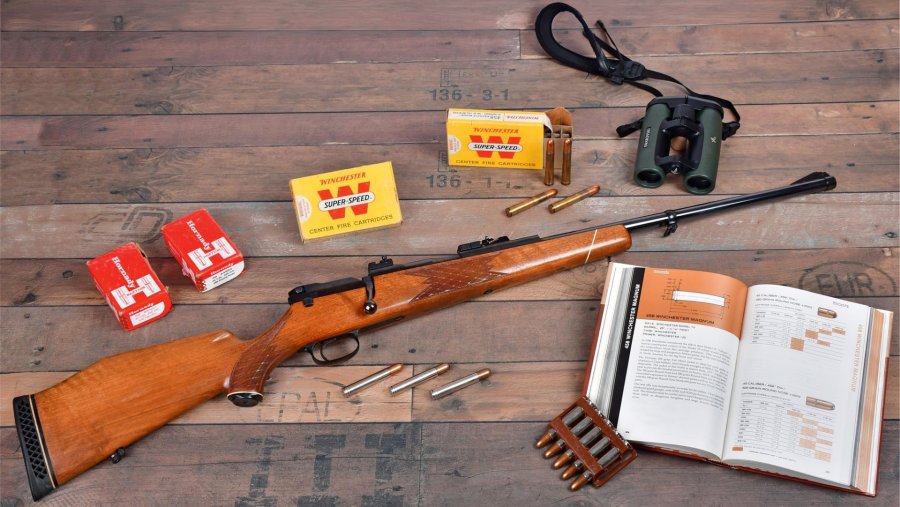
Our test rifle was a 1970-production Mauser 66 featuring the distinctive telescoping bolt system and a 25" (650 mm) barrel. Loaded with Hodgdon H335 powder and 500gr Hornady full metal jacket bullets, the rifle delivered very respectable accuracy. Vihtavuori N530 also proved to be an excellent choice.
With powder charges ranging from 60 to 75 grains, magnum primers provide reliable ignition. A firm roll crimp is also recommended to prevent bullets from creeping forward in the magazine under recoil while ensuring consistent ignition of the powder charge.
The flush-fitting magazine holds three cartridges in a staggered arrangement, and both feeding and cycling proved completely reliable throughout testing.
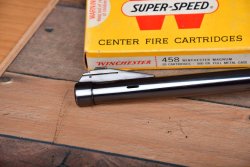
To help tame recoil, the barrel is fitted with two MagnaPort gas-relief slots on each side of the front sight base. Redirecting propellant gases through these ports noticeably reduces both recoil and muzzle rise. The trade-off, however, is a
substantial increase in muzzle blast. While an additional 3 to 6 dB may not sound significant, an increase of 10 dB represents a doubling of perceived sound intensity.
Many professional hunters and game scouts in Africa have suffered permanent hearing damage after years of exposure to big-bore rifles fitted with muzzle brakes or compensators. Our recommendation is simple: it is far better to shoot and handle a slightly smaller caliber with confidence than to rely on recoil-reducing devices that expose everyone nearby to excessive muzzle blast.
The Mauser 66's stock design is less than ideal for managing heavy recoil, and the rifle delivers a fairly sharp kick. We are also not fans of filling the buttstock with steel or lead shot to increase weight. While doing so reduces felt recoil, it also upsets the rifle's balance.
Several experienced handloaders have reported excellent results using reduced .458 Winchester Magnum loads with 350-grain bullets for driven hunts on wild boar and red deer. According to their experience, animals rarely travel far after the shot, with most dropping where they stand.
Conclusion: The .458 Winchester Magnum
The .458 Winchester Magnum has made an impressive comeback and today offers more than enough performance to cleanly take even the largest and most dangerous game when bullets are properly placed.
Loaded with lighter bullets, it can also serve as an effective choice for driven hunts on wild boar and other large European game, making it considerably more versatile than its original purpose might suggest.
The .458 Winchester Magnum has also served as the parent case for numerous wildcat cartridges over the years. Of these, only one has achieved widespread commercial success: the .458 Lott.
We'll take a closer look at this even more powerful dangerous-game cartridge in the next installment of our Safari cartridge series.