
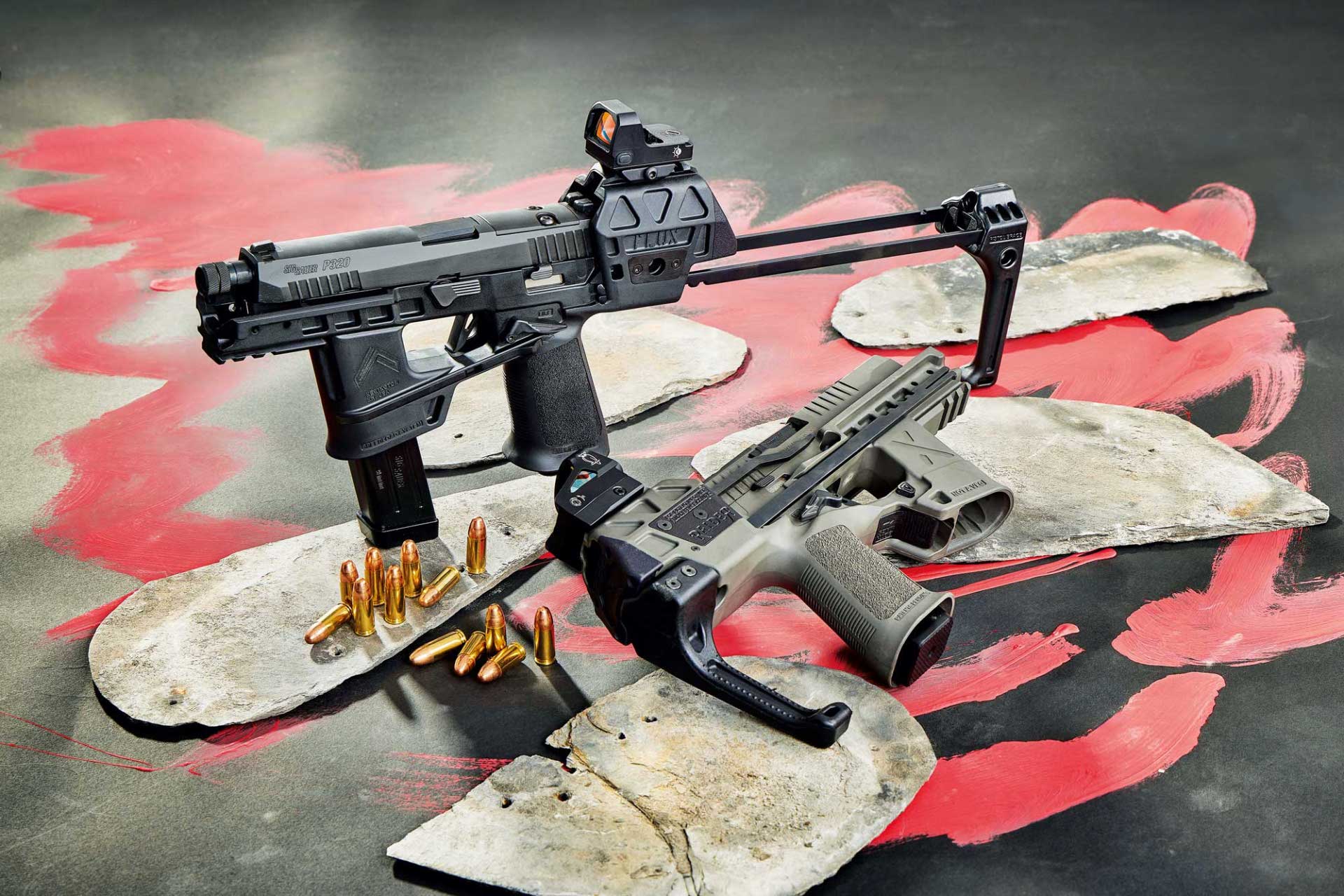
Equipping a pistol with a stock to enable more accurate shooting at greater distances has been around for centuries. Especially in the case of pistols, detachable stocks have been part of the overall concept from the very beginning, as early as the Borchardt C93 and Mauser C96. The concept went out of fashion between the world wars, but was never completely forgotten. And for some years now, conversion kits from various manufacturers for semi-automatic pistols have become firmly established on the accessories market. Here, the pistol itself is inserted into a compact chassis – the latter is sometimes available in a more open design, sometimes more enclosing the pistol. The "Raider X" chassis system from the US company Flux Defense takes a completely unique approach to equipping a P320 pistol with a brace option.
The chassis concept behind the SIG Sauer P320 Flux
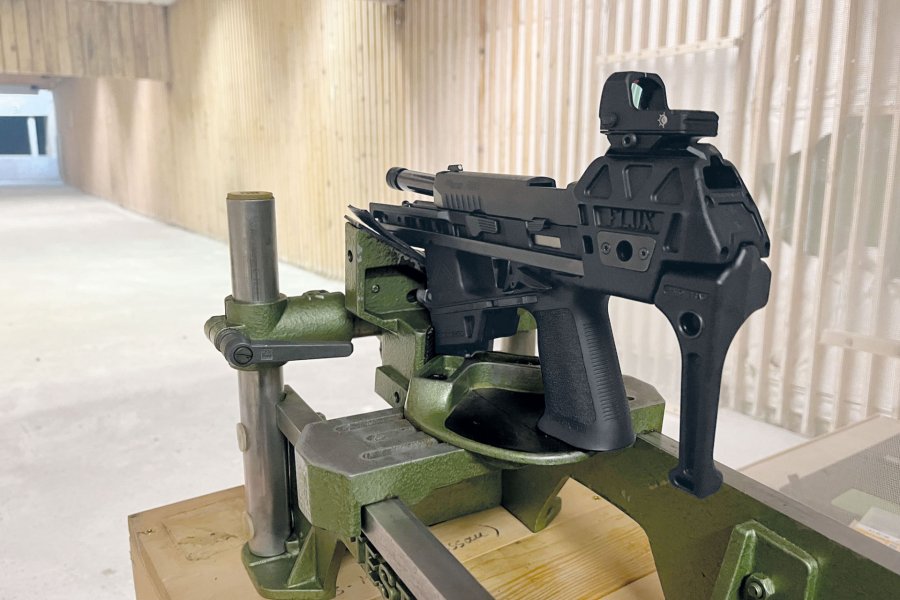
US manufacturer Flux Defense, based in Sandy – a suburb of Salt Lake City – relies largely on a one-piece polymer construction for the Raider-X chassis designed for the SIG Sauer P320. The functional parts are, of course, largely made of steel. And the system offers a whole bundle of functional parts. The eye-catcher is, of course, the brace: two steel rails to the right and left of the "grip" form the brace, finished off at the rear by a narrow polymer butt pad. And because the gun is also intended to be ready for use at lightning speed as a "PDW", a spring-release lever below the cartridge ejection port provides the right amount of responsiveness. A touch of the finger and the spring-loaded brace snaps backwards out of the chassis and locks automatically. If the P320 was fully loaded beforehand, it would be ready to fire as a "carbine" in a flash.
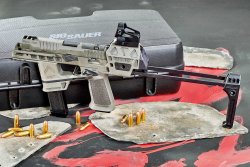
Since, unlike pistols, carbines are not always stored either in the holster or in the shooting hand, the Flux chassis always has a practical ambidextrous thumb safety should the gun need to be laid down loaded or carried on a shoulder sling. Two QD swivels are factory integrated on the left-hand side, one at the rear of the chassis itself and one in the brace. Of course, even the best stock/brace is useless without a sighting device. Flux Defence solves the problem by means of a short polymer bridge over the slide that is firmly integrated into the chassis and equipped with a Picatinny rail and, due to its one-piece design, does not move along with the slide underneath when firing. In an emergency, the pistol's rear sight and front sight could also be used for aiming; they remain in place under the Picatinny bridge.
The SIG Sauer P320 Flux has a spare magazine on board
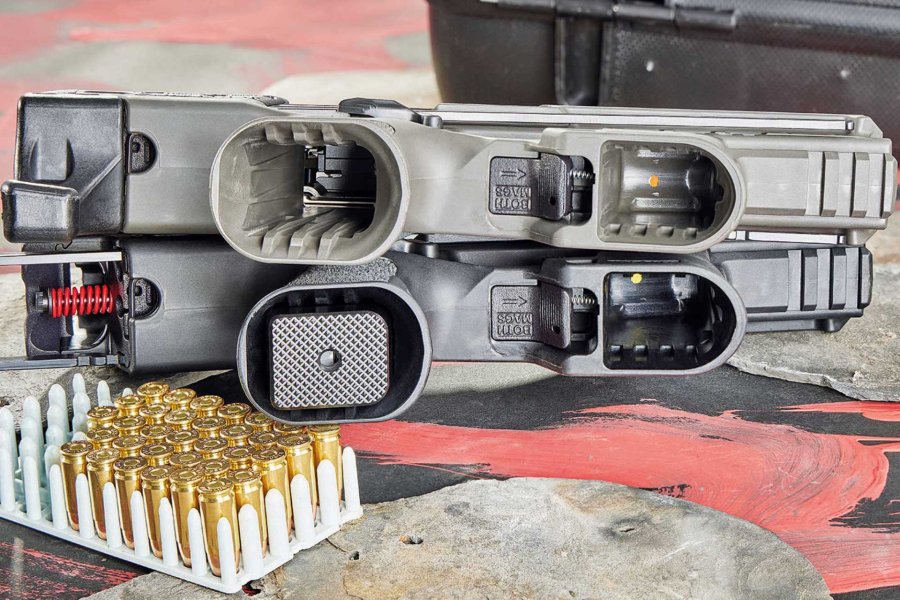
A second slot for a spare magazine forms the trigger guard at the front of the chassis and also serves as a grip for the supporting hand – with a spare magazine inserted, you naturally have more grip surface there. The manufacturer has provided three controls for releasing the magazine(s) so that the inserted magazines can be accessed again. These are: a slide on the left-hand side, directly below the safety catch. When pressed forwards, it releases the magazine. Alternatively, the same can also be done using the push button on the front right of the trigger guard. Given its position directly behind the reserve magazine inserted at the front, you would think that the push button releases the front, i.e. the "reserve magazine". But it doesn't: it is responsible for the release of the rear magazine – the "live" one, so to speak. The infernal trio of magazine releases is completed by a spring-loaded lever at the rear of the spare magazine storage. If you press it in (which works equally easily from the right and left), it releases the magazine catch in both magazine wells at the same time. Ideally, the procedure here would be to grip the front spare magazine with the supporting hand as a grip replacement. Once you have decided to change the magazine quickly, press button number 3: the fully or partially empty live magazine now snaps out of the back of the pistol and you hold the full spare magazine in your support hand. Drop it into the generously sized magazine well in the rear grip and voilà: ready to fire again! In theory, it all sounds well thought out. But until you have really familiarized yourself with all the optional controls for the two magazine wells, you will probably end up with a lot of magazines on the floor during practice before you've mastered the process.
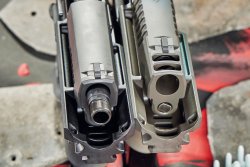
The manufacturer has also put some thought into the front section. The chassis is sufficiently recessed below the muzzle to accommodate standard silencers or other muzzle attachments. There are two holes on the right and left to attach additional Picatinny adapter pieces.
The gun comes factory with a short pica rail at 6 o'clock for a light. A small barricade stop would not be a bad idea either, as the supporting hand inevitably comes very close to the muzzle with the small PDW.
The most important details about the SIG Sauer P320 itself
The pistol itself, which works inside the chassis system, is well-known. Launched twelve years ago, it is now the workhorse among SIG Sauer's pistols. The polymer-framed, striker-fired gun replaced the Beretta 92 (M9) as the service pistol for the US armed forces in 2017 as the M17 and the M18 compact model. Last year, the Swiss Army also opted for the P320 as a replacement for the SIG Sauer P220 (Pistol 75).
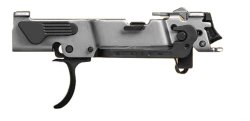
The modular design is one of the hallmarks of the entire P320 series. The internal Fire Control Unit (FCU) houses the trigger mechanism and the guide rails for the slide. The serial number is on the outside. The FCU is the serialized part of the P320 pistol in terms of firearms law. The outer polymer frames are available in different colors and sizes, slides and barrels in several lengths. The P320 is also available in different calibers. So if you like, you can use interchangeable chassis and/or braces and frames based on a single FCU. With regard to the caliber groups, however, the "large" calibers 10mm Auto and .45 ACP must be separated from the smaller calibers (9mm Luger, .40 S&W and .357 SIG) when swapping; changing between the "large calibers" and the "small calibers" does not work technically. No tools are required for the removal and conversion of an FCU. The disassembly lever on the left in front of the trigger holds all assemblies together and can be pulled out completely to remove the fire control unit. If you are experienced in P320 conversions, you can do this in a few simple steps. Inexperienced users should allow a few minutes until all parts are back in place.
Practical impressions of handling the P320 Flux with the brace collapsed and extended
The ballistic data and the groupings achieved with the aid of a reflex sight do not differ greatly from those achieved with an Optics Ready P320 without a Flux chassis. The shorter barrel costs the Legion around 25 m/s in v0 compared to the Tacops. So what happens when you handle and shoot them quickly? First of all, it should be noted that there were no malfunctions with either gun, all types of ammunition were fed properly, and the fired cases were ejected properly. The ejection from the Legion, when using a two-handed grip, seemed a touch sluggish depending on the load, but only a few casings landed on the right arm, never in the face.
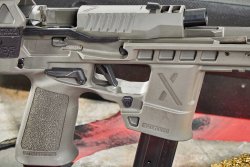
Speaking of the face: with the brace extended, you have the reflex sight right in front of your nose – the brace is not that terribly long. However, everything works perfectly, the sight picture through Red Dot is completely okay and, at least in the 9mm Luger test caliber, there is no gas, smoke, smear or speckles that would be carried from the weapon to your face during firing. If you want to aim using the iron rear and front sights with the brace extended under the Picatinny bridge, you have to aim very low with the cheek on the brace. It works, but it's not comfortable. The brace of the Flux pistols is (correctly) designed for shooting with reflex sights. For a slim lightweight design, the brace has comparatively little play in the firing position, but the rattling of the spare magazine in the front magazine well is rather irritating. However, if you use the second magazine as a front grip, the rattling is gone again. Overall, the Flux looks solid as a PDW in the shooting position. However, some handling characteristics reveal that it's a converted pistol and not a weapon designed from the ground up as a mini-carbine: the slide has to be manipulated using the front loading grooves instead of a real charging handle and the (double-sided) slide stop levers are no longer as easy to reach as on a conventional P320 without a chassis. Two small things were a little annoying in terms of handling, at least subjectively: the generously flared grip would be more ergonomic if the manufacturer had dispensed with the enlarged "magwell". And depending on the position of the trigger finger on the trigger, the rather sharp plastic edges on the bottom of the trigger guard can be irritating.
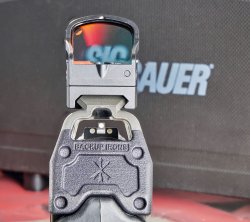
Briefly on the handling the pistol with the brace collapsed, when things have to happen particularly quickly. As a last resort, the Flux can also be fired without the brace extended. However, the disadvantage here is that the sights are primarily designed for use with the brace. In the two-handed position, you therefore aim under the bridge mount and sight the target in the classic way using the rear sight and front sight. This has the disadvantage that the rear sight is completely in the shadow of the bridge mount and both the mount and the red dot optic (probably) attached to the top obscure a lot of the target and its surroundings: Not ideal once the fire is so intense that you don't even have time to press the brace release .The alternative is to use the reflex sight without the brace. However, the red dot is then a good 9 cm above the back of your hand. In such a situation, there is an extremely high chance that, in a quick attack, you might look through the lens but not find the red dot.
Flux Defense also offers a "Left Hand Brace Kit" as a conversion kit for southpaws, but according to the manufacturer, the spring-loaded brace mechanisms are factory-tuned and not necessarily intended as "plug & play" for replacement by the user.
SIG Sauer P320 Flux models specs
Model: | SIG Sauer P320 Flux Legion | SIG Sauer P320 Flux Tacops |
Caliber: | 9mm | |
Capacity: | 17+1 rounds | |
Barrel Length: | 96 mm | 137 mm |
Sight Radius: | 165 mm | |
Trigger Pull Weight: | 1,870 g | 1,770 g |
Dimensions (LxWxH): | 272/455×44×160 mm | 287/474×44×160 mm |
Weight: | 1,215 g | 1,230 g |
Conclusion on the SIG Sauer P320 Flux Tacops and P320 Flux Legion
The P320 Flux is a fine thing, especially the Tacops version without compensator openings. The PDW is pleasantly compact and light with the brace collapsed. Especially in an emergency, the brace helps immensely when shooting at somewhat greater distances than just a few meters. In the USA, the concept makes sense as a home defense weapon: a handy mini-carbine in a small, quickly accessible safe, and not as loud as a "real" short barrel rifle (SBR) in a rifle caliber. In addition, not all US states are generous with "real" carbines with an extra short barrel. And if you are allowed to own one as a US citizen, you have to register it with the ATF, unlike a pistol – but many gun owners don't want to do this.
Further information can be found on the SIG Sauer website.