
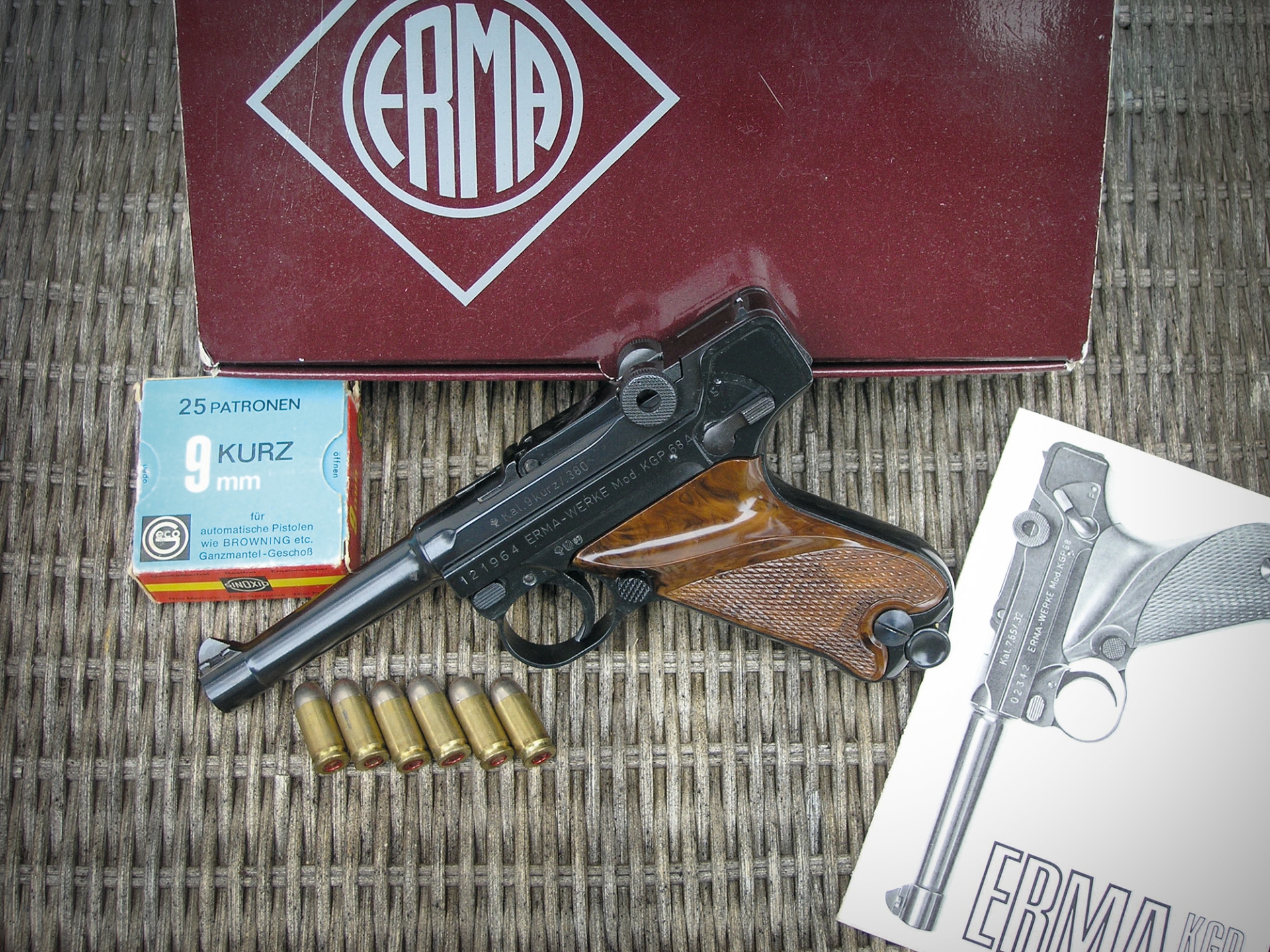
Opening the box, our first impressions ranged from disbelief at something that almost seemed like a practical joke to admiration for details showing genuine ingenuity. Handle this "miniature Luger" for a few moments, however, and appreciation for the technical solutions soon takes over.
The quality of manufacture also leaves very little to be desired, even by today's standards. The plastic grip panels may look somewhat inexpensive at first, but they offer more than satisfactory ergonomics. The thumb rest molded into the left grip panel improves hand positioning, while the molded checkering provides a secure hold.
The grip angle, inherited from the P.08, works equally well on this considerably smaller pistol. Miniaturization does have a drawback, though: even shooters with medium-sized hands will find their little finger hanging below the bottom of the grip.
Erma KGP 68 A: Finish, controls and safeties
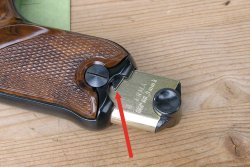
The engineers at Erfurter Maschinen- und Werkzeugfabrik Bertold Geipel GmbH in Germany, better known as Erma, did an excellent job of matching the appearance of the blued steel components, including the barrel and breechblock, with that of the painted, cast-aluminum alloy frame.
Inserting a fully loaded magazine requires a certain amount of pressure before it locks securely into place. This resistance comes from the magazine-disconnect safety, which prevents the pistol from firing when the magazine is removed. At the time, this device was essential for exporting the Erma KGP 68 A to the United States.
A similar safety had been introduced as an optional feature on the original P.08 only in 1933, using a Walther patent.
The manual safety and magazine release also require more effort to operate than the pistol's small dimensions might suggest. The magazine release is partially covered by the thumb rest, making it easier to operate with the thumb of the support hand. Both controls nevertheless move smoothly and consistently.
Another feature borrowed from the P.08 is the extractor design. As early as 1904, Georg Luger had designed the extractor to protrude noticeably when a cartridge was chambered, allowing it to function as a loaded-chamber indicator.
On the Erma, the sides of the extractor are also painted red, making the indication both visible and perceptible by touch. Even judged against modern standards, this little pistol therefore offers a respectable combination of safety features: a loaded-chamber indicator, a magazine-disconnect safety and a manual safety.
A Luger-style toggle mechanism, but a different operating system
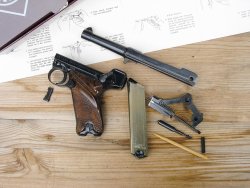
Anyone familiar with the P.08 will immediately notice the absence of its sideplate. The disassembly lever found on the original Luger frame is also missing. In approximately the same position, the Erma instead has a push pin.
The most significant technical difference between the KGP 68 A and the P.08 becomes apparent as soon as the action is manually cycled.
When the original Luger fires, the breechblock, toggle assembly and barrel recoil together for a short distance. The toggle knobs then encounter the camming surfaces on the raised sides of the frame, initiating the unlocking sequence. The toggle joint rises and folds upward.
The Erma's toggle also folds upward, which explains the initials KGP: Kniegelenk-Pistole, German for "toggle-joint pistol." Beyond this visual similarity, however, the operating principle is entirely different.
The barrel and its mounting assembly remain stationary. The toggle knobs serve only as gripping surfaces for manually cocking the action and do not even touch the camming surfaces, whose outlines are merely reproduced on the frame.
The KGP 68 A actually uses a blowback-operated action with an articulated breechblock that visually and mechanically, but not functionally, reproduces the familiar movement of the P.08 toggle mechanism.
Hats off to Erma's designers for what they managed to achieve almost sixty years ago.
The Erma KGP 68 A at the shooting range
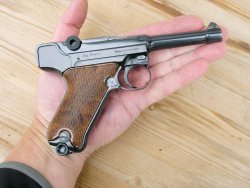
"Did you wash it at too high a temperature?"
The little Erma immediately attracts attention at the range, along with a few sarcastic remarks from fellow shooters.
Surprisingly, even beginners and youngsters recognize the P.08 and immediately notice that something is unusual about its proportions. Before long, we find ourselves spending more time explaining the pistol than actually shooting it.
At just beyond the canonical 25 yards, the KGP 68 A is capable of considerably more than merely hitting the proverbial tin can, but it remains far from the accuracy of a dedicated target pistol.
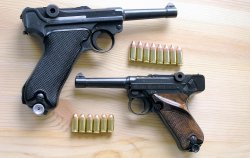
With both pistols loaded, the little Erma weighs almost 8.8 ounces less than the P.08. Its unloaded weight of 640 grams (22.6 oz.), combined with a trigger pull slightly exceeding 5.5 pounds, is hardly an ideal combination for precision shooting.
The short grip also makes it difficult to keep a truly secure hold. The sights are as small as those of the original Luger, and windage adjustments can only be made by drifting the front sight sideways in its dovetail.
With considerable concentration, it is possible to barely keep five shots within the black scoring area of an ISSF precision pistol target – a circle that’s 7⅞” across.
After all, the Erma KGP 68 A was never intended to be a target pistol.
The strong recoil spring requires a fair amount of finger strength when manually cocking the action. Once fired, the pistol delivers surprisingly sharp recoil, certainly comparable to that of a full-size P.08.
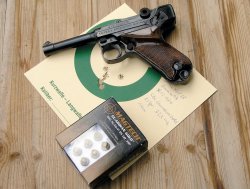
Shooting from a seated position with the pistol supported, at a more realistic distance of 10 yards, produced surprisingly tight groups.
The point of impact showed a slight horizontal deviation from the point of aim. Considering the almost new condition of our test pistol, we preferred not to drift the front sight, compensating for the deviation by adjusting our point of aim instead.
With hollow point bullets, we experienced occasional feeding problems when chambering the first round, depending on the diameter of the hollow-point cavity.
The problem disappeared when we limited the magazine load to five rounds. With round-nose full metal jacket ammunition, on the other hand, the KGP 68 A functioned flawlessly.
The surprisingly high ballistic performance prompted us to test the load that had produced the highest score, Magtech Guardian Gold, in a fresh block of Clear Ballistics ballistic gelatin.
The bullet expanded to a diameter of 0.55”, penetrated approximately 10.2 inches, and transferred 212 ft-lb (287 joules) of energy.
Our conclusions on the Erma KGP 68 A
There have been, and still are, countries where private citizens are allowed to purchase firearms, but subject to restrictions based on caliber. Brazil, where 9mm Luger is classified as a restricted-use cartridge, provides one example.
The .380 ACP, also known as 9mm Browning Short or 9mm Kurz, therefore represented a respectable alternative for anyone looking for a handgun with the dimensions of a pocket pistol.
Admittedly, a six-round capacity for a pocket semiauto may seem modest today. Around 1970, however, apart from the Walther P1, much of the German police force was still equipped with Walther PP and PPK pistols chambered in .32 ACP.
In its day, the KGP 68 A was certainly a defensive handgun worth taking seriously. And, within certain limitations, it can still fulfill that role today – provided you can find one.
The Erma KGP 68 A was commercially imported into the United States, where examples were distributed by Mandall's Shooting Supplies of Scottsdale, Arizona, and Excam of Hialeah, Florida. Between 1988 and 1990, Beeman also imported a modified .380 ACP version under the MP-08 designation, featuring checkered walnut grips and a shorter, 3.5-inch barrel. They’re out there, on the collectors' market, and a good-condition Erma KGP 68 A in .380 ACP currently commands approximately $700–$850, with exceptionally well-preserved examples occasionally exceeding $1,000.
Thanks to Frankonia in Germany, which kindly consulted its old catalogs, we were also able to establish the pistol's original retail price. Around 1970, an Erma KGP 68 A cost exactly 238.50 Deutsche Marks. Allowing for inflation, this represents purchasing power equivalent to approximately $720 today.
The Erma KGP 68 A was therefore an affordable, well-made pocket pistol chambered for a capable cartridge, particularly when loaded with expanding bullets. It also had one other quality that has lost none of its appeal over the decades: an appearance guaranteed to attract attention.