
During the author's trip to the range with the ERMA rimfire pistol, a few "young gun enthusiasts" were also present. After shooting at some targets, they asked what brand and model it was. As soon as the name ERMA was mentioned, the answer was a prompt "I've never heard of it". All the more reason to take a closer look at this famous – and sadly defunct – "Made in Germany" brand.
Over the rainbow: the ERMA ESP85A in detail
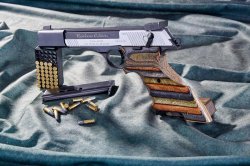
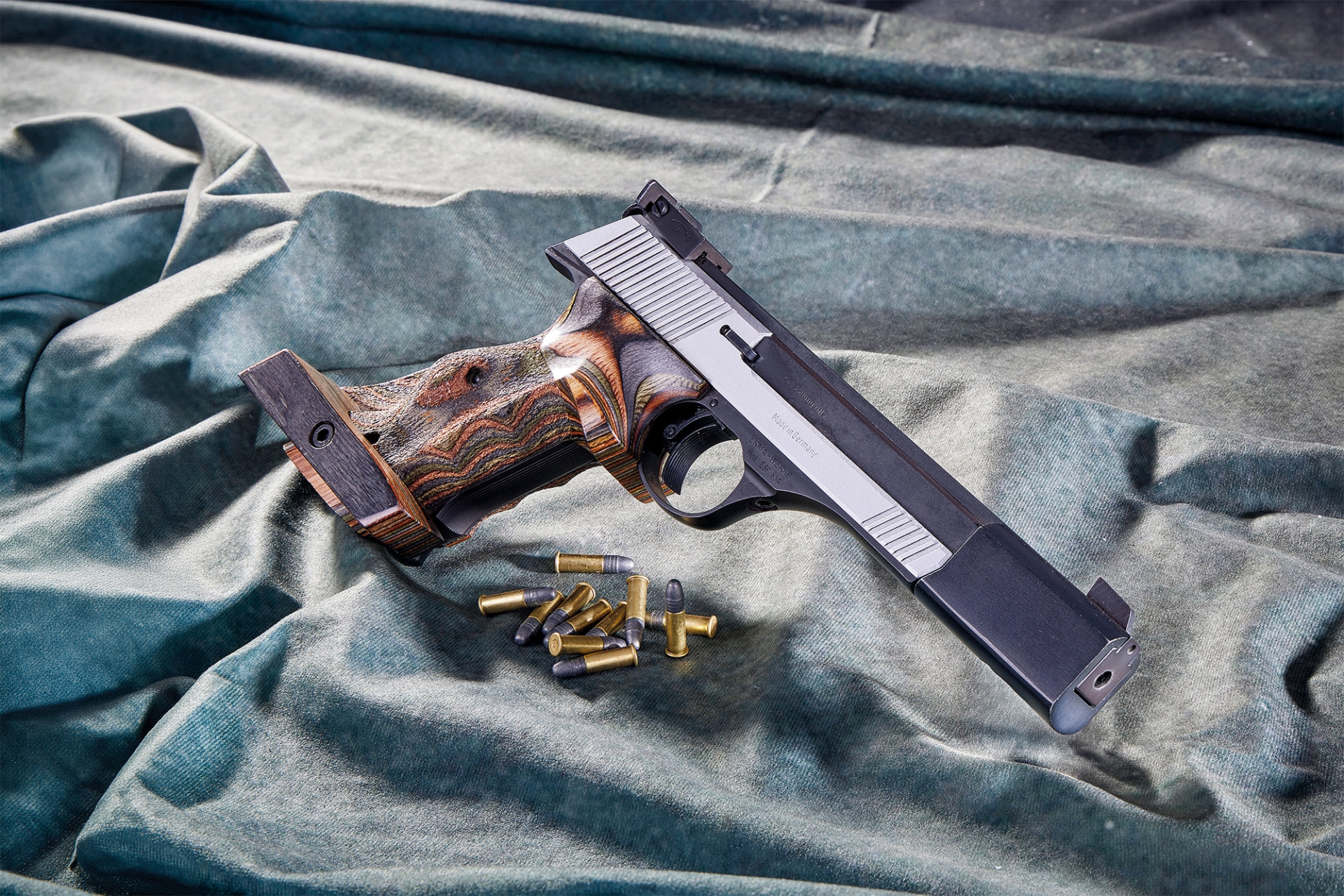
In the case of this classic firearm, the ERMA ESP85A "Rainbow Edition", the abbreviation stands for: Erma Sport Pistole 85 Aufgerüstet, or Erma Sport Pistol 85 Upgraded. This limited special edition features a multicolored finish – and yes, even back in the '80s, people were talking about rainbows – just in a different way. The ESP85 was launched by ERMA in 1985 and immediately became very popular, including among hunters, where this model is still used today for the German Hunting Association's (DJV) "Skill Shooting" discipline. At the time, it was a genuine alternative to the models from other manufacturers of sporting rimfire pistols on the market. With the production of sporting pistols, ERMA broke new ground in post-war Germany (apart from the ESP72) and various variants and special editions were released over the course of its production run. Examples include the ESP85 and ESP85A, as well as the special models "Jäger", "Junior", Rainbow Edition", "Golden Target 93" and the rare "Germania-Edition". ERMA made the sport pistol in .22 Long Rifle and .32 S&W Wadcutter, naturally also available as a complete package including the gun and conversion kit. Although the production period covered the years 1985 to 1997, existing stocks were sold until 2001. A total of approximately 16,200 units were likely produced. The highest known serial number is 023919 (made in Suhl in 2000 using remaining parts). Production began with the ESP85A, serial number 5000.
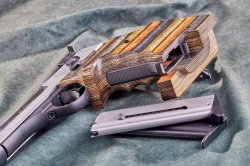
As already mentioned, there are differences between the models labelled ESP85 and ESP85A. Both variants could be ordered with either a 100-mm (4-inch) or 153-mm (6-inch) barrel. The example presented here bears the proof mark KE combined with the mark of the Mellrichstadt Proof House, indicating a 1994 production date. The external trademark was the colorful, adjustable match grip made of laminated wood, which was developed by the Nill company on behalf of ERMA, as well as the external hammer. It also featured micrometer sights adjustable for elevation and windage, bearing the ERMA logo, an undercut front sight, and a 120-gram barrel weight. The prominent "Rainbow Edition" logo is printed in large letters on the left side of the barrel. Unlike the blued barrel, the slide was nickel-plated. At the time, the pistol came with a second (blued) single-stack steel magazine without grip shoe; the "main" magazine (with shoe) is also nickel-plated. Other accessories included were a second "large" barrel weight (180g), a second front sight (4mm), an interchangeable rear sight and various tools. Included were the instruction manual, a target and the green warranty card. A so-called "hunter's grip" was later offered as an accessory for the gun so that it could also be used for two-handed shooting. The whole thing came in a hard plastic pistol case.
Technology and workmanship of the ERMA ESP85A
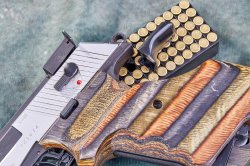
As is usual for rimfire pistols, the gun is blowback-operated and has a single action trigger with an external hammer. The safety is external on the left side and is visually similar to the safety/decocker of the Walther P38/P1. The magazine holds eight cartridges in the .22 LR version. The .32 S&W WC version holds five cartridges. The ESP85 also features a simpler, all-steel trigger, while the ESP85A tested here has a fully adjustable match trigger for both take-up and pull weight. From the factory, the trigger pull weight was 1,360 grams and can be adjusted downwards to around 1,100 grams. The trigger on this particular pistol is crisp and clean, without any grittiness or overtravel, and with a clean break. The plastic "beavertail" on the back of the grip, basically a slide-on piece, appears to be more of a wear part and has already been replaced. Since the newly fitted beavertail was also broken, it was glued on as a makeshift solution and will eventually be replaced with a custom-milled part.
The ERMA ESP85A Rainbow on the shooting range
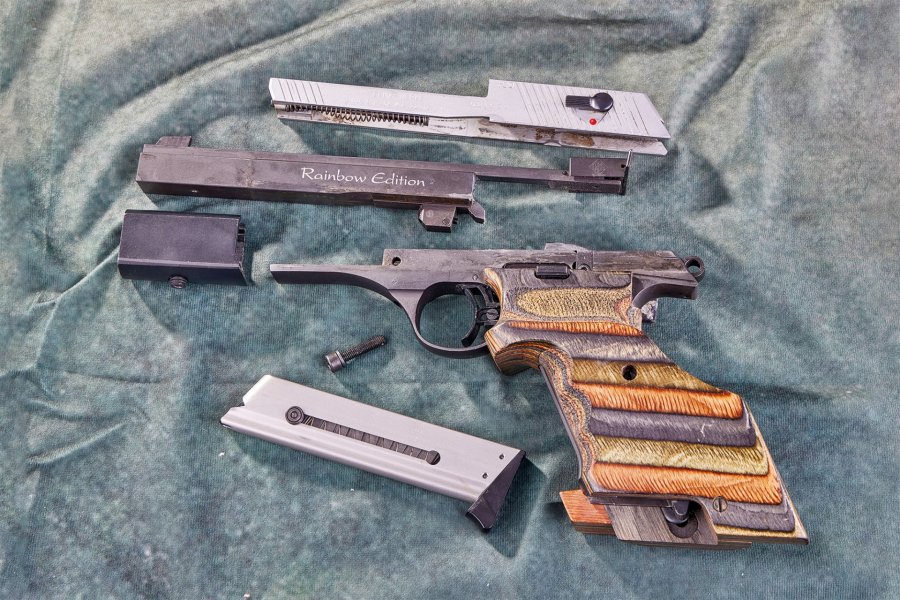
The ERMA requires minimal cleaning. A few drops of oil in the right places are all it takes for reliable cycling. Removing the barrel and slide for cleaning or to insert the conversion kit is very straightforward: with the slide open and the magazine removed, the Allen retaining screw above the trigger guard is loosened. By engaging the slide stop lever, the slide is then pulled forward – that's it. In almost 20 years of "endurance testing", the ESP85A has impressed with its reliability and accuracy. Malfunctions were the absolute exception. With the right ammunition, the 10-ring of the pistol target can still be held consistently after all these years.
Let's move on to accuracy with different makes of ammunition: in principle, the ESP85A can handle almost any type of cartridge without malfunctions, with the exception of high-velocity cartridges, which it absolutely does not like. Problems only arise with the standard CCI cartridges. Here, the test pistol is prone to occasional jams. Prompted by the report, the question now arose: "What accuracy can a pistol that is over 30 years old still achieve?" A Ransom Rest was used and the ERMA was clamped. The results achieved over a shooting distance of 25 meters proved to be very satisfactory. Even the worst load remained under the 45-millimeter mark. The Eley Tenex achieved the best value with 21-mm groups, well within the inner 10-ring of the pistol target (25-mm diameter). The groups were also all round and it was not possible to determine that any make was absolutely unsuitable. Testing was carried out using RWS Pistol Match, Rifle Match, Special Match, Eley Tenex, Lapua Midas, GECO and a CCI bulk pack load.
The magazine release can be described as fiddly to operate. It's located at the bottom of the frame, beneath the grip, and, like the safety lever, is somewhat reminiscent of the release on the P38/P1. One problem with all firearms that are no longer in production and whose manufacturer no longer exists is clearly the supply of spare parts. Here you have to rely on various platforms on the Internet to get hold of a sought-after spare part. A good address for spare parts for this pistol is also the company CDS Ehrenreich from Neukirchen near Sulzbach-Rosenberg, Germany. It is always worth giving them a call.
ERMA ESP85A Rainbow Edition technical specs
| Model: | ERMA ESP85A Rainbow Edition |
| Caliber: | .22 LR |
| Magazine Capacity: | 8 rounds (.22 LR) / 5 rounds (.32 S&W WC) |
| Barrel Length: | 153mm |
| Sight Radius: | 200mm |
| Rear Sight Notch: | 3.5mm |
| Front Sight Width: | 3.5mm |
| Trigger Pull Weight: | 1,000–1,360g |
| Weight: | 1,140 g |
| Barrel Weights: | 120 and 180g |
| Dimensions: | 255x45x130mm |
| Equipment: | Spare magazine, trigger stop, adjustable trigger first stage, second barrel weight, Nill grip, micrometer rear sight. |
Conclusions
Of course, it cannot (and should not) compete with the modern high-tech sports guns such as the Walther GSP500. Both the grip ergonomics and the shooting behavior are completely different. However, the ESP85A is still a good rimfire beginner's pistol that has every right to exist and belongs on the shooting range: be it for plinking or recreational shooters, beginners in rimfire sport shooting, or for inexpensive training. The fact that the ERMA is available at low prices on the second-hand market is to its advantage. A fully equipped model is available for a maximum of 400 euros. If you're lucky enough to get a good example of the ESP85A (and not a worn-out club pistol), then you have a good sporting pistol for the average shooter who is not aiming for top-level competition, which will continue to serve its owner well in many disciplines today with reliability, durability and accuracy.
Text: Frank H. Neis
Editor: Hamza Malalla