
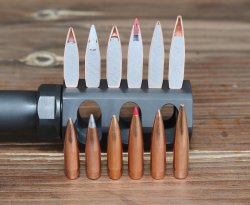
The Precision Rifle model was first presented by Sturm, Ruger and Co. in 2015. It is a bolt action rifle that can be used for both sporting and tactical applications thanks to its wide range of adjustment options. The 2nd generation of the Precision Rifle (PR) appeared just one year later. The design changes to the Gen2 concerned the handguard and the muzzle brake. The Precision Rifle is currently in its 4th generation, although the manufacturer does not refer to it as Gen4, but only with the original model name Precision Rifle. The extensive range of calibers starts with the 6 mm Creedmoor and extends up to the .338 Lapua Magnum. We tested the rifle in the powerful .300 PRC chambering. As there are still relatively few sporting factory loads in this caliber, the testers resorted exclusively to handloads.
In detail: barrel and handguard of the Ruger Precision Rifle
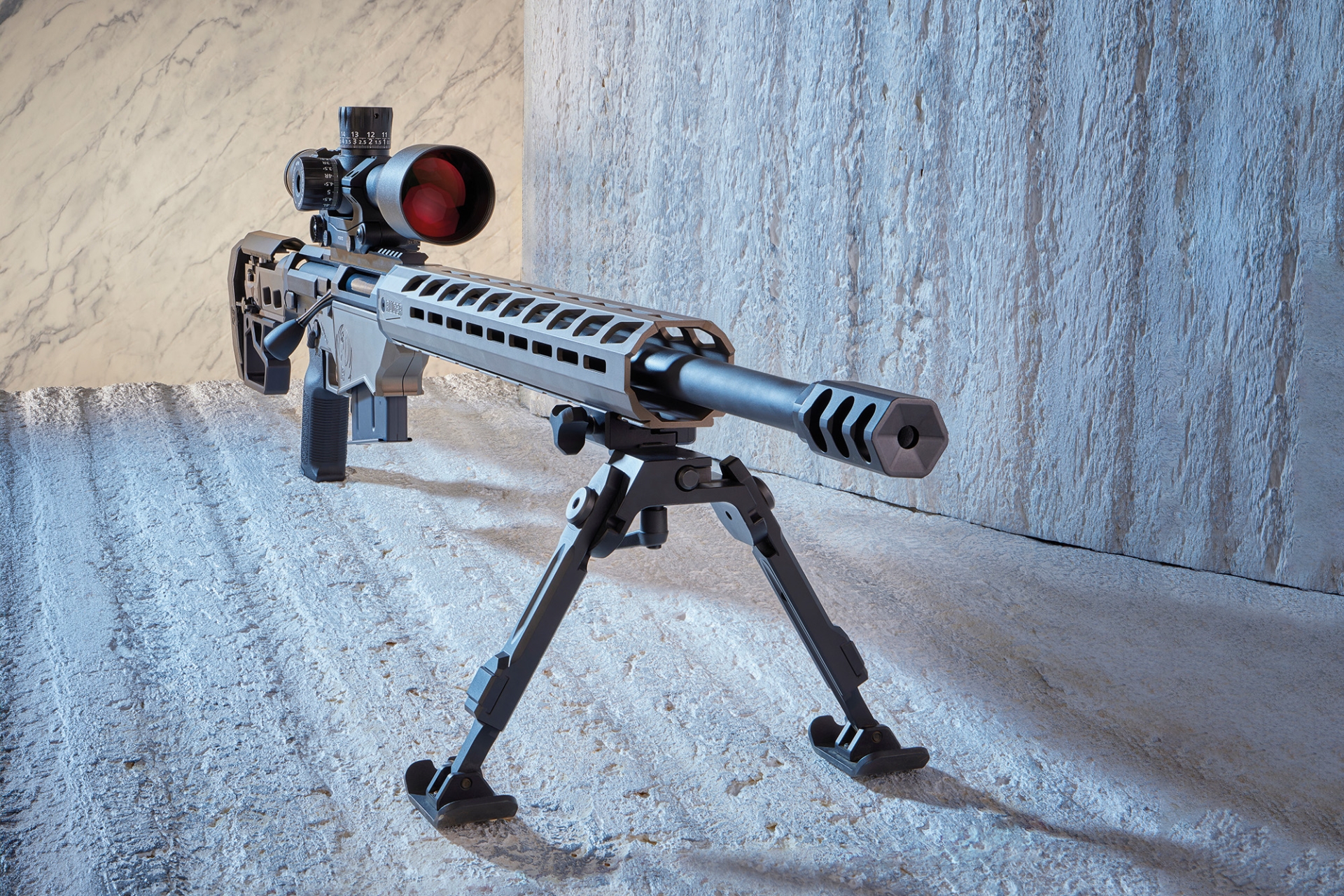
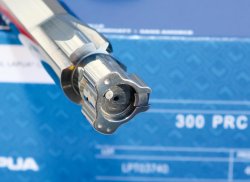
Ruger has cut a 5/8 "x24 fine thread at the muzzle. The in-house three-chamber muzzle brake is mounted on this as standard. Its impact surfaces are arranged in such a way that the powder gases are distributed to the right and left at right angles to the barrel axis. Although this reduces the effectiveness somewhat, the blast is not directed straight at the neighboring shooters, as is the case with rear-facing baffles. A lock nut ensures that the brake is held firmly in place. The barrel measures 22.2 mm in diameter directly behind the thread. This value increases evenly to around 25.4 mm. In the area of the barrel root, the diameter is 30.5 mm. Inside the cold hammer forged barrel, rifling is the familiar 5R profile. The twist rate is 1:9". This means that classic match bullets with lead cores up to a weight class of around 245 gr can be safely stabilized. A 1:8.5" twist rate would only be required for the extra-long 250-gr A-Tip bullets from Hornady. Between the barrel nut and the barrel itself is the extremely solid mount for the aluminum handguard, known as the "handguard bushing" at Ruger. Six screws and a 12-sided profile create a stable connection between the receiver and the handguard. The handguard was manufactured using an extrusion process, then machined and has a Cerakote coating in "Smoked Bronze" color. The part features ten M-Lok interfaces at 6 and 12 o'clock and a further nine M-Lok slots at 3 and 9 o'clock. In addition, a 445-mm long ARCA rail is milled into the bottom of the hand guard body. With a cross-section of 58x52 mm, the handguard is quite chunky, but this is in keeping with the over 120-cm long gun.
Action, bolt and trigger: Ruger Precision Rifle
Below the receiver sits the magazine well assembly, milled from an aluminum alloy. This assembly houses the magazine, the ambidextrous two-position safety lever, and the pistol grip, and also encloses the trigger group. In order to simplify the manufacture of this component and thus be able to produce it more cost-effectively, it is made in two parts. The magazine release can be operated from both sides and ensures a free-falling magazine when operated. The AICS-compatible magazine is made of sheet steel and holds a single row of five rounds in .300 PRC caliber. The Magpul MOE-K2-XL pistol grip has the standard AR interface so that it can also be exchanged for aftermarket accessories. From the testers' point of view, however, there is no reason to do so. There is a small storage compartment with an oil bottle in the pistol grip.
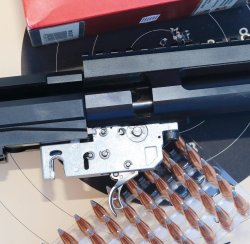
The Precisison Rifle has a direct trigger. According to the manufacturer, the trigger pull weight can be adjusted by the user from approximately 1,020 to 2,270 grams. This requires a 5/64" Allen wrench, which is conveniently located at the rear of the bolt shroud. The trigger can then be adjusted via a hole in the magazine well area. The average trigger pull of the test gun was 9.4 N (≈ 942 g). Ruger recommends cleaning the trigger group at regular intervals, approximately every 1,000 rounds or when the trigger pull weight becomes noticeably harder without prior adjustment. To do this, the assembly is removed, cleaned of oil and dirt with a technical parts cleaner and lightly oiled again on the axle shafts and moving parts. The Ruger manual describes the removal, cleaning and final installation of the trigger group in detail.
The bolt locks directly into the receiver with three lugs, resulting in a 60-degree bolt throw. On the top of the receiver is a Picatinny rail with four screws and a 30 MOA cant. The Marksman Adjustable trigger group is screwed to the underside. The bolt of the Ruger Precisison Rifle is very long and made from pre-tempered tool steel. The bolt head and cocking cam are therefore not induction hardened, as this could result in distortion. The bolt head comes with a conventional spring-loaded ejector pin and a spring-loaded extractor. There is only one gas relief hole on the right-hand side in case of excessive gas pressure. The bolt has a polished surface, with a DLC coating according to the manufacturer.
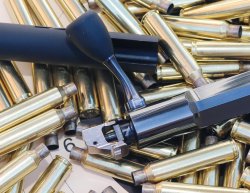
The screw-on bolt handle can be replaced with other handles if required. Behind the bolt handle is a firing pin nut cover made of anodized aluminum, which is designed to prevent the ingress of dirt or foreign objects. At the rear end of the cover is a plastic cap, underneath which is the Allen key for trigger adjustment. The cocking piece is controlled by two 180-degree offset cocking cams. This results in symmetrical force distribution, which prevents canting. The two-position safety only acts on the trigger. Due to the design with the cover, a firing pin safety would be much more complex to implement. Last but not least, the bolt features a secondary extraction mechanism. To facilitate the removing of the spent cartridge case from the chamber, the bolt makes a small axial movement when opening. This achieves the necessary breakaway torque for the case in the chamber. In primary extraction, this is achieved by angled camming surfaces on the locking lugs, in secondary extraction by the bolt handle and an angled camming surface in the receiver.
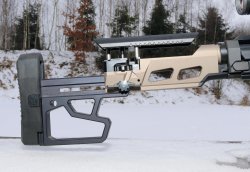
The buttstock of the Ruger Precision Rifle
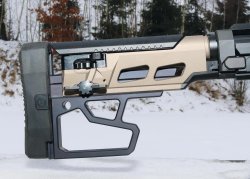
The buttstock consists of a solid profile made of a high-strength aluminum alloy. The butt plate can be adjusted by approximately 32 mm in six positions at the push of a button. To adjust the stock length, a wing nut must first be loosened by turning it approximately 90 degrees. This releases the clamp. Pressing the wing nut releases the locking mechanism, allowing the stock end to be moved within its guide. The maximum adjustment range is approximately 91 mm in quarter-inch (6.35 mm) increments. This can also be done while lying down or in a sitting fire position. The best way to do this is to fully extend the buttstock and then, while holding the nut down, push the buttpad in with the shoulder until the relief between the eye and the optic's eyepiece is correct.
The cheek piece offers a height adjustment of approx. 20 mm in 0.4 mm increments. A handy knurled nut underneath the jaw must be turned for adjustment. The cheek piece can also be adjusted axially in a dozen positions of ¼ inch each by a total of 70 mm in length. This provides the stock with all the necessary adjustments to allow for individual customization by the shooter.
The folding stock rests against the left side of the rifle. The release button is smooth-running and easy to reach. The hinge for the folding mechanism is cleanly made and free of axial and radial play. To unfold it, simply pull on the side of the buttstock. A hook lock secures the buttstock firmly in place.
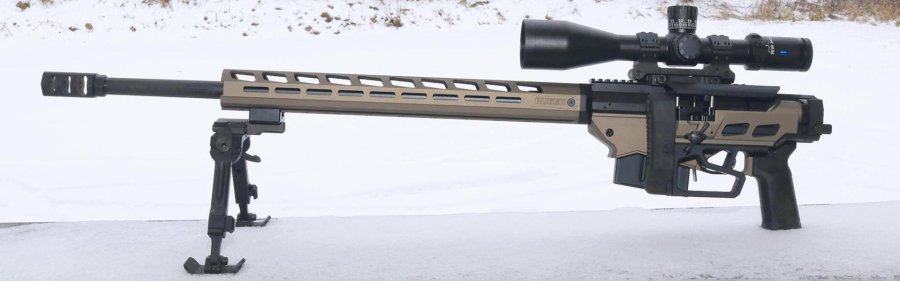
At 100 and 300 meters: A shooting range visit with the Ruger Precision Rifle
Before the accuracy measurements were taken on an open 300-meter shooting range, the testers had to mount the appropriate optic. The choice fell on a Zeiss LRP S3 636-56. With a 6x zoom and a maximum magnification of 36x, the LRP is particularly suitable for longer distances. In contrast to the older Zeiss V8 with 36x magnification, the LRP S3 with 32 Mrad (320 cm at 100 meters) offers more than twice the adjustment range in elevation. The aiming point in the center of the reticle covers just 0.4 mm at 100 meters and therefore obscures almost nothing of the actual aiming point. A block mount from ERATAC with variable cant from 0 to 25 Mrad was used. An extremely stable Fortmeier bipod was mounted on the ARCA rail of the handguard using an appropriate adapter. The Garmin Xero C1 Pro was again used to measure bullet velocity close to the muzzle. The testers were pleasantly surprised by the recoil impulse. Although the handloads sent the bullets on their way with muzzle energies of up to almost 6,000 joules, the testers noticed little of this. Subjectively, the recoil felt more like that of a .308 Winchester. The reason for this is, on the one hand, the relatively high gun weight, complete with optic, mount and bipod, and on the other, the effective muzzle brake. The brake's effectiveness is primarily due to the size of the baffles. The propellant gases, which expand abruptly at the muzzle after leaving the cylindrical bullet guide section, hit the baffles at high pressure and high flow velocity. This counteracts the recoil push and weakens it. With long barrels such as the one in the test gun, the muzzle gas pressure has already dropped considerably. As a result, the impulse of the gases is also lower, but this can be counteracted with larger baffles.
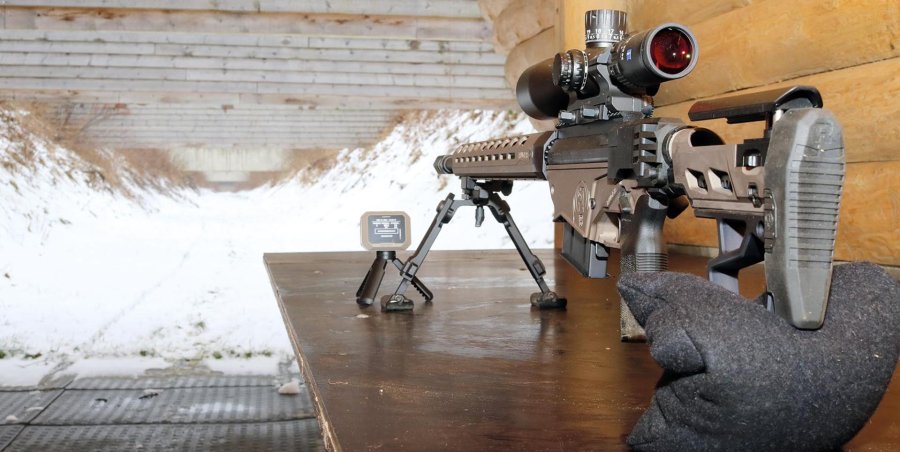
During the 120 or so cartridges fired, no weaknesses or technical problems were found in the cartridge feed or case ejection. As always, at the end of the test series the testers checked whether all the adjustments made to the buttstock before firing had retained their position and were firm. Here, too, there is no reason for complaint. What the testers did find annoying, however, was the trigger, or more precisely the "trigger release". This is located in the center of the actual trigger blade and protrudes. The trigger release must therefore be activated before the trigger finger reaches the actual trigger blade. If the shooter does not pull their trigger finger straight back, but rather at a slight angle, the trigger release scrapes against the trigger blade, which disrupts the otherwise good trigger characteristics. Another thing that stood out, although this had nothing to do with the Ruger test gun, was the ARCA rail. The adapter between the bipod and the rail has a clamping jaw. Although this was firmly tightened, it kept coming loose. In contrast to the Weaver or Picatinny rail, the ARCA rail does not offer an additional serration option for a crossbar. Therefore, the clamping should be checked regularly, especially with large calibers.
Ruger Precision Rifle in .300 PRC technical specs and price
Model: | Ruger Precision Rifle |
Caliber: | .300 PRC (Precision Rifle Cartridge) |
Capacity: | 5+1 rounds |
Overall Length: | 1,230 / 1,015 mm |
Barrel Length: | 664 mm |
Twist Rate: | 1:9" |
Trigger Pull Weight: | 962 g / 9.4 N |
Weight: | 6,900 g |
| Price (MSRP in the US): | $2829 |
Equipment: | Folding stock, adjustable buttstock, sheet metal magazine, top rail, 30 MOA, adjustable single-stage trigger, hammer forged barrel, handguard with ARCA rail and M-Lok mounts, muzzle brake. |
Conclusion
For a recommended retail price of €3,149, the current generation of the Ruger Precision Rifle offers great value for money. With chamberings such as the .300 PRC or the .338 Lapua Magnum, the rifle can be used accurately at long-range distances of up to around 1,500 meters. If you only have a 300-meter range at your disposal, you can also purchase the RPR in the smaller calibers in the 6 and 6.5 mm class. Of course, these calibers can also be used safely at distances from 800 to 1,000 meters and sometimes beyond. The buttstock offers numerous adjustment options so that every shooter can customize it to suit their needs. There is nothing to complain about in terms of accuracy, with six of the ten loads achieving an accuracy of less than 0.75 MOA at 100 meters. One load even achieved an outstanding 13 mm at 100 meters. The only fly in the ointment is the trigger release, which is only annoying if the shooting finger pulls the trigger blade at a slight angle. If necessary, the trigger group can also be replaced with parts from other aftermarket manufacturers.
Text: Christopher Hocke
Editor: Hamza Malalla
For more information on the Ruger Precision Rifle, please visit the manufacturer's website