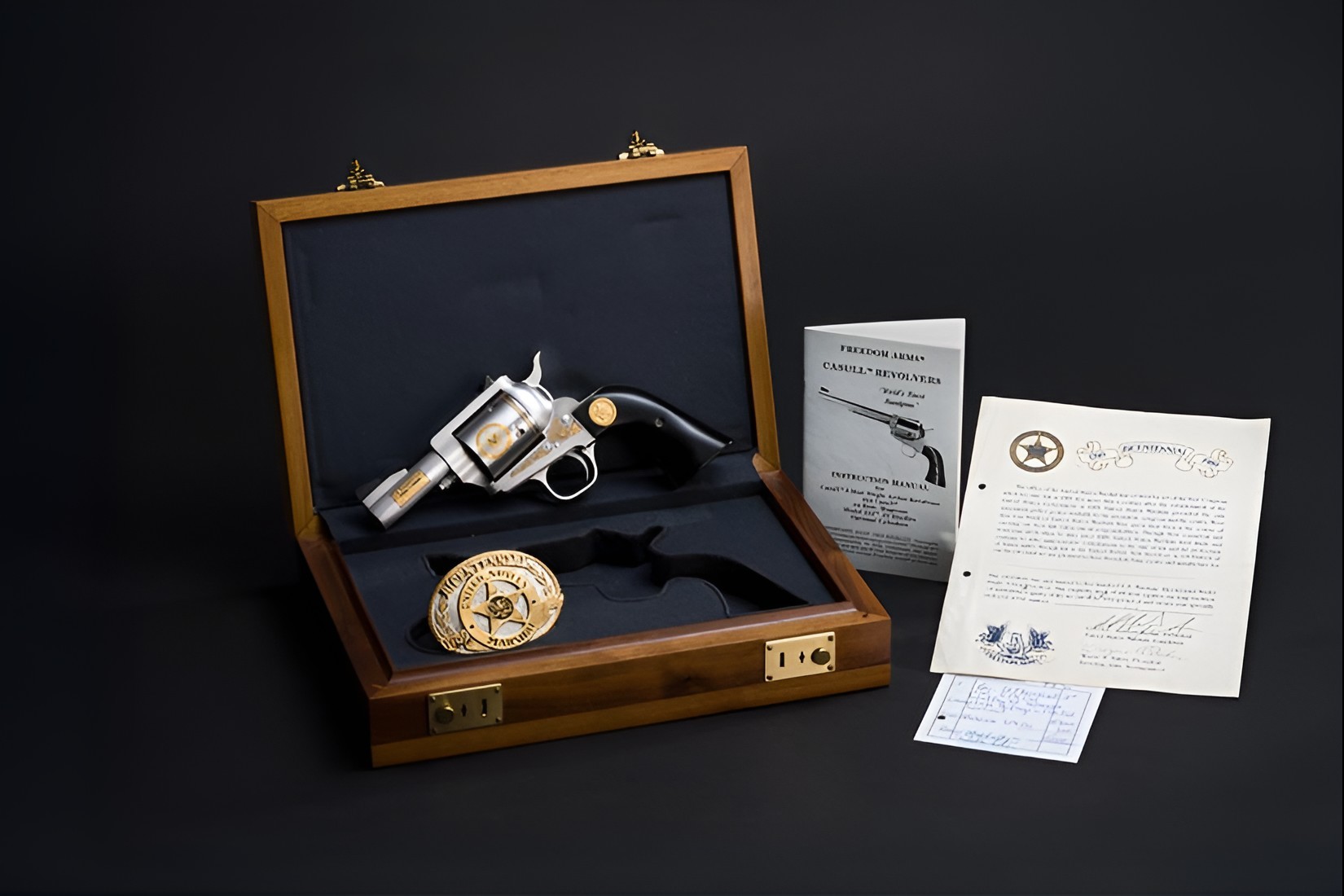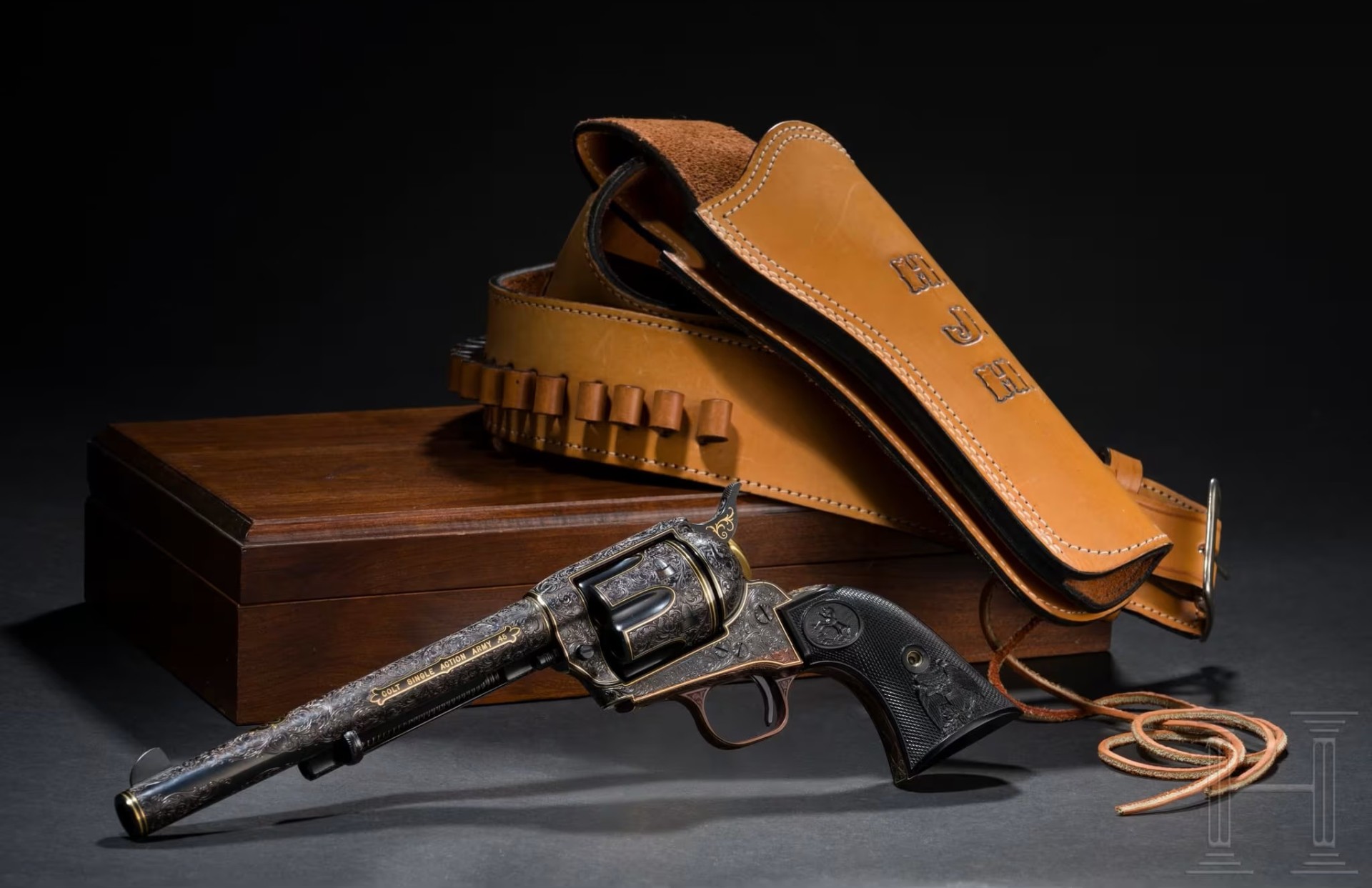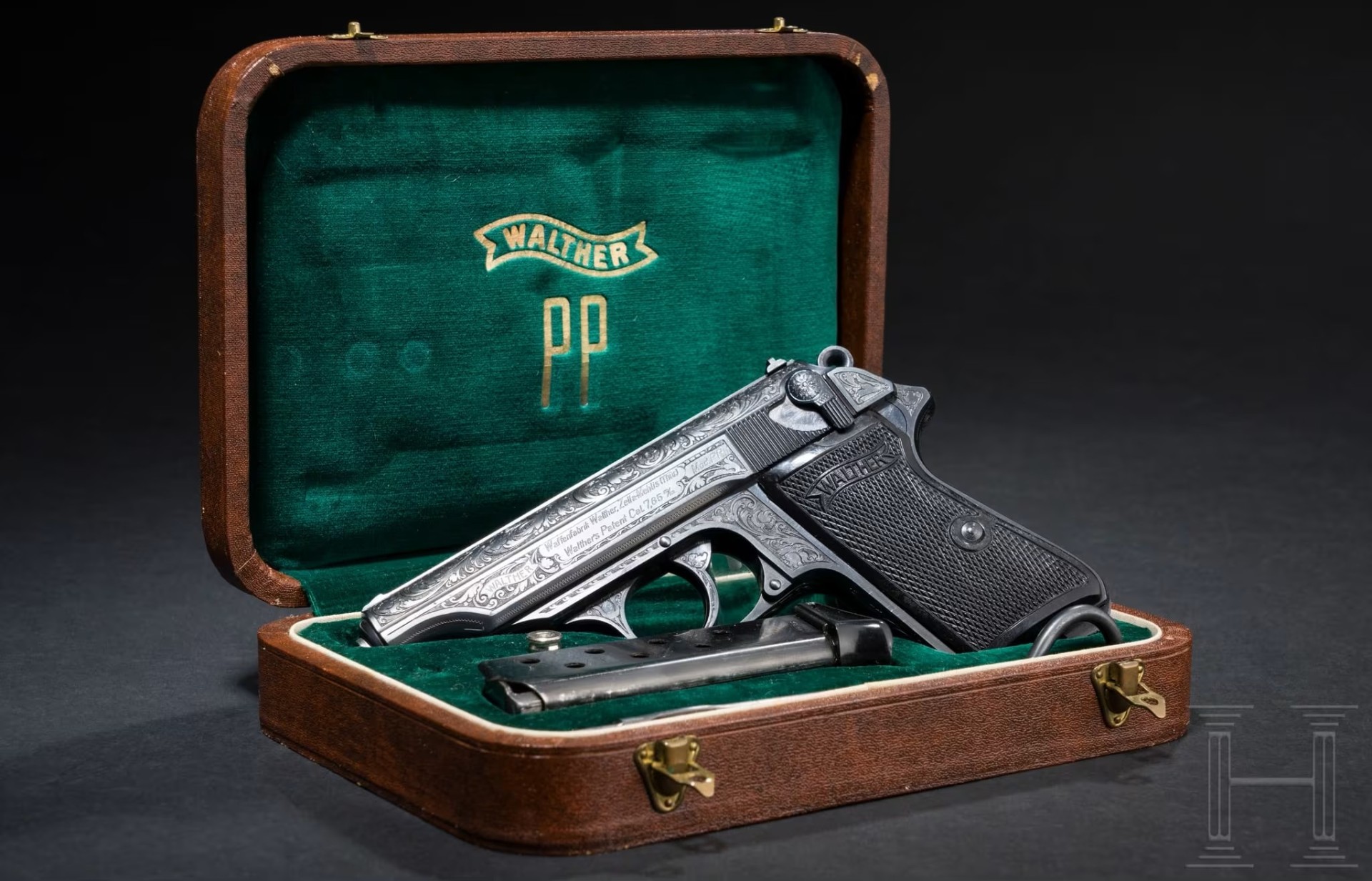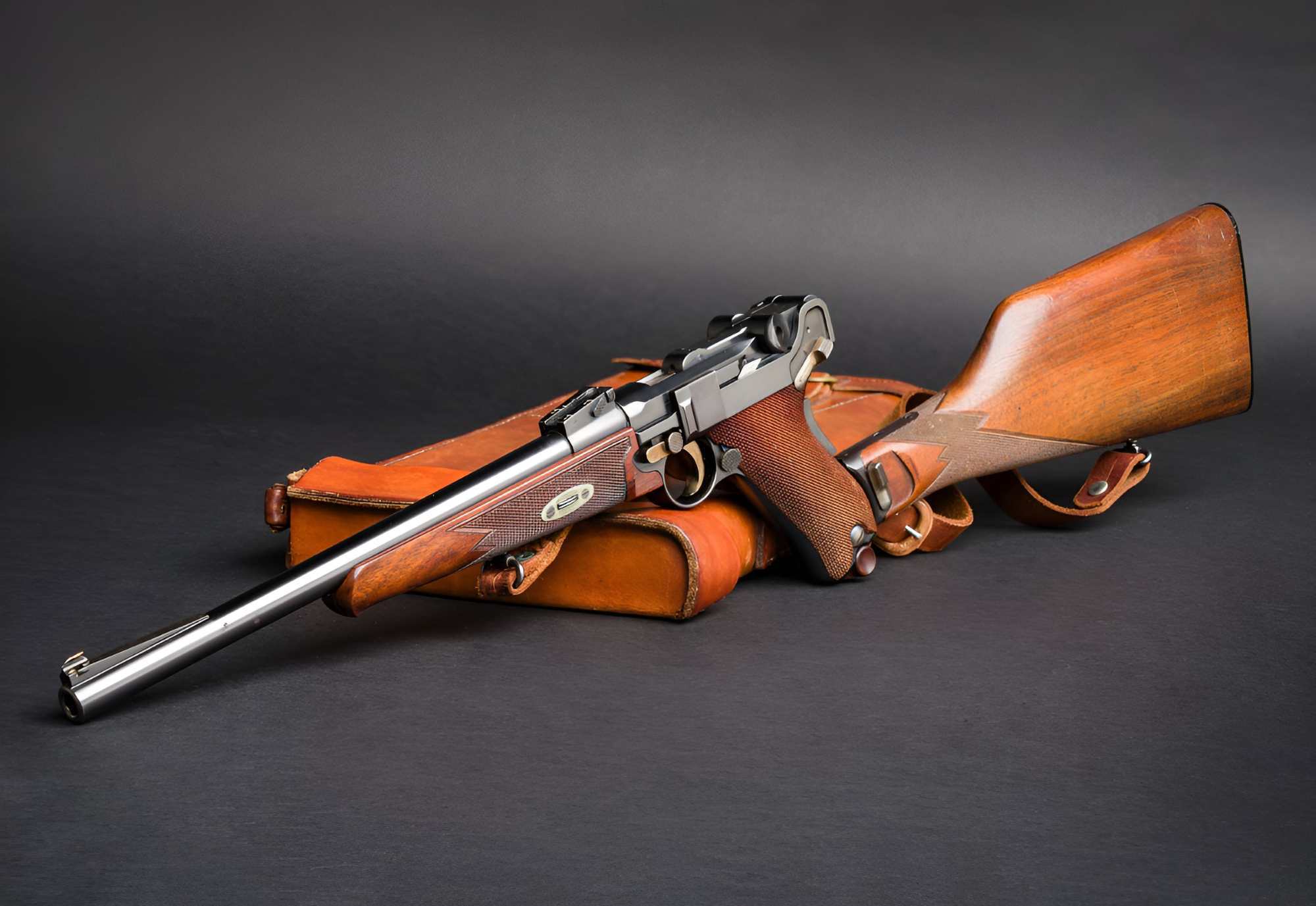

Hermann Historica's Auction No. 109 will take place on November 19 and 20, 2026, starting at 10 a.m. on both days, at the Bavarian auction house's headquarters in Grasbrunn, near Munich. Lots 4001–4887 will be offered on the first day, followed by lots 4888–5727 on the second. Those fortunate enough to visit the auction house in person can preview the lots from November 9 to 13, between 11 a.m. and 5 p.m. Viewing firearms requires an appointment.
We have already devoted a separate article on all4shooters to the extremely rare TARN pistol. This time, our selection focuses on other highlights from the catalog, presented in descending order of starting price.
Engraved Mauser C96 Prewar Commercial
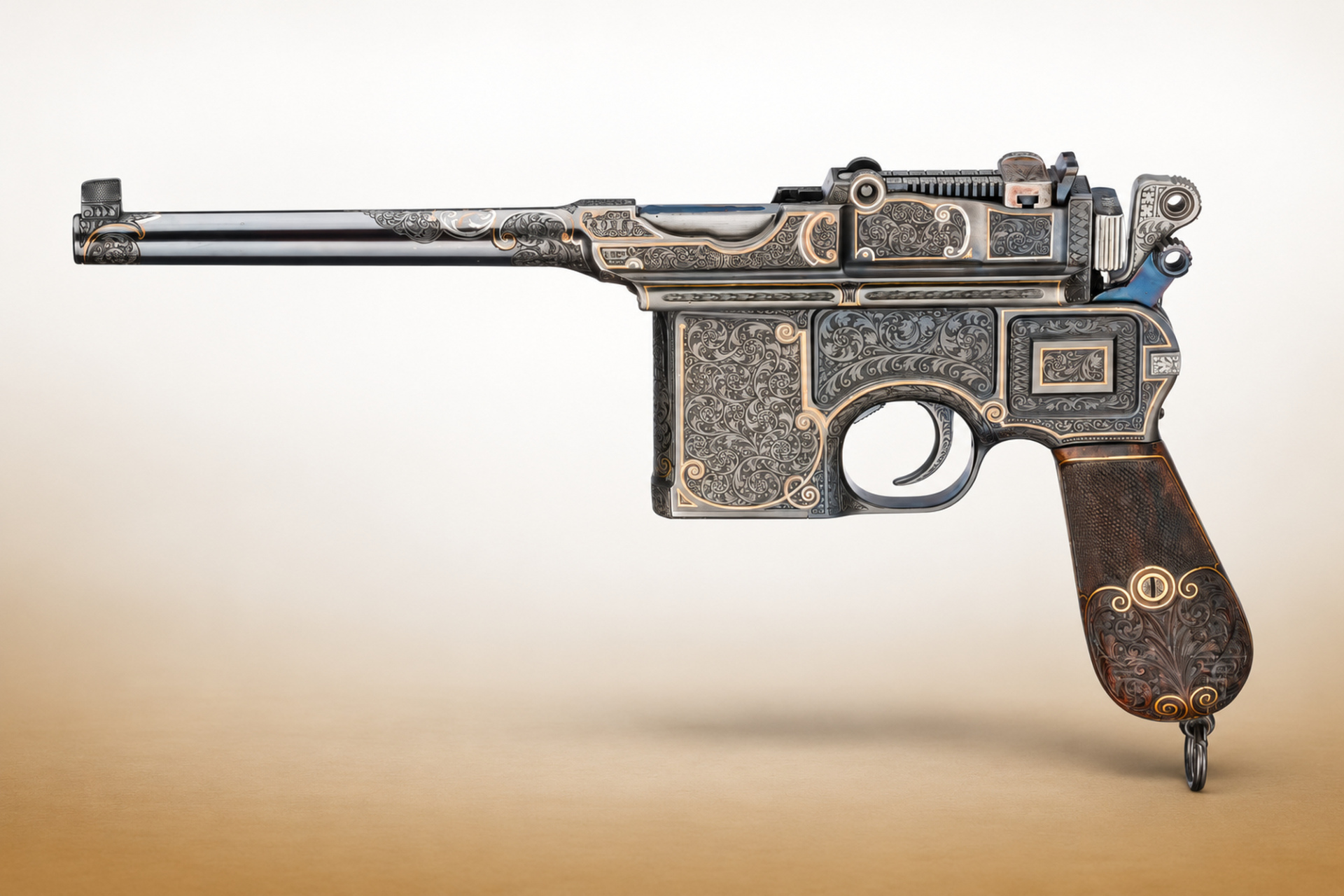
We begin with the pistol carrying the highest starting bid of this auction session. Lot 4384 is a magnificent prewar Mauser C96, combining mechanical craftsmanship with the decorative elegance of period engraving covering all its metal components.
Manufactured in 1913 and chambered in 7.63 mm Mauser, the pistol bears serial number 140567. It is described as being in mint condition, with matching serial numbers and double crown/U proof marks. The fixed magazine holds ten rounds, while the rear sight is graduated from 50 to 1,000 meters. The attachment for a shoulder stock/holster is absent, and the bore is slightly dull.
Scroll engraving extends even to the smaller components, with gold line accents. More than 99% of the blued finish remains, while the hammer and locking block retain their case-hardened finish. The dark walnut grip panels are carved and finely checkered.
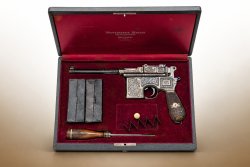
The leather-covered presentation case contains two ammunition pouches and cleaning accessories. This particular pistol is also illustrated in the reference book on the C96 by Kersten, Moll and Schmid. Starting bid: €15,000.
Korth pistol with two conversion barrels
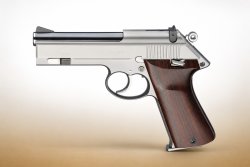
Lot 4374 is a Korth semiautomatic pistol chambered in .40 S&W, accompanied by two conversion barrels allowing it to fire 9mm Luger and .357 SIG ammunition.
The pistol bears serial number 26.07.52, with matching numbers throughout. Its 100 mm (3.9-inch) barrel has a mirror-bright bore and German proof marks. The magazine holds ten rounds, and the trigger mechanism operates in double-action/single-action (DA/SA) mode. A trigger stop, adjustable rear sight and combat-style front sight complete the controls and sighting system.
The frame and slide feature an unusual matte, light-colored plasma coating, while all three barrels have a polished blue finish. The frontstrap is hand-checkered, and both the grip panels and backstrap are made of rosewood.Supplied with a Korth case and spare magazine, this pistol belongs to a limited production run of just 200 examples. Starting bid: €13,500.
Russian Contract Winchester Model 1895
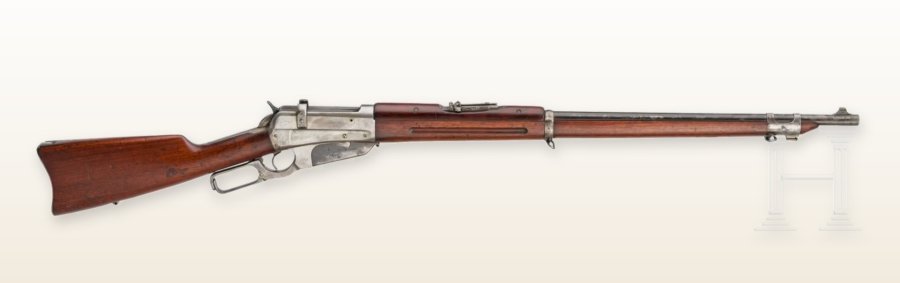
During World War I, Russia faced an enormous demand for rifles, as domestic production could not keep pace with losses at the front. In 1914–1915, the Russian government signed a contract with Winchester for approximately 300,000 Model 1895 rifles chambered in 7.62×54R. According to historical sources, Winchester delivered approximately 294,000 rifles before the Russian Revolution of 1917. Lot 5187 is a Russian Contract Winchester Model 1895, Model 1915, chambered in 7.62×54R and bearing serial number 114920B. The barrel measures 71 cm (28 inches), with an overall length of 118 cm (46.5 inches). The auction catalog notes the absence of valid proof marks. The left side of the receiver carries the manufacturer's name and patent information, while the tang bears the model and manufacturer markings. The inscription "7.62 M.M." is also present. The tangent rear sight has a graduated scale marked from 15 to 32. Russian acceptance marks appear on the right side of the receiver and stock. The dark walnut furniture shows a repair on the left side of the fore-end. The steel buttplate covers an empty storage compartment, and the rear sling swivel is missing. Starting bid: €7,500.
Grässle Ferlach double rifle with Hensoldt Diapi scope
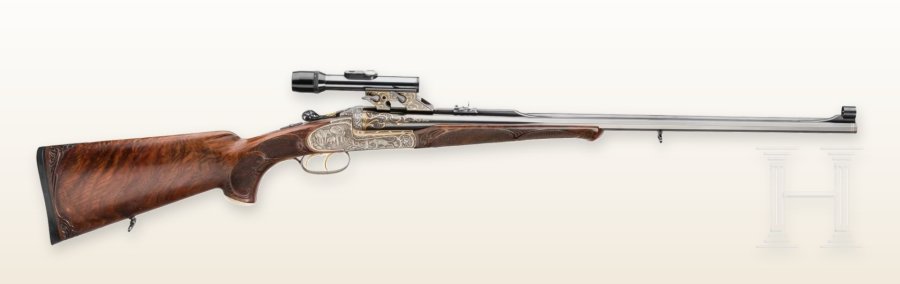
Lot 4118 is a Grässle side-by-side double rifle made in Ferlach, Austria, chambered in .375 H&H Magnum and bearing serial number 27746. Its 65 cm (25.6-inch) barrels have mirror-bright bores, with valid proof marks dating from 1987. The rifle, intended for African big-game hunting, has an overall length of 108 cm (42.5 inches).
The locking system combines two underlugs with a Greener-type crossbolt, while the barrels have individual ejectors. The steel action features sidelocks and a tang-mounted safety. Both triggers are gold-plated, and the front trigger incorporates a set-trigger mechanism. The dark walnut stock has a German-style cheekpiece, horn pistol-grip cap and rubber recoil pad. Raised engravings with gold inlays depict scenes of African wildlife.
The rifle is fitted with a compact Hensoldt Diapi 2.5×15 scope with a No. 1 reticle. There is a slight dent on the right edge of the eyepiece. The length of pull measures 38.5 cm (15.2 inches). Starting bid: €7,000.
Blaser R8 hunting rifle with Zeiss scope
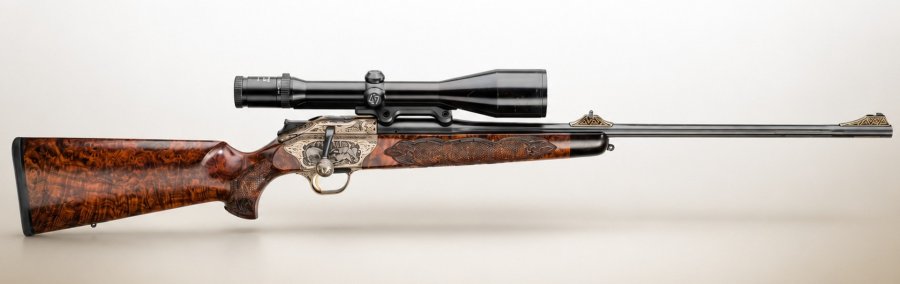
Contemporary hunting rifles from Central European manufacturers regularly command impressive prices at auction, and lot 4126 offers another example: a richly engraved Blaser R8 chambered in .300 Winchester Magnum.
The rifle bears serial number R/018212 and valid proof marks dated 2011. Its fluted barrel measures 60 cm (23.6 inches) and has a mirror-bright bore. The Blaser action uses the company's radial collet locking system. Express-style iron sights include a rear sight with a white insert and a post front sight. The elaborate engravings depict wolves with a fallow deer and bears fighting over a stag.
The selected figured walnut stock features fish-scale checkering, carved decorations and a German-style cheekpiece. A horn fore-end tip, engraved pistol-grip cap and rubber recoil pad complete the furniture.
The rifle is equipped with a Zeiss Diavari-ZM 3–12×56 T* scope with a No. 4 reticle, fitted using a MAK mount. The scope tube shows minor scratches. Overall length is 110 cm (43.3 inches), with a length of pull of 38 cm (15 inches). Starting bid: €6,500.
Nedbal-Luger pistol in .45 ACP
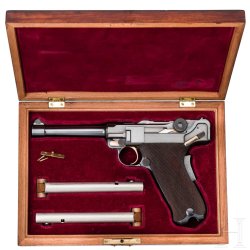
The Nedbal-Luger offered as lot 4629 brings back one of the great holy grails of military handgun collecting: the legendary .45 ACP Luger.
This particular example bears serial number 008, with matching numbers throughout. The bore is mirror-bright, and the pistol carries Austrian proof marks.
The rear toggle link is marked "NK," identifying the maker of this replica: Karl Nedbal, the Austrian gunsmith widely known among collectors of historical firearms as the "Master of Conversions." According to the auction catalog, Nedbal built only a handful of these pistols. CNC machining was complemented by painstaking hand-fitting.
The pistol comes in an oak presentation case lined with red cloth. The case shows minor damage, and a spare magazine is included. Starting bid: €6,000.
Fischer of Schaffhausen percussion revolving rifle
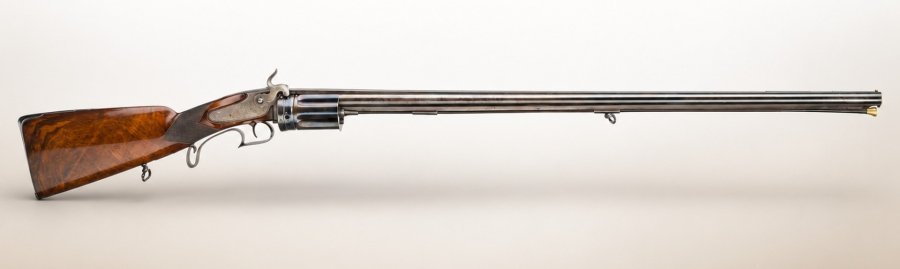
Lot 4018 is an unusual percussion revolving rifle dating from approximately 1840.
The lockplate bears the signature "J.C. Fischer Schaffhausen," and the rifle is marked with serial number 21. It is a .55-caliber black-powder firearm, with a 75 cm (29.5-inch) barrel and an overall length of 124 cm (48.8 inches).
The fluted cylinder has five chambers and retains traces of its original bluing. The percussion nipples are missing, and two shields protect the chambers at the front and rear.
The barrel has been reblued, and the hammer shows a small crack. The action retains its original case-hardened finish, while the ramrod is a later addition. The dark, figured and varnished stock features fine checkering and a German-style cheekpiece.
The auction catalog notes minor alterations and assigns the rifle an overall condition grade of I–II. According to research conducted by Hermann Historica, no other comparable examples are known. Starting bid: €5,400.
Before the modern era: Arms, armor and antique firearms
The modern and historical firearms auction will be preceded by a separate two-day sale devoted to arms, armor and antique firearms, scheduled for November 17 and 18, 2026. Among the lots are several edged weapons of exceptional historical and artistic value. Although these fall somewhat outside the subjects usually covered by all4shooters, we could not resist showing you two outstanding examples in all their beauty. We invite you to discover their finer details on the Hermann Historica website.
A shamshir dedicated to Nadir Shah
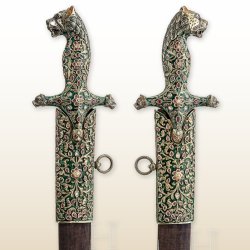
Lot 2235 is a magnificent Persian-Indian shamshir dating from the 18th or 19th century.
According to the auction house, its blade was made for Nadir Shah Afshar, ruler of Persia from 1736 to 1747 and founder of the Afsharid dynasty.
The substantial, slightly curved blade is made of wootz Damascus steel. Its gold-damascened inscriptions include the Basmala, the Islamic invocation "In the name of Allah, the Compassionate, the Merciful," along with a dedication to the ruler. The blade also bears the signature "Asadullah Isfahani," as recorded in the catalog.
The gilt-silver hilt is decorated with enamel, diamonds and rubies. Both the pommel and the ends of the guard terminate in tiger heads. The wooden scabbard is covered in velvet, with matching fittings and two suspension rings. Overall length is 101 cm (39.8 inches), and Hermann Historica assigns it a condition grade of II−. Starting bid: €90,000.
A British saber with a Mamluk blade
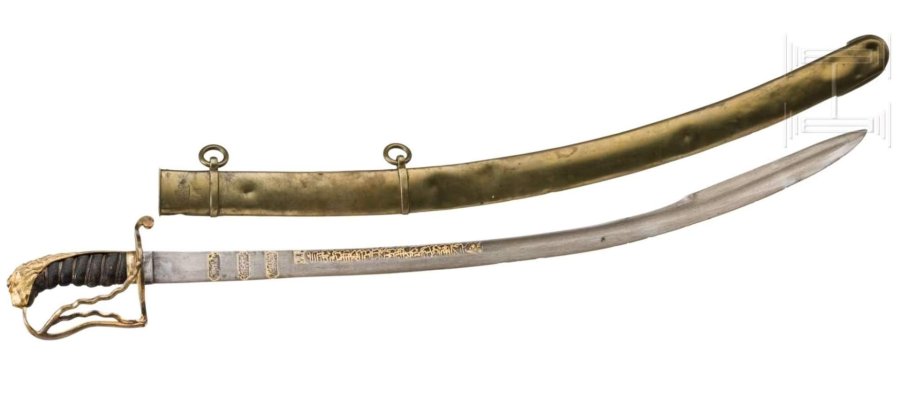
Lot 2144 is an unusual saber combining a Mamluk blade with British fittings.
The blade dates from the late 15th or early 16th century. Slightly curved and single-edged, it has a pronounced false edge. It is made of wootz Damascus steel, with a shallow fuller on each side. Three gold-damascened cartouches include the signature of the master craftsman Haji Sunqur. A Quranic inscription in gold runs along the spine, framed by floral motifs. The lion-head hilt dates from the reign of George IV and retains traces of gilding. The grip is leather-covered, while the brass scabbard shows minor dents. The catalog also notes a baronial coronet with the letter B and the name R. Johnson. The blade measures 83 cm (32.7 inches), with an overall length of 98.5 cm (38.8 inches). The condition is graded II. Starting bid: €40,000.
Information for U.S. buyers: How to bid and import purchased firearms
American collectors can participate in Hermann Historica auctions without traveling to Germany. The auction house accepts advance absentee bids, live online bidding and telephone bids, all subject to registration. Those wishing to attend in person can bid at the saleroom in Grasbrunn, although bidding on firearms may require additional documentation and authorization. Registration instructions are available on the Hermann Historica website. The November 19–20 firearms auctions begin at 10 a.m. Central European Time, corresponding to 4 a.m. Eastern and 1 a.m. Pacific Time.
The listed starting prices are not the final purchase prices. Hermann Historica currently charges a buyer's premium of 29.5% of the hammer price, including German VAT. Additional charges may apply when bidding through third-party platforms, while payment processing, shipping, insurance, export documentation and import-related expenses must also be considered. Successful bidders receive an invoice from the auction house. Unsold lots may subsequently be offered for purchase through its post-auction sale.
U.S. firearms purchasers should verify import eligibility before placing a bid. As of January 1, 2026, Hermann Historica's former U.S. importer no longer provides import services. US buyers must arrange the importation themselves through an appropriate U.S. FFL, coordinating shipment with a German exporter. Hermann Historica can provide information about export arrangements but no longer offers its former direct U.S. import service.
Most firearms manufactured after 1898 require an approved ATF Form 6 import permit, and certain firearms may be ineligible for importation under federal law. Genuine pre-1899 antique firearms, such as the Fischer percussion rifle described above, are generally exempt from the Form 6 requirement, provided their age and legal status can be established. German export regulations, U.S. customs requirements and applicable state and local laws must still be observed.
Prospective buyers should therefore confirm the importability of their chosen lot, the necessary documentation and the total cost of delivery with qualified exporters and importers before making a binding bid.
Further information is available through Hermann Historica's official bidding and shipping pages or from its firearms department at guns@hermann-historica.com.
For more information, visit the Hermann Historica website.