

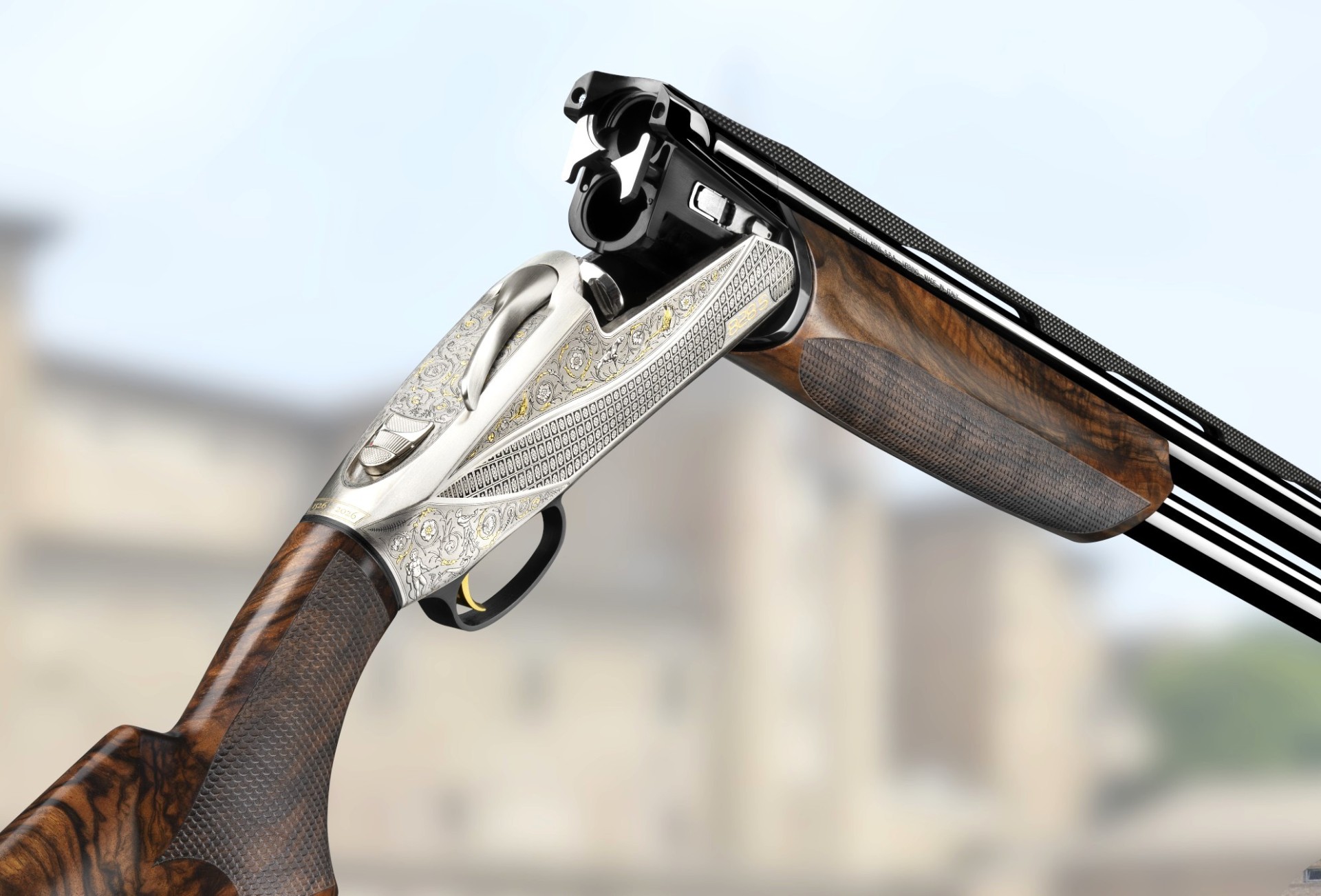
Ingenuity through evolution: how the Benelli 828 S rewrites the future during Beretta's fifth century
In 2026 the global firearms industry celebrates an unprecedented milestone: five centuries of uninterrupted activity by Fabbrica d'Armi Pietro Beretta. On 3 October 1526 Bartolomeo Beretta received payment from the Arsenal of the Republic of Venice for 185 arquebus barrels. Five hundred years later, the company is still the world's oldest firearms manufacturer and one of the finest expressions of Italian engineering, craftsmanship and industrial continuity.

Celebrating Beretta's quincentenary, however, is not simply about looking back. Within the industrial universe that has grown around the Gardone Val Trompia company, evolution is expressed through the courage to innovate as much as through the preservation of tradition.
It is in this context, that the Benelli 828, first introduced as the U and now developed into the S, finds its true significance. Rather than following the established principles of over-and-under gunmaking, it questioned them from the outset. If Beretta embodies the continuity of a centuries-old tradition, Benelli, founded in Urbino in 1967 and now one of the leading companies within the Beretta Group, represents the determination to redefine the future through engineering innovation. Looking at the 828 S during Beretta's 500th anniversary allows the opportunity to understand how Italian gunmaking continues to evolve through two complementary philosophies: the historic hand and fine craftsmanship of Brescia and the technological vision of Urbino.
The mechanical and geometrical revolution of the 828 U
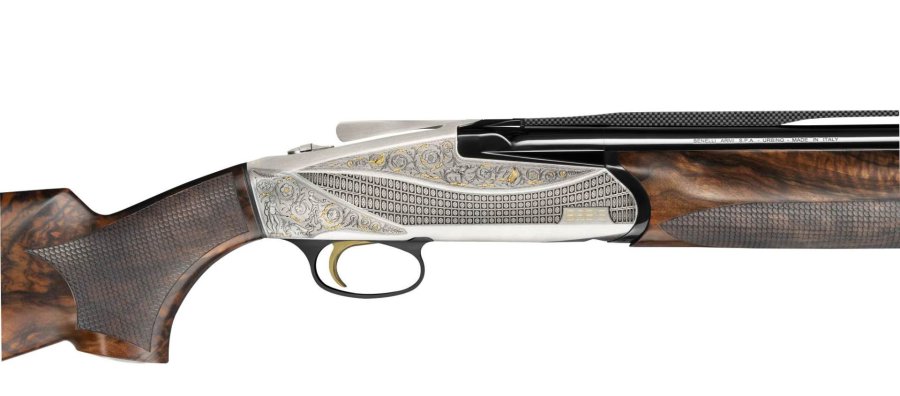
When the Benelli 828 U was introduced, it marked a genuine turning point in the history of break-action shotguns. Until then, the architecture of the over-and-under had remained tied to well-established solutions based on steel or aluminium alloy receivers combined with conventional locking systems. Benelli broke with that tradition by introducing its patented Lock Plate system.
At the heart of the design is a hardened steel locking plate with four locking points engaging directly with the barrel monobloc. When the shotgun is fired, chamber pressure is
contained entirely within this steel-to-steel assembly, virtually eliminating mechanical stress on the receiver. Freed from structural duties, the receiver becomes a lightweight housing for the trigger mechanism rather than a pressure-bearing component. This allowed Benelli's engineers to manufacture it from aerospace-grade Ergal aluminium alloy, keeping the weight of the 12-gauge below the three-kilogram threshold while paving the way for even lighter developments, including the elegant 20-gauge version.
Technical Specifications and Platform Evolution
Feature | Benelli 828 U (12-gauge) | Benelli 828 U (20-gauge) | Benelli 828 S A.I. Woodcock |
Receiver | Anodised/nickel aluminium | Black/silver anodised aluminium | Bronze anodised Ergal |
Locking | Steel Lock Plate | Steel Lock Plate | Lock Plate + Advanced Impact |
Weight | ~ 2.9 k | ~ 2.7 k | ~ 2,45 k |
Barrels | 61 / 65 / 71 / 76 cm | 65 / 71 cm | 61 cm |
Chamber | 76 mm | 76 mm | 76 mm |
The expansion from the original 12-gauge platform to the lighter 20-gauge demonstrated the versatility of the design. In the smaller calibre the shotgun becomes noticeably slimmer and faster handling, making it particularly well suited to walked-up hunting behind pointing dogs. The specialised Woodcock version was developed for hunters requiring maximum pattern spread at short range in dense woodland while minimising fatigue during long days afield.
Advanced Ergonomics: Perfect Fitting

One of the traditional limitations of over-and-under shotguns has always been stock fit. Unlike semi-automatic shotguns, which have long offered shim systems to adjust drop and cast, break-action guns generally required the intervention of a skilled stockmaker. Benelli addressed this issue with the Perfect Fitting system. Taking advantage of the interface between the walnut stock and the aluminium receiver, the shotgun is supplied with a comprehensive shim kit allowing drop and cast to be adjusted through forty different combinations. The result is a natural alignment between the shooter's eye and the carbon-fibre rib, improving instinctive mounting and target acquisition. Complementing this modular geometry is the Progressive Comfort recoil reduction system housed inside the walnut stock. Its flexible polymer elements progressively absorb recoil energy according to cartridge power, reducing muzzle flip, speeding sight picture recovery for the second shot and significantly improving shooting comfort even with heavy Magnum loads
Surface Treatments and Ballistics: The Era of BE.S.T. and Advanced Impact
The evolution of the Benelli 828 naturally extends beyond its mechanical architecture into metallurgy and barrel technologies. Among the most significant innovations is BE.S.T. (Benelli Surface Treatment), a proprietary protective finish combining Physical Vapour Deposition (PVD) and Plasma Enhanced Chemical Vapour Deposition (PECVD). The hybrid layer provides exceptional surface hardness and outstanding resistance to salt, humidity and harsh weather corrosion, dramatically extending barrel life while reducing maintenance requirements both in the field and at home.
Inside the barrels, Benelli's Advanced Impact (A.I.) bore profile further refines ballistic performance. By redesigning the internal geometry, the system optimises gas expansion and pellet travel. Compared with conventional 18.5 mm 12-gauge bores, Advanced Impact delivers higher retained pellet velocity, more uniform patterns with fewer gaps and increased penetration with lead, steel or bismuth shot. These gains are achieved without sacrificing effective pattern opening at short hunting distances, preserving the versatility expected from a modern sporting shotgun
Two Philosophies, One Destiny: Tradition and Innovation in Italian Gunmaking
Comparing the centuries-old tradition of Gardone Val Trompia with the technological vision that emerged from Urbino offers a revealing perspective on the richness of Italian gunmaking. Fabbrica d'Armi Pietro Beretta has spent five centuries refining the art of firearms manufacture, producing classics ranging from the SO-series over-and-under shotguns to its renowned gas-operated semi-automatics and today's lightweight hunting guns. Benelli followed a different path. The 828 was never conceived as another conventional over-and-under, but as a technological alternative capable of challenging long-established assumptions. Its engineering sought practical solutions rather than stylistic exercises, offering the twenty-first-century hunter a fresh interpretation of the sporting shotgun. The coexistence of these two companies within the same industrial group demonstrates that Italian leadership is founded not only on preserving tradition, but also on continually reinventing it. The finest tribute to Beretta's five centuries of history lies in recognising that the same inventive spirit which guided Bartolomeo Beretta in 1526 lives on today in aerospace aluminium, carbon fibre and the innovative Lock Plate system of the Benelli 828.
A Special Edition for Beretta's 500th Anniversary
The Anniversary edition provides the ideal bridge between Benelli's engineering innovation and Beretta's extraordinary historical legacy. More than a commemorative model, it celebrates the dialogue between two complementary visions of Italian excellence: one rooted in five centuries of craftsmanship, the other driven by constant technological research. To understand the inspiration behind this remarkable shotgun, however, it is necessary to leave the workshop for a moment and enter one of the symbolic places of the Italian Renaissance: the Ducal Palace of Urbino.
The Spirit of Urbino
The year was 1463. Under the guidance of Federico da Montefeltro and his half-brother Ottaviano Ubaldini, work began on the expansion of what had once been little more than a medieval fortress. Their ambition was not simply to create a princely residence, but the palace of an enlightened ruler, a place where politics, philosophy, military science and culture could all coexist at the highest level. It was conceived to inspire wonder not only among contemporaries but for generations to come. To realise that vision, one of the great masters of the Renaissance, Luciano Laurana, was entrusted with the project. Around him gathered some of the finest craftsmen of the age, giving life to what remains one of the world's greatest princely residences. Its true greatness lies not merely in its size or daring architecture, later enriched by Francesco di Giorgio Martini, but in the philosophy behind every space and every proportion. The Ducal Palace embodies a coherent vision of knowledge, becoming the very essence of the refined court that flourished within its walls.
The Renaissance of Urbino developed a personality of its own. While Florence looked towards philosophy and humanism, and Venice rediscovered Classical antiquity through art and architecture, Urbino cultivated a profound fascination with science and technology. Piero della Francesca, mathematician as much as painter, perfectly embodied this union of scientific thought and artistic expression. Equally significant were the complementary interests of Federico and Ottaviano. Federico demanded objects that worked, in peace as in war. Ottaviano sought to explore the hidden mysteries of nature and the human spirit, searching for forms capable of connecting the earthly with the infinite.
Nothing illustrates this philosophy more clearly than the marble reliefs decorating the great stone bench in the Cortile d'Onore of the Ducal Palace. There are no cherubs. No nymphs. No pagan gods. Instead, visitors encounter machines: civil machines, military machines, instruments designed to measure, build and transform the world. They celebrate science and technology as the highest expressions of human ingenuity, surrounded by symbols whose meanings continue to fascinate scholars today. This perfect synthesis of artistic beauty and rational thought remains one of the defining characteristics of Urbino's Renaissance.
Benelli and the Soul of Urbino
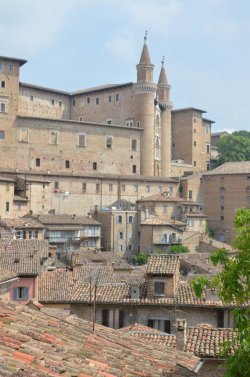
Today one of Urbino's streets is known as Via degli Scienziati. Along it stand commemorative plaques dedicated to some of the city's greatest minds, from the mathematician Federico Commandino to the military architect Girolamo Genga and the celebrated Barocci family of clockmakers, whose precision instruments were used even by Galileo Galilei. Against such a backdrop, it is hardly surprising that Benelli was born in Urbino. The company has always represented far more than a firearms manufacturer. It has been a
workshop of ideas, combining rigorous engineering with technological innovation in a way that reflects the city's own intellectual tradition. The 828 embodies that philosophy from its very name, while the 828 S LE created for Beretta's 500th anniversary takes the concept a step further. Its advanced mechanical heart is clothed in an aesthetic language that goes beyond decoration, becoming a conscious celebration of what makes Made in Italy unique: a culture in which beauty, craftsmanship and technology have never been separate values, but different expressions of the same way of thinking.
The 500th Anniversary Edition
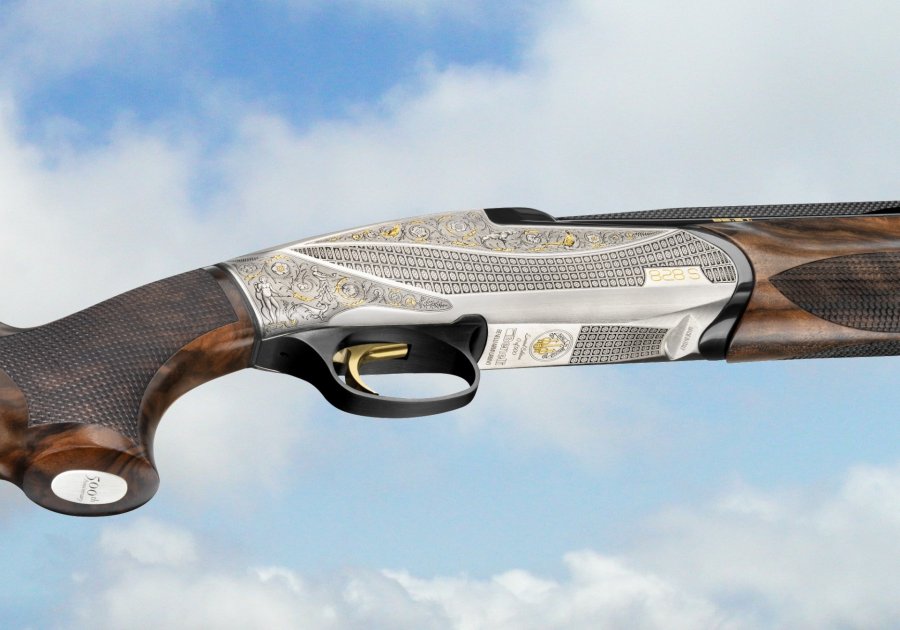
Everything comes together in the Anniversary edition, whose decorative programme revolves around three defining elements. The first is the laser-cut border, meticulously finished by hand. Far more than a simple English-style scroll, it faithfully reproduces the coffered ceiling and rosette motif of the third loggia of the Torricini façade of the Ducal Palace, overlooking the Duke's celebrated Studiolo. More than an ornamental detail, it reflects the philosophical meaning of the palace itself, where architecture becomes a symbolic journey from the material world towards the realm of the spirit. The three superimposed loggias embody this ascent. The lower level, built in exposed Roman brick, represents the Body. Above it, the second loggia, with its blend of Ionic and Corinthian forms, symbolises the Soul through the Chapel of Forgiveness and the Chapel of the Muses. The upper loggia, executed in an evolved Corinthian style, represents the Spirit, opening towards the skyline of Urbino through sweeping volutes and extraordinary views.
The second decorative motif engraved above the border is equally meaningful. Rather than generic floral scrollwork, Benelli faithfully reproduces authentic Renaissance grotesques inspired by those commissioned by the Della Rovere family in 1526 to decorate the Duchess's apartments, particularly the Sala delle Veglie. Their presence establishes a direct visual dialogue between the shotgun and one of the highest artistic expressions of the Italian Renaissance.
The third and perhaps most recognisable element is Gabriele d'Annunzio's famous emblem of the three arrows enclosed within three circles, accompanied by the celebrated motto 'Dare in brocca'. Literally meaning 'to hit the jug', the expression has long come to signify hitting the mark perfectly. Few mottos could better summarise the spirit of this remarkable shotgun.
More Than a Shotgun
The Benelli 828 S LE created for Beretta's 500th anniversary is far more than a commemorative firearm. It succeeds in bringing together engineering, history, art and culture in a way that few sporting arms can achieve. Its Lock Plate system, aerospace-grade aluminium receiver, carbon-fibre rib and Advanced Impact barrel technology express the language of modern engineering. Its engravings tell another story entirely: one of Urbino, the Renaissance, scientific curiosity and the uniquely
Italian ability to unite beauty with function. This is perhaps the deepest connection between Benelli and Beretta. One celebrates five centuries of uninterrupted history; the other demonstrates that innovation itself can become tradition. Together they remind us that the finest Italian sporting arms have never been conceived merely as tools, nor simply as works of art, but as the meeting point between technology, culture and craftsmanship. Perhaps that is why reducing creations such as this to the simple word 'shotgun' somehow seems inadequate.