
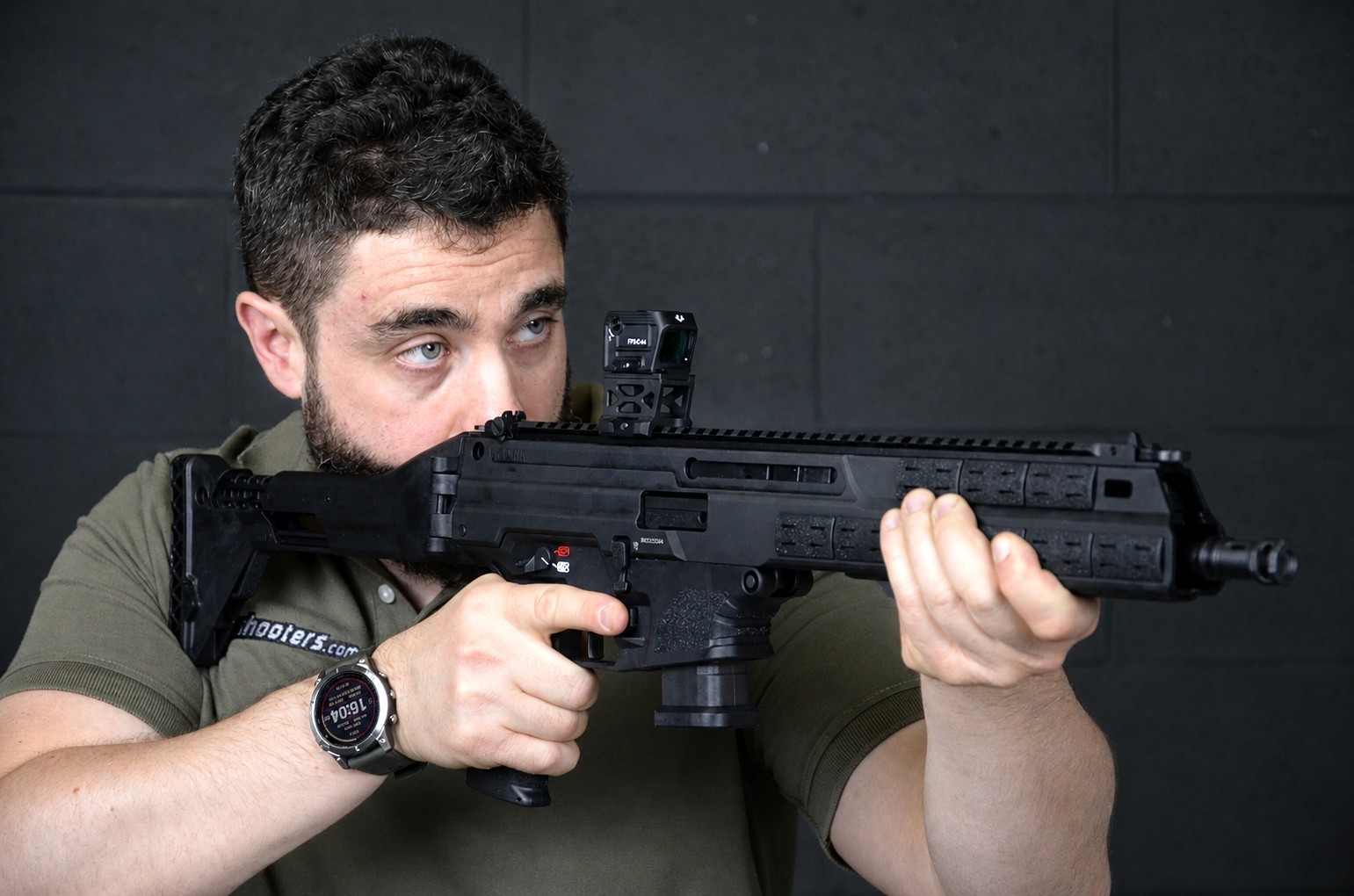
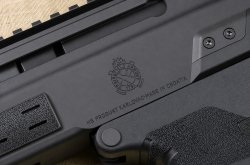
The Springfield Armory Kuna continues the successful partnership between HS Produkt and Springfield Armory not only on handguns, but also rifles - such as the Hellion. Springfield markets the firearm in the U.S., while in EU the gun is distributed under the manufacturer's brand in civilian legal variants that would qualify as SBR in the US: a 12" carbine and a 5.5" pistol.
We emphasize civilian variants because the Kuna was originally developed for military and law-enforcement procurement programs. The original compact model was offered in both 9mm Luger and .40 S&W, with select-fire capability. Military versions are immediately recognizable by their 6.5" barrel equipped with the familiar 3-Lug quick-attach suppressor interface, like the one found on the legendary HK MP5.
Some observers have dismissed the Kuna as little more than a copy of the Grand Power Stribog—much like those who label every striker-fired pistol a "Glock clone" or every black rifle chambered in .223 an AR-15 imitation. While the Kuna certainly shares a few external similarities with the Stribog, such as the bolt design and hybrid iron sights, a closer examination—and, more importantly, time behind the trigger—quickly reveals that it is very much its own firearm.
An interesting side note: "Kuna" is the Croatian word for marten, the country's national animal and the namesake of Croatia's former currency before adoption of the euro. We first had the opportunity to see the Kuna at Enforce Tac 2025, where it made its public debut.
Video: Springfield Kuna at Enforce TAC 2025
The Elephant in the Room: Roller-Delayed Blowback
Let's begin with the Kuna's defining technical feature. Instead of the simple blowback operating system found on the vast majority of today's PCCs, the Kuna employs a roller-delayed blowback action.
If that immediately makes you think of Heckler & Koch, you're not alone. There is, however, a significant difference. While the HK MP5 and G3 use two laterally positioned rollers, the Kuna relies on a single horizontally mounted roller, a solution more akin the Grand Power Stribog than the classic HK system.
So how does it work?
The roller momentarily delays rearward bolt movement after firing, at the same time accelerating the bolt carrier at a higher speed, allowing chamber pressure to drop to safe levels before the bolt is pulled back by the carrier in its rearward travel . Because part of the recoil impulse is mechanically delayed, the system can use a significantly lighter bolt than a conventional straight-blowback design, which relies almost entirely on bolt mass to keep the action closed.
The result is a lightweight firearm with noticeably reduced felt recoil and muzzle rise, smoother cycling, improved controllability, and excellent suppressor compatibility.
Aluminum and Polymer: Lightweight Without Compromise
From the moment you pick it up, the Kuna gives the impression of being a very well-built firearm.
Its construction centers on two main assemblies: a glass-fiber-reinforced polymer lower receiver mated to a monolithic Type III hard-anodized aluminum upper receiver.
Field stripping follows a procedure familiar to AR-pattern rifle users. After pushing out the rear takedown pin, the upper receiver swings open while remaining attached by the front pivot pin. The bolt assembly can then be withdrawn from the rear of the upper and easily disassembled into its primary components.
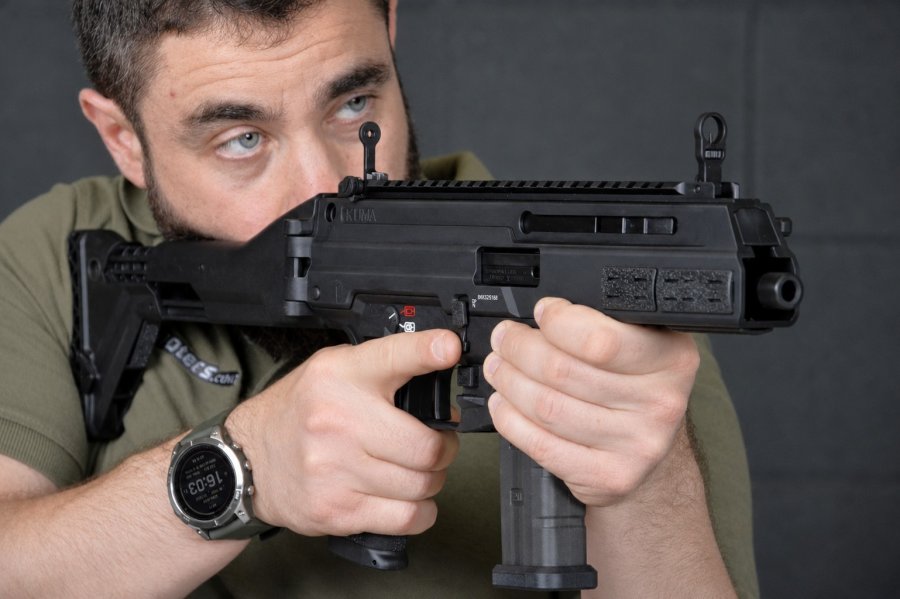
The pistol grip is AR-15 compatible, featuring a relatively vertical grip angle and an aggressive texture. The same textured surface is also applied around the magazine well and to the rounded polymer covers that protect the numerous M-LOK accessory slots located along the front portion of the upper receiver.
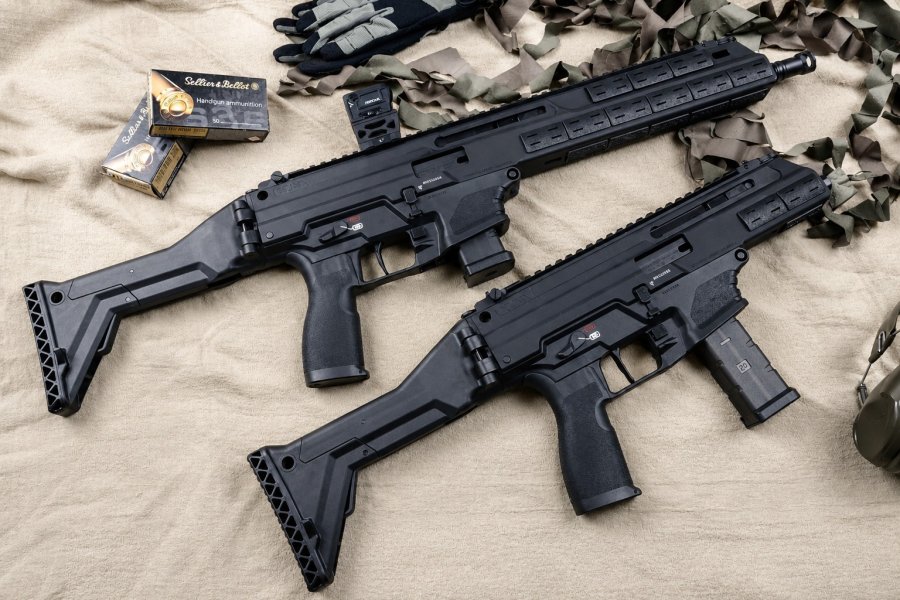
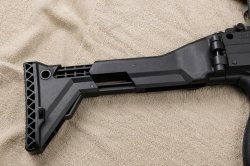
Both European civilian models, due to different EU legislation, are equipped with a practical three-position adjustable buttstock (plus the fully collapsed position), positioned low enough to provide an excellent cheek weld when using the factory iron sights.
Unfortunately, in the US, only the Pistol version with a 6” barrel is available (in a variety of configurations, both in 9mm and .40S&W) directly from Springfield Armory with the optional Strike Industries FSA stabilizing brace.
On the 5.5" model, in EU also classified as a pistol, the stock folds to the right side, significantly reducing the firearm's overall length. On the 12" carbine, classified as a rifle, however due to the barrel being over 30cm, the stock is fixed in the open position to comply with local legal requirements (rifles cannot be less than 60cm - 23,5"). Interestingly, you can find both of these guns as tested on Springfield Armory’s website on the Kuna Pistol page, listed as ‘International Only’ firearms.
At the rear of the upper receiver, quick-detach sling attachment sockets are provided on both sides.
Fully Ambidextrous... Almost
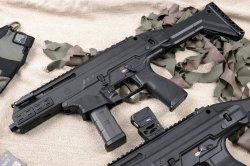
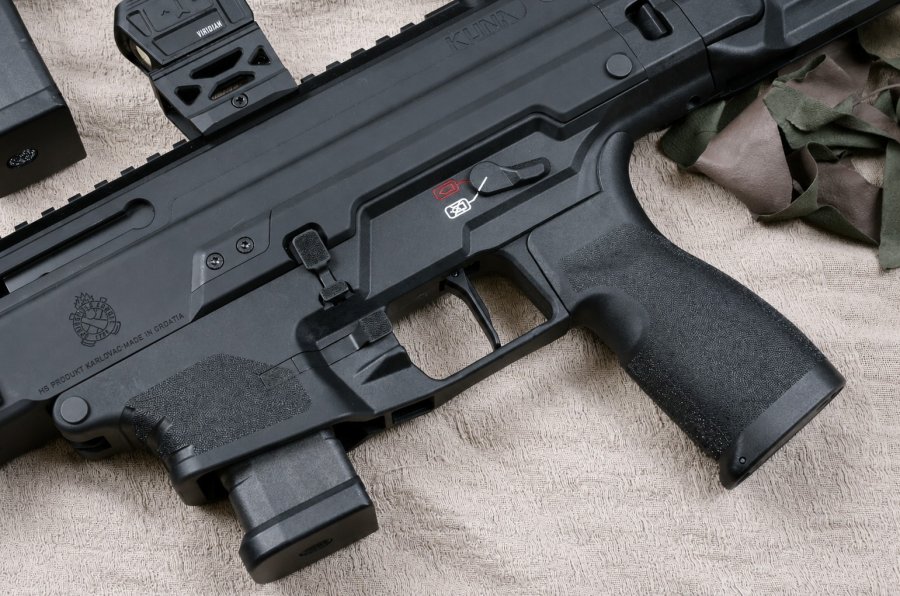
The safety selector, magazine release, and bolt release are all fully ambidextrous, thoughtfully positioned, and highly intuitive to operate. Their layout will feel immediately familiar to AR-platform users, requiring only minimal adaptation.
The primary difference is the non-reciprocating forward-mounted charging handle, which can be quickly reversed for right- or left-handed shooters. When not in use, its folding handle tucks neatly against the receiver to minimize the risk of snagging on gear or clothing.
The only real compromise for left-handed shooters is the right-side-only ejection port.
Civilian Barrels: Threaded and Ready
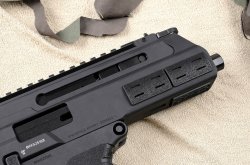
The compact model features a 5.5" (140 mm) cold hammer-forged barrel, while the carbine is fitted with a 12" (301 mm) barrel.
Both feature a 1:10" twist rate and receive a durable Melonite surface treatment for enhanced wear and corrosion resistance.
Unlike the military models equipped with the 3-Lug suppressor/flash hider interface, both civilian versions terminate in the far more familiar 1/2×28 muzzle thread.
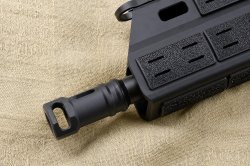
The pistol ships with a simple thread protector, while the 12" carbine is fitted with a multi-port muzzle brake.
Hybrid Iron Sights for Every Scenario
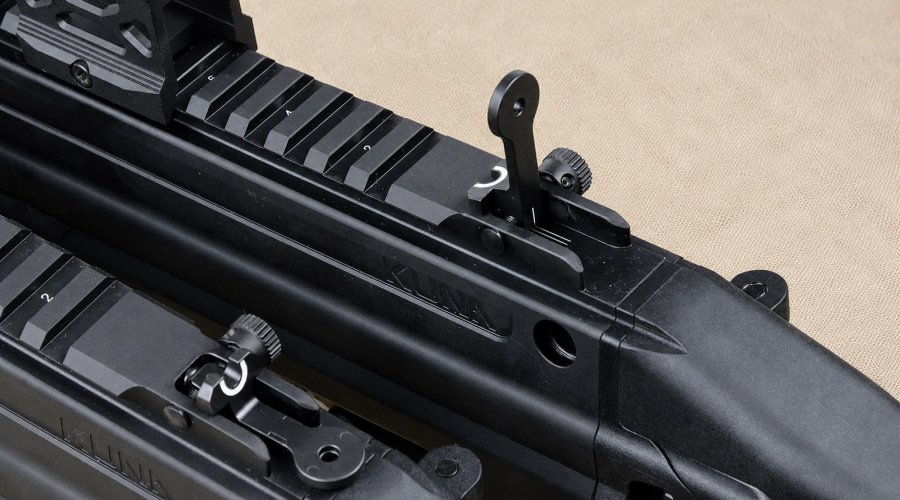
Despite providing a full-length Picatinny optics rail, HS Produkt also equipped the Kuna with one of the most versatile iron-sight systems currently found on a PCC.
Rather than simple backup sights, the Kuna offers two distinct sighting systems integrated into the same folding assemblies.
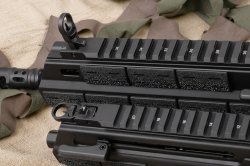
With the sights folded, the shooter uses a white-dot front sight paired with a white U-notch rear sight, creating a fast, instinctive sight picture reminiscent of a service pistol and well suited for close-range engagements.
Flip the sights upright, however, and they transform into a much more accurate system consisting of a front post and a rear aperture (diopter). The front sight is adjustable for elevation, while the rear peep sight is adjustable for windage, providing the precision expected for longer-range shooting.
A Surprisingly Good Trigger
Considering its military origins, the Kuna's trigger is one of the firearm's biggest surprises.
While naturally exhibiting a slightly longer and softer pull than a dedicated competition trigger, it offers a clean break, an excellent reset, and a well-designed flat aluminum trigger shoe that makes rapid, accurate shooting remarkably easy.
Proprietary Magazines... Done Right
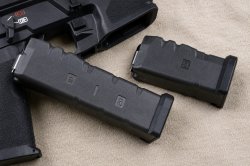
The Kuna is fed from proprietary magazines available in 10-, 20-, and 30-round capacities.
The 10- and 20-round magazines retain the straight-body profile of the original .40 S&W 30-round design, while the 30-round 9mm magazine features the familiar curved profile of the military version.
All magazines are molded from translucent polymer, making it easy to check the remaining ammunition at a glance, while steel feed lips ensure long-term durability and reliable feeding.
On the European commercial market, the 5.5" pistol ships with a 20-round magazine, while the 12" carbine includes a 10-round magazine. This makes practical sense, as the shorter magazine is much more convenient when shooting the carbine from a bench or bipod - and the fact that larger magazines are only availble to LE and Shooting Sports competitions.
The magazine interface is obviously the same for any Kuna version.
Some shooters may wonder why HS Produkt opted for proprietary magazines instead of using an existing pattern such as the Colt SMG magazines found in the Springfield Armory SAINT Victor PCC. Fortunately, there is little reason to complain: Kuna magazines are readily available and very competitively priced.
On the Range with the Springfield Armory Kuna
We tested both Kuna variants at the Italian distributor's indoor range -Bignami - using Sellier & Bellot 124gr FMJ ammunition.
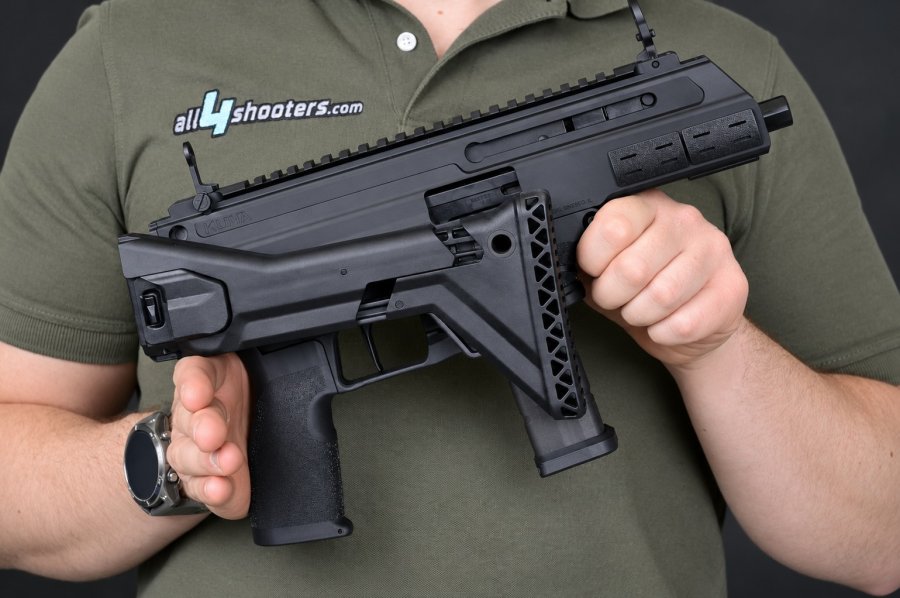
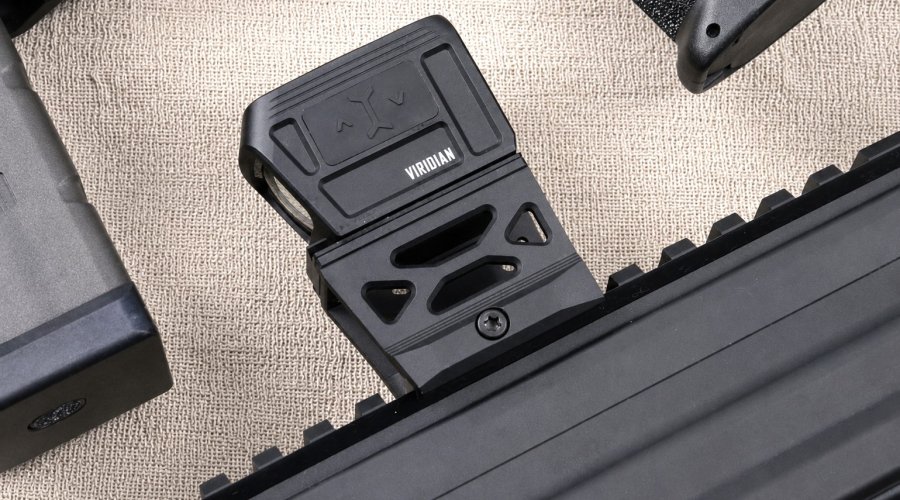
The 12" carbine was equipped with a Viridian RFX44 green-dot sight, while the 5.5" pistol was fired primarily with its factory iron sights. After only a few magazines, we found ourselves using the sights in their upright aperture configuration, as the folded pistol-style sights proved somewhat too coarse for precision target shooting.
Shooting the Kuna is exceptionally enjoyable.
The roller-delayed operating system performs exactly as intended, noticeably softening recoil and making the firearm significantly easier to control than a conventional straight-blowback PCC. Granted, the 9mm Luger cartridge is hardly punishing even in simpler platforms, but the Kuna reduces shooter fatigue, allowing the user to concentrate more fully on fundamentals while making extended range sessions even more enjoyable.
Throughout our test, reliability was flawless, with no malfunctions of any kind.
The compact 5.5" model, in particular, proved difficult to put down. It is simply one of those firearms that immediately makes you want one of your own—especially considering its surprisingly accessible price.
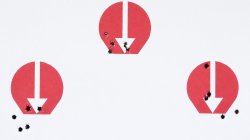
Our groups confirmed the Kuna's excellent intrinsic accuracy, exceeding what could realistically be exploited with either the factory iron sights or, at longer distances, even the red-dot optic. Competitive shooters may therefore want to consider fitting the 12" carbine with a Low Power Variable Optic (LPVO) to fully exploit the platform's potential.
What Is the Kuna Designed For?
True to its military origins, the 5.5" Kuna proved to be an outstanding Personal Defense Weapon (PDW). Compact, lightweight, and exceptionally reliable, it is ideally suited for confined spaces, vehicle operations, and all the roles expected of a modern PDW.
In the United States, Springfield Armory markets it as an ideal vehicle firearm for situations requiring more capability than a concealed-carry handgun. In Europe, however, the Kuna also makes an excellent choice for the recreational or competitive shooter, while offering another significant advantage: it encourages frequent training.
Compared with centerfire rifle calibers, 9mm Luger is considerably more affordable to shoot, and many indoor ranges that prohibit rifle cartridges readily allow pistol calibers. Added bonus, you’re allowed to shoot steel in any range with 9mm too. Moreover, the reduced risk of excessive overpenetration makes the Kuna an attractive option for home-defense applications where legally permitted.
Does the 12" Carbine Make Sense?
The 12" civilian carbine, developed specifically for the commercial market, retains virtually all of the qualities that make the compact Kuna so appealing. Its only real compromise is increased overall size, made somewhat more noticeable by the fixed stock required under current European regulations – by a mere 1mm of the barrel!
And it was on purpose too.
Even so, the longer version fills an important niche. It is an excellent option for shooters who prefer a shoulder-fired firearm while maintaining ammunition commonality with their 9mm handguns, or for those whose local range restrictions effectively limit them to pistol calibers.
One could debate whether a muzzle brake is truly necessary on a 9mm Luger carbine, but regardless, it does contribute to reducing muzzle movement during slow, supported shooting from the bench.
Accessories Define the Mission
Like most modern PCCs, the Kuna is designed as a highly modular platform.
In addition to its full-length Picatinny rail, it offers an abundance of M-LOK mounting slots, allowing shooters to tailor the firearm to a wide variety of roles.
On the 12" carbine, accessory space is plentiful. The compact 5.5" model, however, requires somewhat more careful planning to avoid compromising the usable gripping surface of the short handguard. A hand stop or vertical foregrip can be particularly beneficial, helping prevent the support hand from drifting too close to the muzzle. Alternatively, many shooters may simply find it more comfortable to place their support hand around the magazine well.
LPVO or Red Dot?
Choosing the right optic ultimately depends on how the Kuna will be used.
For dynamic shooting on bays or practical ranges, a red-dot sight is the obvious choice, allowing rapid engagement of multiple close-range targets.
For traditional square-range shooting, however, the 12" carbine arguably benefits more from a quality LPVO, whose magnification and reticle can fully exploit the platform's excellent mechanical accuracy. Adding a bipod further enhances its capabilities as a precision-oriented PCC.
For home-defense applications, where legal, pairing a red-dot sight with a high-quality weapon light remains the most practical configuration.
Technical Specifications
Manufacturer: | HS Produkt – Springfield Armoury | |
Website | ||
Model | Kuna Pistol | Kuna Carbine |
Caliber | 9x19 mm Luger | |
Overall Length | 360 mm (14.2") / 546-591 mm (21.5"-23.3") | 743-788 mm (29.3"-31.0") |
Barrel length | 5.5" (140 mm) | 12" (305 mm) |
Width | 55 mm (2.2") | |
Height (without magazine) | 197 mm (7.8") | |
Sight radius | 255 mm (10.0") | 415 mm (16.3") |
Standard magazine | 20 rounds | 10 rounds |
Weight (without magazine) | 2.1 kg (4.6 lbs) | 2.7 kg (6.0 lbs) |
Weight (with empty magazine) | 2.2 kg (4.9 lbs) | 2.8 kg (6.2 lbs) |
Trigger pull | 25-35 N | |
| MSRP (Europe) | € 1.449,00 | € 1.709,00 |
In the US, MSRP for the Kuna pistol with 6” barrel is $1179 without brace and $1330 with the Strike Industries FSA brace.