

For a long time, things were fairly simple in Western movies: villains in black hats fired essentially the same guns as the heroes in light-colored hats. Most often, these were revolvers patterned after the Colt 1873 Single Action Army, lever-action rifles such as the Winchester 1892, and breechloading rifles along the lines of the Springfield 1873 Trapdoor.
There were practical reasons for this. First, enough original examples of these firearms were available to use as movie props. Second, for safety reasons, film crews soon began using blank cartridges developed specifically for their work, and these were primarily tailored to those three types of firearms. Third, this allowed productions to keep prop-gun logistics as simple as possible. And fourth, everyone involved already knew how these guns worked and understood their particular characteristics.
Understandable as that may be, it has always frustrated Western enthusiasts who care about historical accuracy. The problem is not only that many movies used, and still use, firearms that did not yet exist when the story was supposedly set. This simplification also fails to reflect the true variety of firearms available at the time.
Colt was far from the only revolver manufacturer: Remington, Smith & Wesson, Rogers & Spencer, Starr, Forehand & Wadsworth and Merwin, Hulbert & Co. were also part of the American market. Winchester likewise had plenty of competitors in the lever-action field, including Marlin, Whitney and Bullard. And when it came to metallic-cartridge breechloaders, manufacturers such as Sharps, Remington, Ballard, Savage and Stevens, or Maynard, offered still more alternatives.
Precisely because of this growing demand for historical authenticity, some film productions, especially Westerns, began paying closer attention to period-correct firearms. From the late 1950s onward, they increasingly turned to manufacturers of historical reproductions, a sector that was itself becoming more important.
Uberti: one of the first suppliers of Western replicas to the movie industry
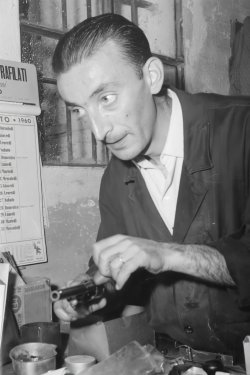
Aldo Uberti was one of those companies. Based in the firearms-manufacturing district around Brescia, it is not only one of the oldest replica makers, but was also among the first to supply its firearms to movie productions, particularly the Westerns of Sergio Leone.
Uberti is also a company that has taken the idea of diversification in its Neo-Classics line unusually far, as the prototype featured here once again demonstrates. In addition to a broad range of reproductions of Colt, Winchester and Remington firearms, the company also offers the only current-production replicas of Smith & Wesson’s American and Russian top-break revolvers, as well as the Colt-Burgess Model 1883 lever-action rifle.
What about the rest of the market? For several years, Western enthusiasts had begun to feel that the well had finally run dry. That did not mean there were no more historically interesting firearms worth reproducing. A Merwin, Hulbert & Co. Pocket Army, for example, would certainly have its fans, as would one of the many pocket revolvers that appeared in the American West in the wake of the worldwide success of Webley’s “British Bull Dog.” The usual answer, however, was that demand would be too limited to justify the cost of developing and producing such replicas. So, nothing new unless it was another variation of an existing model? Not quite.
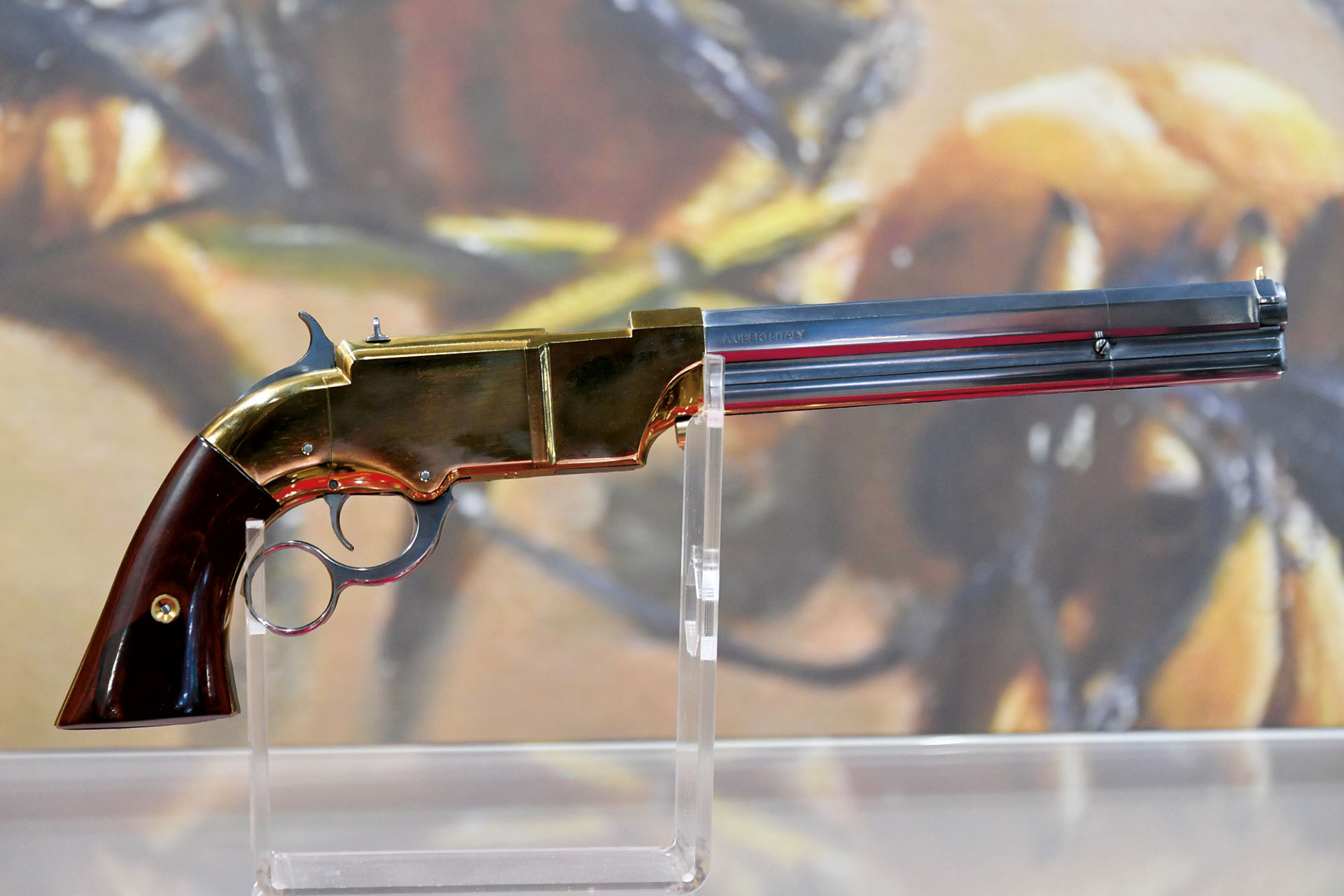
At trade shows this March, including the European Outdoor Show (EOS) in Parma, Uberti dropped something of a bombshell. Company president Giacomo Merlino showed us a particularly unusual prototype: an underlever repeating pistol from the Volcanic family. At first glance, that might sound like just another historic design that had somehow escaped the replica market. In principle, that is true, but there were good reasons why manufacturers had left the Volcanic alone. Those reasons lie mainly in the design of the firearm itself and, even more importantly, in the ammunition for which the originals were built. To understand why Uberti’s project is so unusual, we need to go back to the beginning.
So nothing new, unless it’s a variant of a model that’s already been launched? No. Because back in March, at trade fairs such as the European Outdoor Show (EOS) in Parma, a real bombshell dropped. On that occasion, Giacomo Merlino, president ofUberti, presentedus with a special prototype: a bottom-lever repeating pistol from the Volcanic series. Right, you might say, so what? It was simply another model that had been overlooked until now. In principle, that’s true, but there were valid reasons for ignoring it. These relate to the design of this type of firearm and its ammunition. To understand this better, it’s worth taking a look back at history.
The history of the Volcanic: the dawn of repeating pistols
Experiments with repeating firearms fed from tubular magazines were already underway in the 17th and 18th centuries, when wheel-lock and flintlock ignition systems were still in use. These designs, however, were extremely delicate, mechanically complicated and, because their magazines had to handle separate ammunition components, often far from safe. The concept gained new momentum in the late 1840s when Belgian inventor Charles Fusnot introduced his revolutionary “loaded bullet”: a lead projectile with a cavity in its base containing both the powder charge and the priming compound. Fusnot did not patent his invention until 1855, but an exhibition catalog from 1847 shows that he had already developed this type of projectile by then. Nevertheless, his name largely disappeared from the later story, which instead became associated with an American inventor long credited with creating this early form of caseless ammunition: Walter Hunt, also known as the inventor of the safety pin. In 1848, Hunt received U.S. Patent No. 5,701 for what he called a “metallic cartridge.” He incorporated the concept into a repeating firearm he named the Volition Repeater. His assignee, essentially the project’s financial backer, George A. Arrowsmith, eventually received a patent for the gun on August 21, 1849, after nearly two years of waiting. The patent was titled “Combined Piston Breech and Firing Cock Repeating Gun.” In practical terms, Hunt had devised a tubular-magazine repeater together with the ammunition it needed. His projectile was hollowed out at the rear to hold the powder charge, then closed with a perforated cork disk and a thin paper cover so that the flame from a separately inserted primer could reach the powder.And, in the finest tradition of American advertising, Hunt did not settle for a dry technical description such as “loaded bullet.” He called it the Rocket Ball.
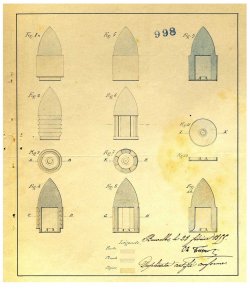
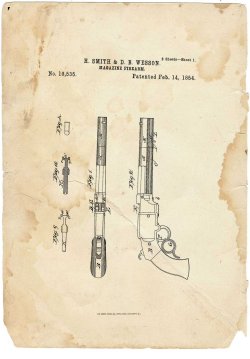
The Rocket Ball itself explains why the American firearms designed around it in the mid-19th century have never been reproduced faithfully. Around 1850, the idea of a “loaded bullet” was certainly attractive: it simplified the complicated handling of loose powder, projectiles and primers, made loading easier and seemed to promise reliable, high-capacity repeaters.
What followed did not immediately solve those shortcomings. Working on Arrowsmith’s behalf, technician Lewis Jennings refined the Volition Repeater and laid the groundwork for the work of Horace Smith, Daniel Wesson and Benjamin Tyler Henry.
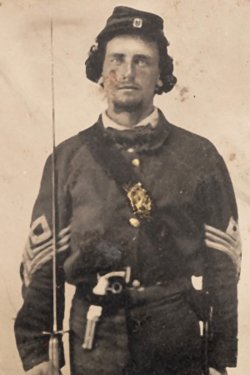
Beginning around 1850/51, Smith’s experiments eventually led, with the involvement of Daniel Wesson and financier Courtland Palmer, to the founding of the Smith & Wesson Company in 1854. They also produced a new type of firearm: repeating pistols with tubular magazines, exposed hammers and a movable trigger guard fitted with a ring-like extension. Operating that lever fed the next round and cocked the action.
The company called these handguns Volcanic pistols. By this stage, the Rocket Ball had also evolved to incorporate its own primer.
None of the Smith & Wesson Volcanic pistols, produced in two models and in .31 and .41 calibers, served directly as Uberti’s pattern gun. Those early S&W examples generally had blued barrels and steel frames.
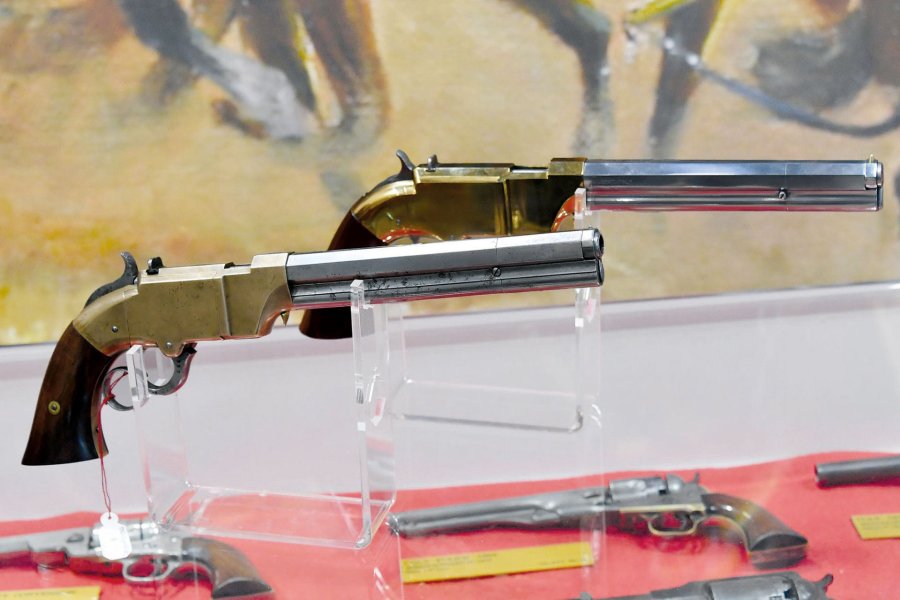
The original selected by Uberti was different: it had a blued barrel and a frame made from what American collectors often rather loosely call “brass”—a term that can encompass brass, red brass or even gunmetal. That configuration points to the next chapter in the Volcanic story.
Forty American investors put money into the project and created a joint-stock company called The Volcanic Repeating Arms Company. Remarkably, even before selling a single firearm, the enterprise raised about $150,000 through stock subscriptions, equivalent to roughly €4.3 million today according to the source.
Smith and Wesson then withdrew from the venture and founded another company under their own names, this time focused on revolver production.
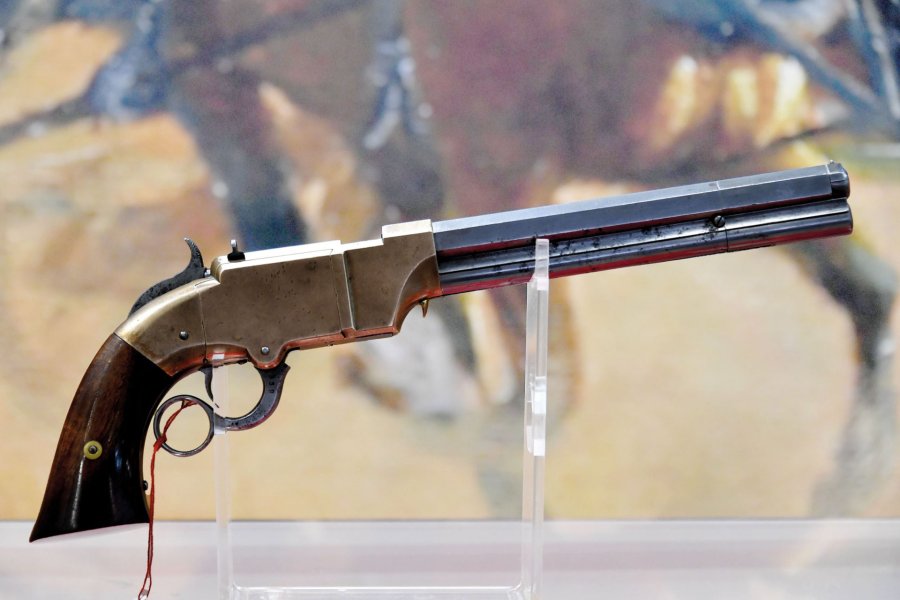
From 1855/56 onward, the new Volcanic company produced both pistols and rifles, all with brass-type frames. One of these was the Lever Action No. 2 Navy Pistol, offered with barrels between six and eight inches long—the same general configuration Uberti chose for its replica.The Volcanic Company was initially based in Norwich, Connecticut, but moved to New Haven around 1856/57, largely under the influence of Oliver Fisher Winchester, who by then had become the dominant figure in the business. The company subsequently became the New Haven Arms Company, although the firearms continued to be marketed under the Volcanic name. New Haven-made examples can often be identified by their barrel markings. Instead of simply reading “VOLCANIC,” many are marked “PATENT FEB. 14, 1854 / NEW HAVEN CONN.” Another definitive marking appears in three lines as “THE VOLCANIC / REPEATING ARMS CO / NEW HAVEN CONN.”, with the patent date arranged around the final line. That is exactly the marking pattern seen on both the original pistol and Uberti’s display prototype.
The Uberti Volcanic prototype
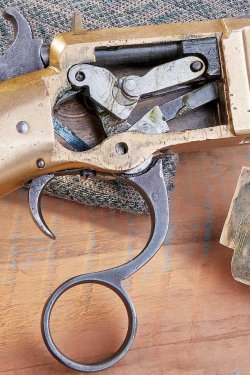
During our discussions, Uberti’s marketing manager also explained how the idea for this firearm came about. Angelo Merlino had acquired a good condition sample of an original Volcanic pistol and described it as the company’s “project of the moment.”
Bringing the design back to life presented several challenges. Beyond adapting a mid-19th-century mechanism to modern production methods, Uberti had three main issues to solve.
The first concerned the U.S. market, which is expected to account for the largest share of sales. Pistols intended for the United States will need an automatic safety system, such as a transfer bar, because without one the gun could not be marketed here.
The second question was ammunition. Reproducing the original Rocket Ball was ruled out for the safety and reliability reasons already discussed. Based on the current development status, Uberti is expected to chamber the new Volcanic in .380 ACP.
The cartridge’s overall length requires only limited changes to the dimensions of the carrier that feeds the rounds and to the ejection port above it. At the same time, .380 ACP operates at relatively modest pressure, which should place only moderate stress on the replica’s brass frame. It also offers one major practical advantage: it is among the most widely available pistol cartridges in the world.
This is not the first time .380 ACP has appeared in a Western-style reproduction. Uberti already used the caliber several years ago in its replica of the Colt 1862 Pocket Police Conversion.
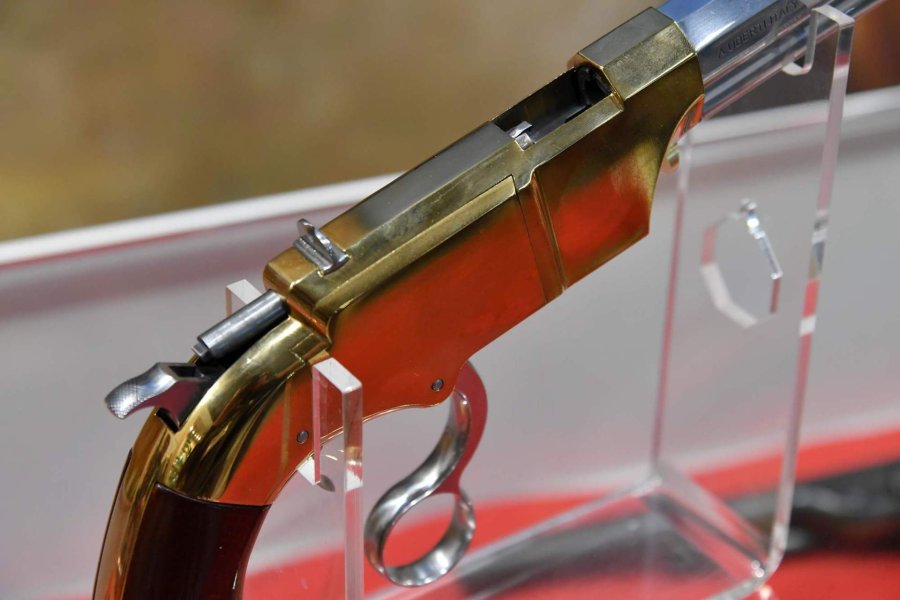
The third major challenge involved extraction and ejection. The original Volcanic was designed around the caseless Rocket Ball and therefore had no need for a conventional extractor or ejector. A modern .380 ACP version obviously does.
Uberti therefore had to incorporate the mechanical elements required to extract and eject fired cartridge cases. The original design had no such provision; if something went wrong, clearing the action could require the use of a cleaning rod.
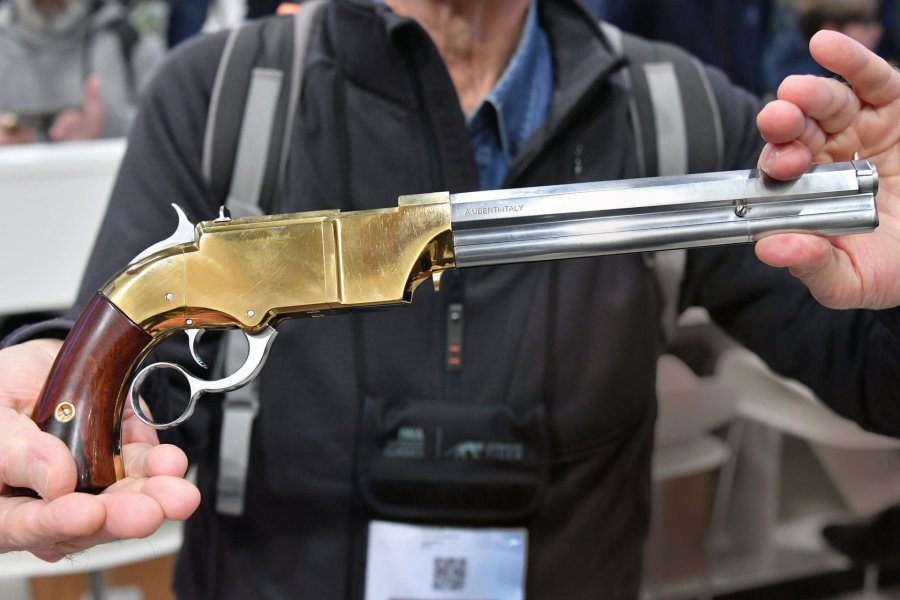
In terms of overall dimensions, comparison between Uberti’s prototype and the original pistol displayed alongside it at events such as EOS in Parma showed that the replica closely follows the historic gun.
And, as curious journalists quickly discovered, the operating procedure is also essentially the same. That applies to the lever, the hammer and the loading system.
To load the pistol, the magazine spring is compressed by means of an external follower button running in a longitudinal slot along the magazine tube. The button is pushed forward until the spring and follower lock into place beneath the muzzle at the front of the magazine.
The magazine-tube end cap can then be released and rotated sideways, allowing cartridges to be inserted from the front.
If this procedure sounds familiar, there is a reason. It is essentially the same loading system used on the rifle Benjamin Tyler Henry developed from the Volcanic concept, together with a .44-caliber rimfire cartridge: the Henry Model 1860. Built by what would become Winchester, the Henry in turn became the ancestor of the Winchester lever-action rifles that followed.
The Uberti prototype shown at the trade show still had an unfinished eight-inch barrel. A six-inch version is also planned. The shorter model is expected to use a proportionally shorter five-round magazine, while the eight-inch version is intended to hold seven rounds.
The Uberti “Volcanic” is expected in 2027
Naturally, after seeing the prototype we would have liked to borrow it and take it to the range. That was not possible, however, because the display gun was unfortunately deactivated, replacing the barrel with a faux.
So there is only one thing left to do, and for enthusiasts it may prove to be the hardest part: wait. If development proceeds as planned, Uberti’s Volcanic should enter series production in 2027, at which point it will finally be available for actual shooting.
Until then, anyone who does not own either an original or a replica can always play movie detective and look for Volcanic pistols or carbines on screen.
At least one appearance is certain. In Sergio Leone’s classic Spaghetti Western For a Few Dollars More, Clint Eastwood acts as the “referee” during the final duel between Gian Maria Volonté and Lee Van Cleef while holding an original Volcanic carbine, although he never fires it – obviously, not only because of the plot, but also because blanks would have been a real nightmare to make...
For more information about the company and its broad range of reproductions of Old West firearms, visit the US importer website: Stoeger Industries / Uberti USA, Accokeek, Maryland – www.uberti-usa.com
