

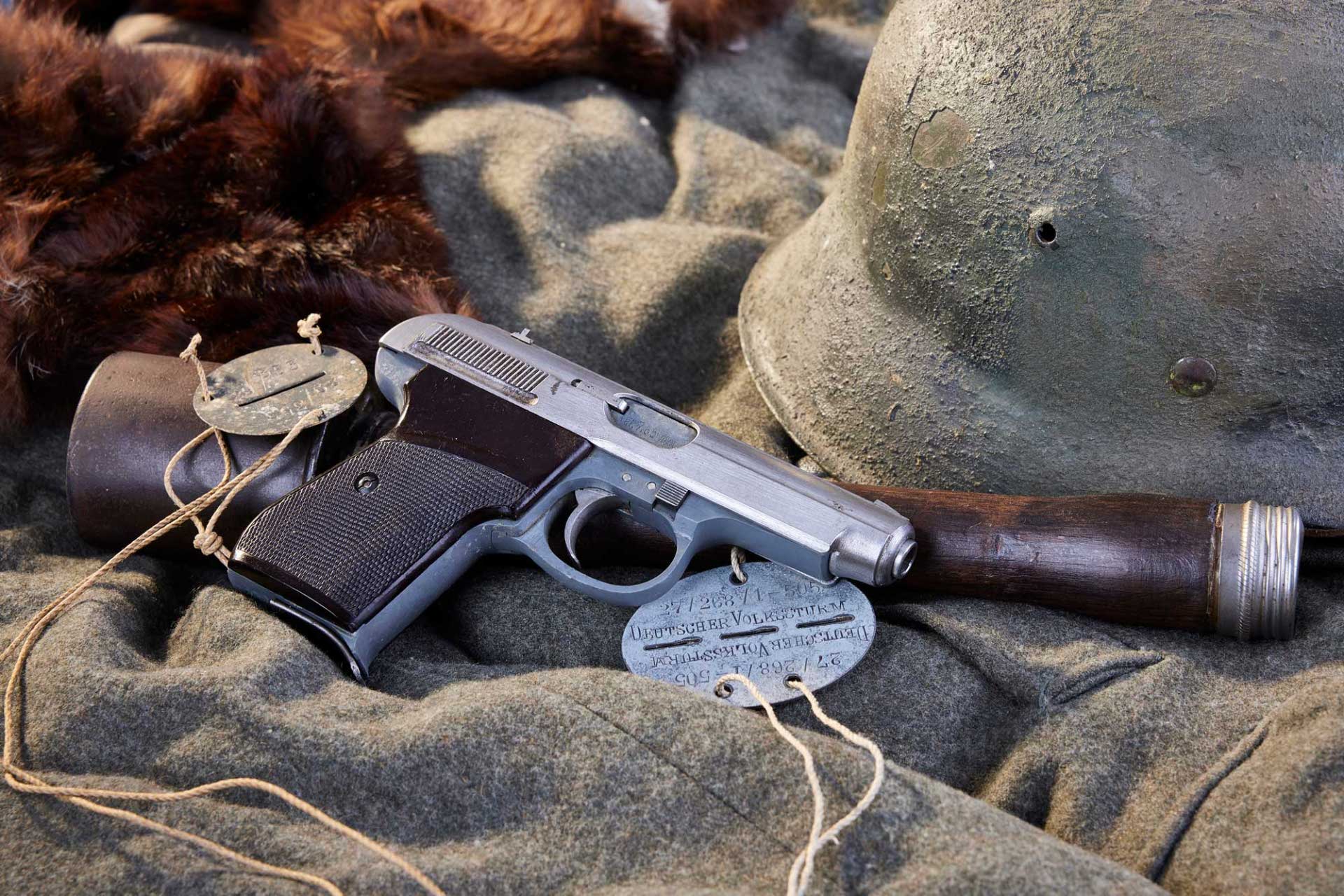
Occasionally they can still be found: historical weapons that are rare, possess unique technology, and carry a rich history. This Gustloff pistol is a case in point. In order to properly contextualize this German rarity from World War 2, we will first look at the historical background before taking a closer look at the design.
Historical background: How the Suhl Simson factories became the Gustloff factories of the Nazis
After World War 1, the Simson company in Suhl was in a key position: Arthur Simson managed the only armaments company authorized by the Allies to supply the Reichswehr, police and other armed forces with firearms. After the National Socialists came to power in 1933, however, as a Jew he faced increasing racist hostility. Judges cooperating with the fascists accused the Simson boss of collaborationism, favoritism and accepting bribes from their hated enemies. They sentenced him to excessive fines and prison terms, which was completely unjustified. It was only a matter of time before the Nazi henchmen ruined him and his company. As early as 1934, the Nazis introduced the forced Aryanization of Jewish businesses by law and converted the Simson-Werke, founded in 1856 by the brothers Löb and Moses Simson, into the "Berlin-Suhler-Waffen- und Fahrzeugwerke G.m.b.H. Berlin". In December 1935 , the Nazis forced Arthur Simson to sell his majority shareholding to the Nazi state at rock-bottom prices. The company was quickly transferred to the "National Socialist Industrial Foundation (N.I.S.)" under the guardianship of Hitler's vassal Fritz Sauckel, the responsible Gauleiter of Thuringia. The Simson family recognized the danger of imprisonment and fled to the USA via Switzerland in a clandestine operation.
After the murder of Wilhelm Gustloff, the national group leader of the Swiss NSDAP foreign organization, Hitler ordered the "N.I.S." to change its name to the "Wilhelm Gustloff Foundation" on 27 May 1936. From then on, it grew into an economic giant by requisitioning further Reich companies. It built everything from weapons, ammunition, vehicles, railway carriages and wood gas generators to mining equipment in line with Hermann Göring's four-year plan. On 1 May 1937, the company was renamed "Fritz-Sauckel-Werke". New facilities set the course for another armaments giant. As early as 1938, a branch plant for the production of machine gun barrels was established in Schmiedefeld am Rennsteig. The outbreak of the Second World War brought a halt to civilian vehicle construction in favour of increased weapons production. The company was also given the new name "Gustloff-Werke - Waffenwerk Suhl". From then on, over 6,000 workers manufactured 98k rifles, machine guns, anti-aircraft guns and other war equipment for the Wehrmacht.
In 1940, the Gustloff factory opened in the southern Thuringian towns of Meiningen and Greiz. Barrels, the Panzerbüchse 39, the MG 13 and the 2-cm Flak 38 were produced here. In 1942, construction of the MG 42 began at the new branch factory in Litzmannstadt (Łódź). For further military contracts, and consequently also for the production of the K43 semi-automatic rifle, Fritz Sauckel – anticipating his later infamous role as a procurer of slave labor for the armaments industry headed by Albert Speer – recruited tens of thousands of prisoners from the neighboring Buchenwald concentration camp on behalf of the Reich Security Main Office. In 1942, he built another largely secluded weapons factory in its Berlstedt subcamp as an SS special camp, namely the Gustloff Plant 2.
The development of the Gustloff pistol
Sauckel liked the idea of equipping growing organizations such as the SS and police, as well as the Wehrmacht, with pistols from his company. Their organizations suffered from a chronic shortage of guns and the demand was immense. So in 1937, Sauckel commissioned Gustloff designers Karl Barnitzke and Erich Ladicke to develop a handgun with a simple blowback action in the then very popular 7.65 Browning caliber, bypassing the industrial property rights of market leaders Walther and Sauer. The result was the Gustloff pistol.
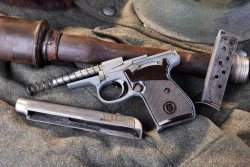
The inventor duo went to great lengths to give their eight-shot pistol not only a pleasing design but also considerable technical ingenuity. Probably the most important feature, the Gustloff was fitted with a die-cast zinc frame. The Simson factories were already experimenting with this rather soft material at the end of the 1920s, but it was only of limited use in combination with the high-alloy steels used for the slides. However, it was ultimately cheaper and easier to manufacture and could be processed without long machine running times. The frame was also divided into two parts. The trigger guard, made from the same material, was inserted neatly and fixed in place with a pin. Nevertheless, the Gustloff pistol consisted of only 37 individual parts. Not many compared to the 51 of the Walther PP or even the 55 parts of the Sauer 38H: a further advantage, and the second feature of this type of firearm.
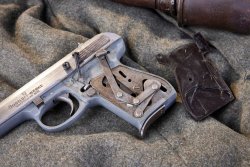
The third feature was located on the left side of the frame. Circumventing the Sauer patents, Barnitzke and Ladicke devised a manual safety mechanism, the riveted lever of which was located beneath the grip panel. When operated, the safety applies (or removes) spring pressure to the hammer by pushing the lever forwards or backwards. However, the transmission of the mechanism requires a lot of force and a well-trained thumb. When cocked, a red dot on the frame indicates that the gun is ready to fire. When the safety was engaged, the slide covered the dot. A pawl in the grip also blocked the trigger. Today's owners of these rarities are advised to keep their hands off the safety because of the fragile mechanism. At the time, however, the designers labelled these extras as an advantage for faster firing: the pistol could be safely carried loaded and was immediately ready to fire with little effort.
The Gustloff has a concealed hammer to protect it from dirt. This model measures 169 mm, has a 6-groove 96mm barrel, holds an eight-round magazine for 7.65 mm Browning cartridges and weighs 625 g including magazine. Interestingly, the Thuringian Gauleiter did not register the new patents on 22 July 1937 under the name of Fritz Sauckel-Werke, but under the old Simson company logo "B.S.W." With an eye on lucrative army orders, Sauckel presented Hitler with a carefully handcrafted, elaborately engraved example. He emphasized that it was "by no means a Walther", but a new design from his company. When the Italian dictator Benito Mussolini was also presented with a deluxe model by Sauckel, Hitler's military adjutant and member of the Army Ordnance Office, Gerhard Engel, ordered one of these "new Führer weapons" for himself. With Engel's help, Sauckel hoped to obtain material and machines for mass production. In a letter, he openly asked him for support to introduce this weapon on a large scale to the armed forces and armed organizations. He sent a copy of his letter to Reichsführer-SS Heinrich Himmler, whom he had already informed verbally about this gun. Himmler took the bait. He liked the idea of having his own "SS pistol" for his Totenkopfverbände (Death's Head Units) and Verfügungstruppen ("Dispositional Troops"). There was very often friction between the Army Ordnance Office and the SS Ordnance Office regarding the allocation of weapons quotas. All too often, his units had to resort to captured stocks due to the lack of Wehrmacht supplies. In April 1940, Himmler instructed the head of the Waffen-SS Weapons and Equipment Office, SS-Oberführer Heinrich Gärtner, to supply Gustloff-Werke with enough material to build 100 (!) sample pistols for a troop trial.
Sauckel, of course, expected orders in the six-figure range. Disappointed, he ignored three further letters from Gärtner. The increase in material for 1,000 sample guns also left him cold. At Himmler's urging, Gärtner held a final meeting with the Suhl management in November 1940. He received a polite but firm rebuff: the current war-related workload and the lack of personnel, machines and materials did not permit any additional pistol production for external organizations at the time. He foresaw the start of possible mass production for the SS no sooner than six months later. But even then, nothing happened. In order not to completely offend Himmler, who held a highly position in the Nazi state, Sauckel presented him with a hand-engraved example with a personal dedication in July 1941. Naturally, he again pointed out the advantages of this masterpiece of Thuringian engineering over the market-leading Walther pistol. Amusingly, Himmler wrote a letter a few days later thanking him for the "wonderful new design of the Walther pistol". When inquiries failed to materialize and the Army Ordnance Office also rejected the pistol, the frustrated Sauckel gave up trying to sell it. Nevertheless, a glossy brochure was published in April 1943, in which the new target group of the Gustloff pistol was identified: "The officer, policeman, bank or forestry official, the plant security guard, hunter or marksman, everyone will find what they need in the Gustloff pistol, namely a loyal and reliable comrade". Apparently, organizations such as the SS or NSDAP were deliberately left out of the description.
When Martin Bormann, the head of the Reich Chancellery, ordered the formation of the Volkssturm by decree of the Führer on 25 September 1944, there was a shortage of material and weapons in all districts. Because Hitler had banned the use of Wehrmacht stocks, Bormann ordered the collection of all available weapons for this last-ditch effort on 11 November 1944. After combing through all warehouses and magazines and requisitioning all available private stocks, a huge collection of firearms and ammunition was gathered. The Fritz-Sauckel-Werke also cleared its shelves and made all surplus weapons, weapon parts and equipment available to the Nazi Party. This included assembling the remaining individual parts of the Gustloff pistols – there was never any series production. The gun described here also left the Suhl factory halls and served one last time as a Nazi weapon. It survived the end of the war and the decades that followed in the deep coat pocket of an unknown Volkssturm soldier.
Only a few real examples of the Gustloff pistol are still known
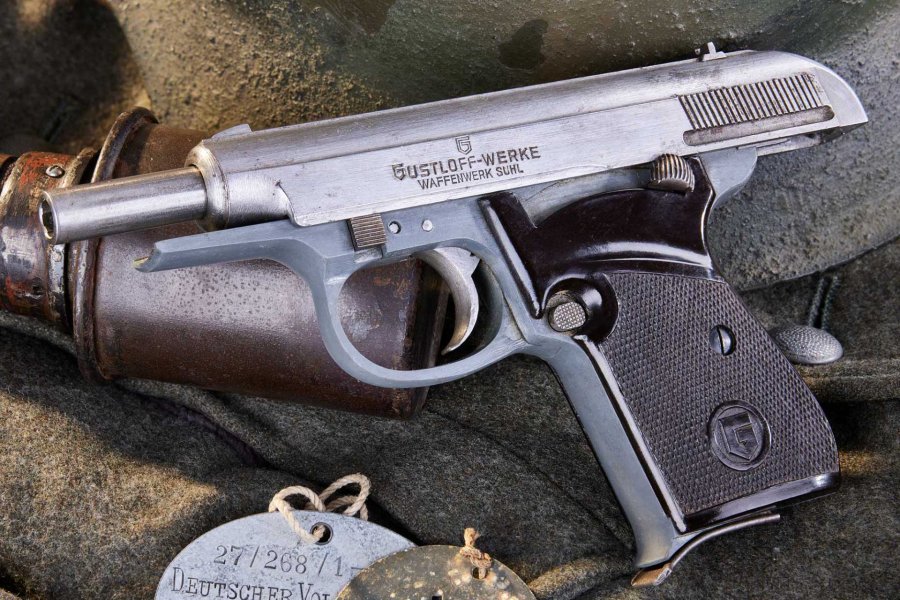
Although for advertising reasons the four-digit serial numbers of some real examples suggest a higher production figure, only around 100 hand-assembled pistols left the factory. No two Gustloff pistols are alike. They were available with or without a double-action trigger, with hard rubber or wooden grips. Some were fitted with an enlarged trigger guard for winter use with gloves. Some were blued or phosphated, while others were left in the white. The known exampled also differed in terms of triggers, trigger bars, slide machining and markings. Some guns are civilian proofed, others remained unproofed. The majority of these pistols were either lost in the final days of the war or were subsequently scrapped. Most of the surviving examples traveled across the Pond as coveted war booty in the duffle bags of US GIs. Today, experts know of 16 real pieces that lie dormant in the vaults and display cases of well-organized collections and museums around the world, including the Bundeswehr's Wehrtechnische Studiensammlung (WTS) in Koblenz. And so well-preserved specimens change hands for five-figure sums – and the trend is rising.
This article was edited by Matthias S. Recktenwald and the all4shooers team.