

For several years now, during our talks with master gunsmith Claus Jarzombek, the conversation has frequently turned to various firearm designs notable for their unconventional technical construction. "I have something special," says Jarzombek, "a Cosmi brand shotgun". Okay, time to quickly access my mental database: a semi-automatic shotgun of unusual design, manufactured in Italy for decades and renowned for its exquisite quality. What else could be special about it? “Take a look and try it out.” Easier said than done. Because a closer look revealed a shotgun that looked very different from what the world has known since the 1902 debut of John Moses Browning's classic FN Auto 5. That model established the archetype of the autoloading shotgun: a tubular magazine positioned beneath the barrel, loaded via a loading port on the receiver, as was usual with pump-action shotguns. And regardless of whether the semi-automatic shotguns built since then were long recoil-operated like the Auto 5 or short recoil-operated like the Walther M 1921, whether they were designed in the style of the Danish Sjøgren as an inertia system with a fixed barrel or gas-operated like the Remington 58, they all followed the concept of an underside loading port and magazine tube under the barrel.
Somehow different: the Cosmi autoloading shotguns

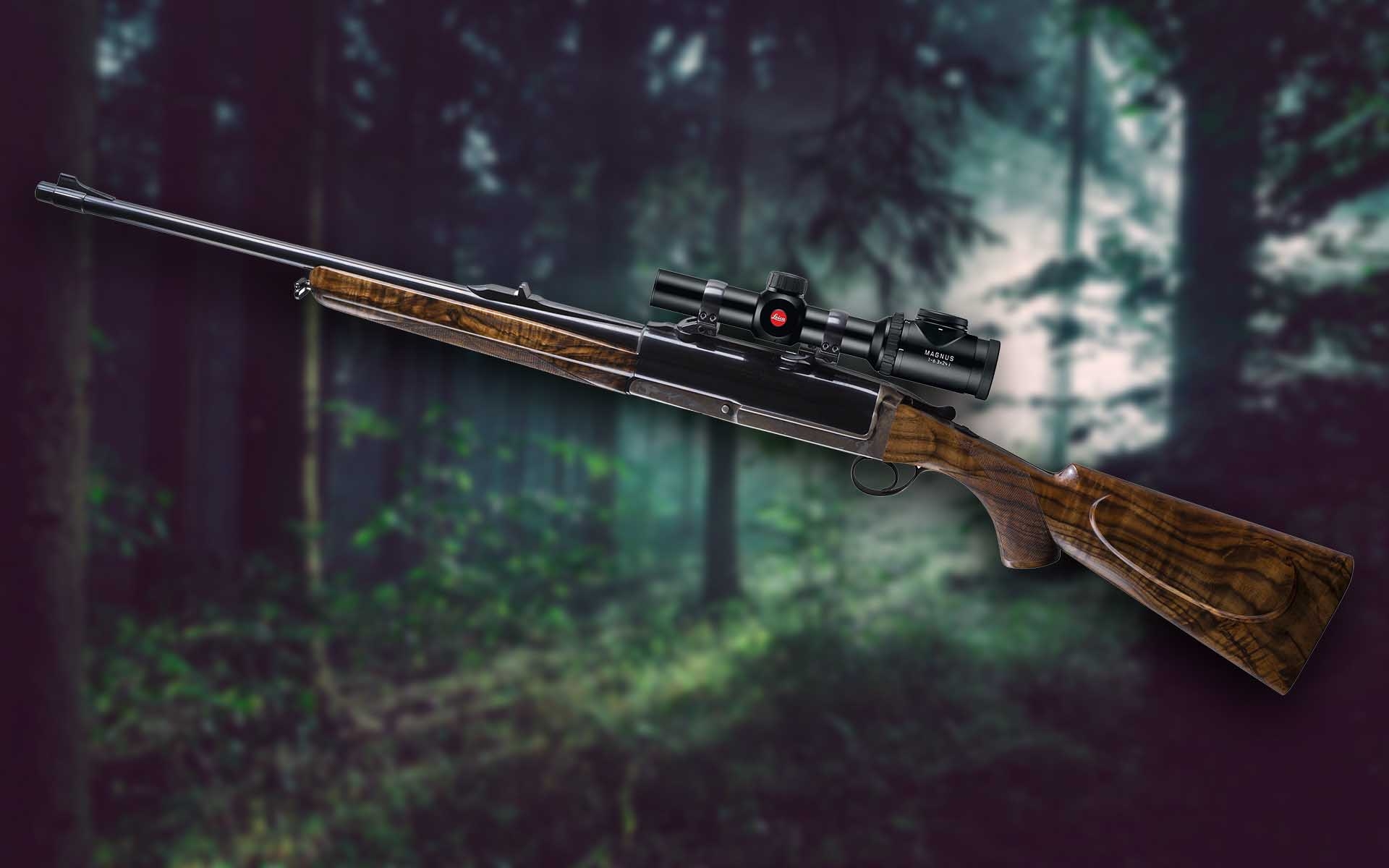
There lay this semi-automatic shotgun, and after an initial all-around inspection, it immediately raised the question: where exactly were the loading port and the magazine to be found? At least not where you would normally find them on semi-auto shotguns. But perhaps the Cosmi shotgun loaded from the rear through the stock, in the style of the Spencer repeaters from the US Civil War? Again, no answer. A look at the butt plate revealed only a screw, but no slide, cover or any other feature that would indicate the loading port for a tubular magazine housed within the stock, to be loaded or inserted from the outside. Whichever way you turned the Cosmi around, it appeared to be a closed system devoid of any externally visible loading port and lacking the tubular magazine beneath the barrel that is characteristic of multi-shot shotguns. The only recognizable opening in the receiver was on the right, but it was also closed by the bolt inside it.
On the contrary, the Cosmi possessed a feature that inventors had been working on since the mid-19th century — a design element, pioneered by the Briton William Middleditch Scott in 1865, that would prove to be groundbreaking right up to the present day: namely, an opening lever situated at the top front of the receiver tang. Such a top lever is normally found on break-action guns, whether side-by-sides or over and unders, whose chambers are exposed for loading and unloading by tilting the barrels downward. The conclusion: since the Cosmi has such a control, it must be a break-action semi-automatic shotgun.
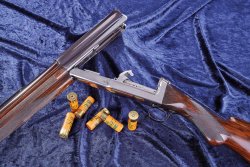
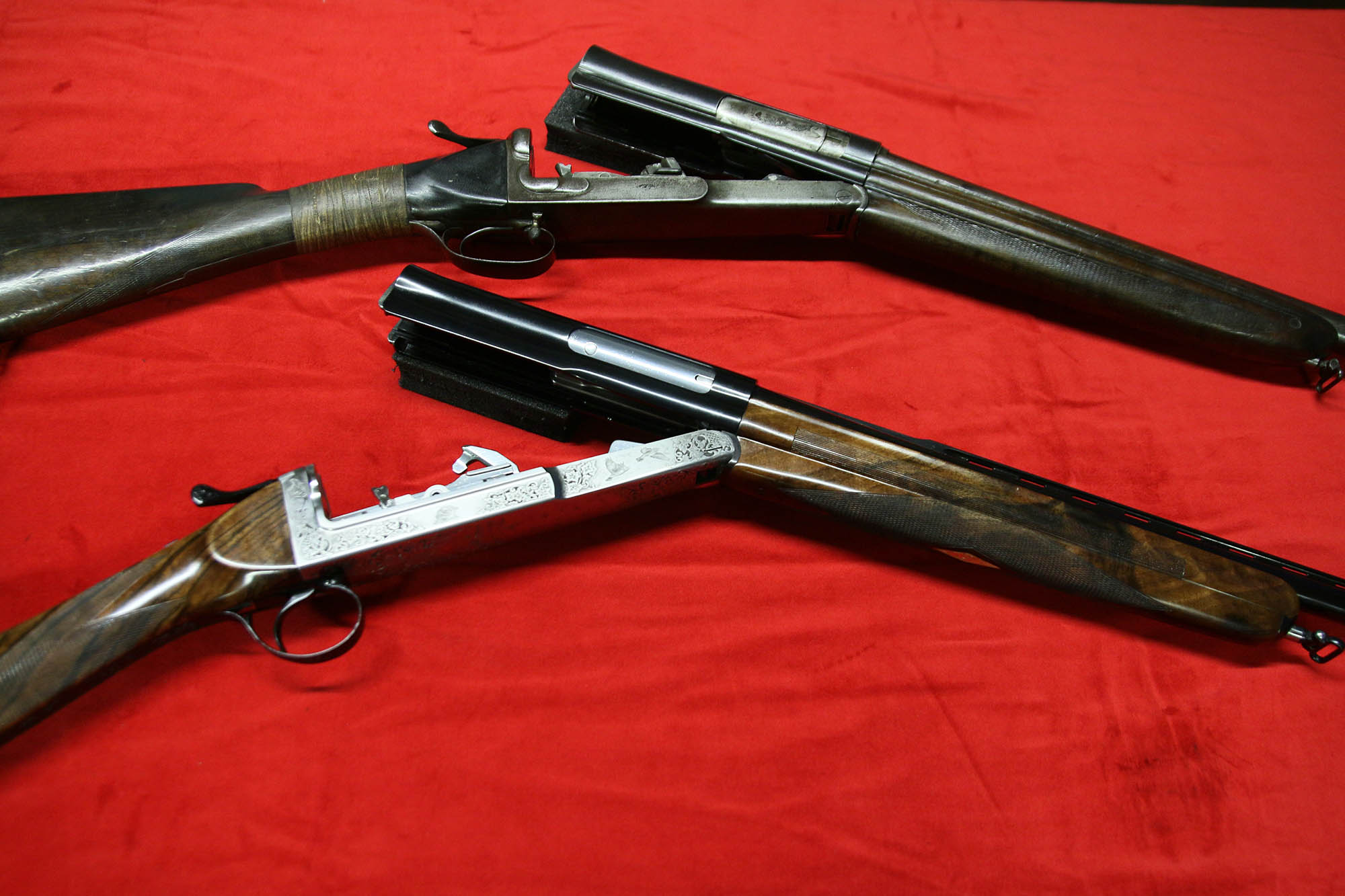
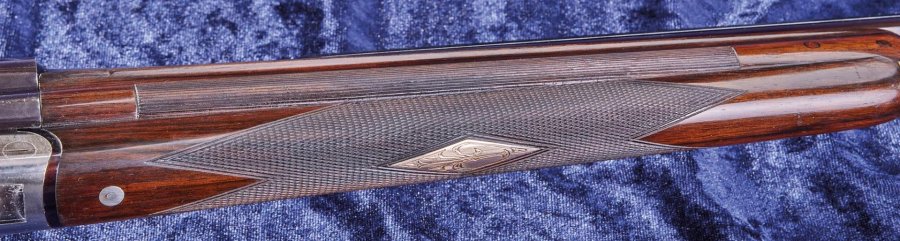
And that's exactly what it is. So break open the Cosmi shotgun, and marvel at two things. Firstly, the arrangement of the mechanism itself, which is completely different from anything you are familiar with from other semi-automatic shotguns. At first glance, the Cosmi's inner workings seem like a mechanical maze. This starts with what happens when the gun is broken open — namely, nothing. In contrast to today's standard boxlock break-action shotguns, pivoting down the barrels does not cock the firing mechanism; that process is accomplished in a different manner. But before delving into the now-indispensable explanation of the mechanism, there is a second aspect that leaves the observer awestruck upon a first glimpse inside: even without having yet grasped the technical intricacies of the Cosmi, the gun reveals to the sense of touch — the very moment it is opened — a movement so buttery-smooth yet distinctly palpable that it betrays the extraordinary degree of meticulous care that must have gone into the fine-tuning of its functional components. And inside, there was a real sparkle and flash. No, not nickel or chrome plating, but plain tool steel that had been polished with the utmost diligence and elbow grease to flawless, mirror-like perfection with the cleanest of tolerances. In short: the Cosmi housed a mechanism crafted and finished with true mastery — one in which, arguably, the only missing element was machine work. This type of firearm stands as proof of the splendor that can be achieved through hand craftsmanship and also that in any case such work is invariably superior to machine-made products in terms of both quality and design. The respect for all this increases when you realize that the Cosmi mechanism comprises more than 100 parts, some of which are intricately shaped. In keeping with this, the gun presented itself with the finest, perfectly oiled walnut wood, which harmonized wonderfully with the brightly polished lower receiver, and the blued upper and barrel. This gun dates from the mid-1950s and while it naturally showed clear signs of having been well-used, the fit and finish were still superb.
How does the Cosmi semi-automatic shotgun work?
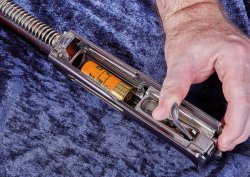
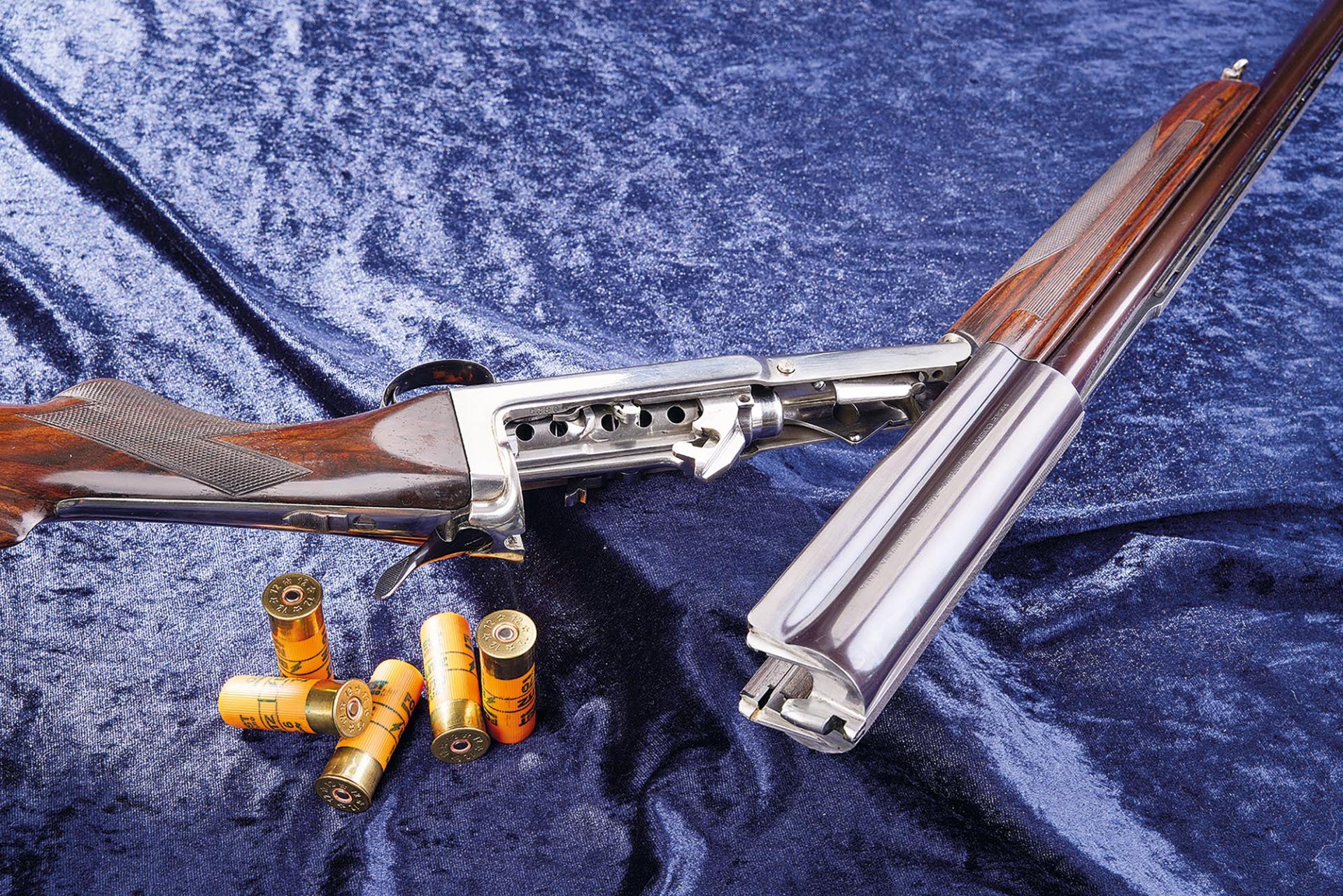
Upon opening, the barrel-and-upper assembly detaches from the receiver. The mechanism is distributed accordingly: in the "top floor" — or à la AR, in the "upper" — is the bolt together with its slightly slanted firing pin and an element that directly catches the eye and resembles a miniature spoon. In fact, however, it is a hinged lever that can be used to release the bolt from its locked position inside the upper, allowing it to be slid rearward. The purpose of this operation is to expose the barrel’s chamber for loading. Once this has been done, the bolt can be easily pushed forward again via a ribbed gripping surface at its rear end. Important: when the gun is open, the "bolt" must be returned to the forward position, otherwise the Cosmi can't be closed later.
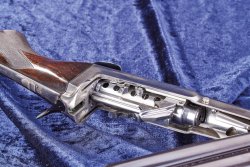
In the "lower receiver" connected to the trigger mechanism and stock, there are two components that are fundamental to the function. Here you can see the front section of the magazine assembly: at the very front of the receiver is an element consisting of two shell-like curved parts that lifts the shells in position behind the barrel when cycling the gun. This is the lifter. Directly behind it is the perforated magazine tube together with the protruding follower, both of which are polished to a mirror finish like the rest of the interior. Loading is as follows: place one cartridge after another in the half-shells of the lifter and use them to push the follower back into the stock against the tension of the magazine spring until the tube is full. However, the Cosmi wouldn't be the Cosmi without a touch of finesse: on the left side of the tube, precisely where the magazine tube enters the rear wall of the receiver just ahead of the stock wrist, sits a small push-button switch. This serves as a magazine cutoff: when visibly protruding, the tube is open and can be filled to capacity — in the case of the shotgun at hand, with seven 12/70 shells. When the catch is activated, i.e. pressed in, it stops after two cartridges. A total of three rounds would then be available, because the barrel can be loaded separately. But that's not all when it comes to loading: once you have fired all the rounds in your Cosmi, the bolt remains locked open in the rear position. Now you can simply insert a shell into the gun from the side through the ejection port. If you now press the button on the bottom left of the receiver, the bolt releases from its rear position and slides forward, chambering the cartridge. Now you can break open the Cosmi again and refill the magazine as described.
Inside the receiver, on the left in front of the magazine tube attachment, the Cosmi hammer protrudes. In this position it is still uncocked. How to operate it is revealed by its forward-facing, cross-ribbed pressure surface: place your thumb on it and simply press the hammer downwards to the rear until it engages audibly and visibly with the sear — a catch protruding upward from the lower wall of the receiver housing. If you now close the Cosmi, it is cocked. And if it is loaded, it is also ready to fire when the safety slider on the wrist of the stock is in the forward position. If you open the cocked shotgun, you can manually decock the hammer by pressing the trigger. Nothing can happen, as there is no contact with the firing pin. The break-action mechanism also serves a safety function.
A family history: the development of the Cosmi shotgun

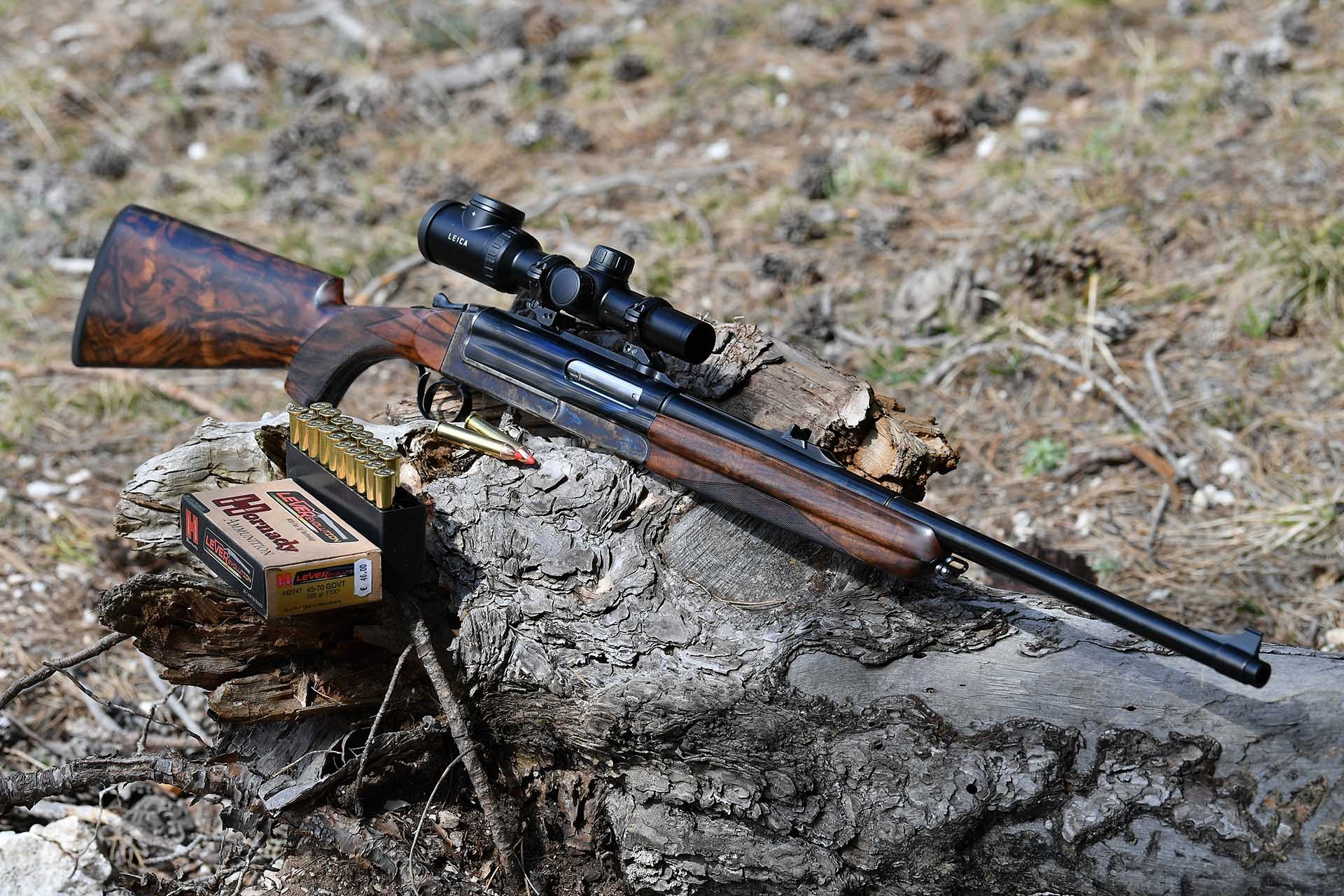
None of this started overnight, but has a history of its own. Since this type of shotgun — designed primarily with bird hunting in mind and featuring a long-recoil operating system — originated in Italy, it seems only natural to look to the place where the heart of the Italian arms industry beats: Lombardy, specifically the area surrounding Gardone Val Trompia and Brescia. But you won't find the Cosmi origins there. Because they were in the Montefeltro area. This, in turn, is a name that makes those interested in military history think primarily of the Renaissance warlords known as "condottieri". Indeed, one of the most famous of these mercenary captains was Federico da Montefeltro (1422-82), who even rose to become Duke of Urbino after the assassination of his half-brother Oddantonio. In the context of Cosmi, "Montefeltro" refers to the territory of an ancient diocese, located in what are now the Italian regions of Tuscany, Marche and Emilia-Romagna as well as the small state of San Marino. Montefeltro is a portion of what geographers refer to as the "Tuscan-Emilian Apennines". And it was precisely in this wonderfully enchanted, hilly region with its cypress trees, country estates and the occasional hilltop fortress that at the end of the 19th century a young man named Rodolfo Cosmi (1873-1936) went hunting and ran a small workshop in the medieval-looking town of Macerata Feltria, located in the Marche region in the southeastern part of the Montefeltro. He began repairing and maintaining, designing and building firearms, especially shotguns, around 1890, when he was just 17 or 18 years old. Cosmi spent a long time tinkering until he had perfected his distinctive shotgun design, which was probably around 1920. Most sources consulted on the subject report that Rodolfo Cosmi presented his first prototype in 1925, a good 100 years ago. The inventor naturally had the design protected, and the corresponding US patent with no. 1,802,198 was issued on 21 April 1931.
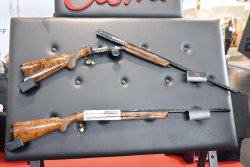
By that time, father Cosmi had already trained his two sons Marcello and Americo. Two years after his death in 1936, the two brothers moved the company headquarters to the port town of Torrette di Ancona, where Marcello Cosmi (who passed away in 1963) in particular transformed the small workshop into a modern company. According to the factory records, a good 8,000 shotguns were produced here, with Americo Cosmi (1918-2015) responsible for the technical refinement of his father's design. Members of the famous Cosmi family still work at the manufactory, which has been managed by Luca Gaeti since 2018, including Rodolfo II Cosmi, who has served the company for more than 50 years, and Federico Cosmi. Internationally, Cosmi has joined forces with the US manufacturer Nighthawk Custom from Berryville in Arkansas, which is known for its top-tier 1911 pistols. Cosmi continues to craft its break-action semi-automatic shotguns as bespoke, one-of-a-kind pieces of breathtaking quality. They are available in Steel, Titanium, Superleggero Titanio and Special Editions in gauges ranging from .410 to 28, 20, 16 and 12. In other words: pack a fat wallet and head to the Adriatic, specifically to beautiful Ancona, to have your measurements taken at the factory and discuss the features of the shotgun you want with the Cosmi experts and, after a few months (remember: true craftsmanship takes time...), take delivery of a magnificent piece of lasting value. But that’s not all: the Cosmi product range also includes the semi-automatic Rigato rifle, naturally also with the distinctive break-action design and the tube magazine integrated in the stock. And for those who want the classic look, Cosmi also offers luxury side-by-side boxlock shotguns.
Wrapping up
It goes without saying that for a new piece, one must expect to pay a five-figure sum — at the very least. In that regard, you fare better with a vintage gem like the one from Jarzombek’s inventory. But here too, the price is negotiable. Whether new or used, once you have managed to acquire a Cosmi, it will delight you with its "Rolls-Royce" quality, though its unconventional design may initially prove somewhat perplexing. Once you have familiarized yourself with it, you will realize that a) it works flawlessly, simply and safely, b) it has additional safety features thanks to its manual operation and break action and, c) it provides an unexpectedly wonderful balance due to the magazine being moved to the rear. Sure, at 3,550 grams this Cosmi is not exactly light, but it swings just as you would expect from a really fine double-barrelled shotgun.
The only question is where the rich uncle from Argentina has gone when you need him...
The Cosmi self-loading shotgun came from Waffen-Design Claus Jarzombek: thank you very much!
Further information on the shotgun can also be found on the website of the manufacturer Cosmi.