
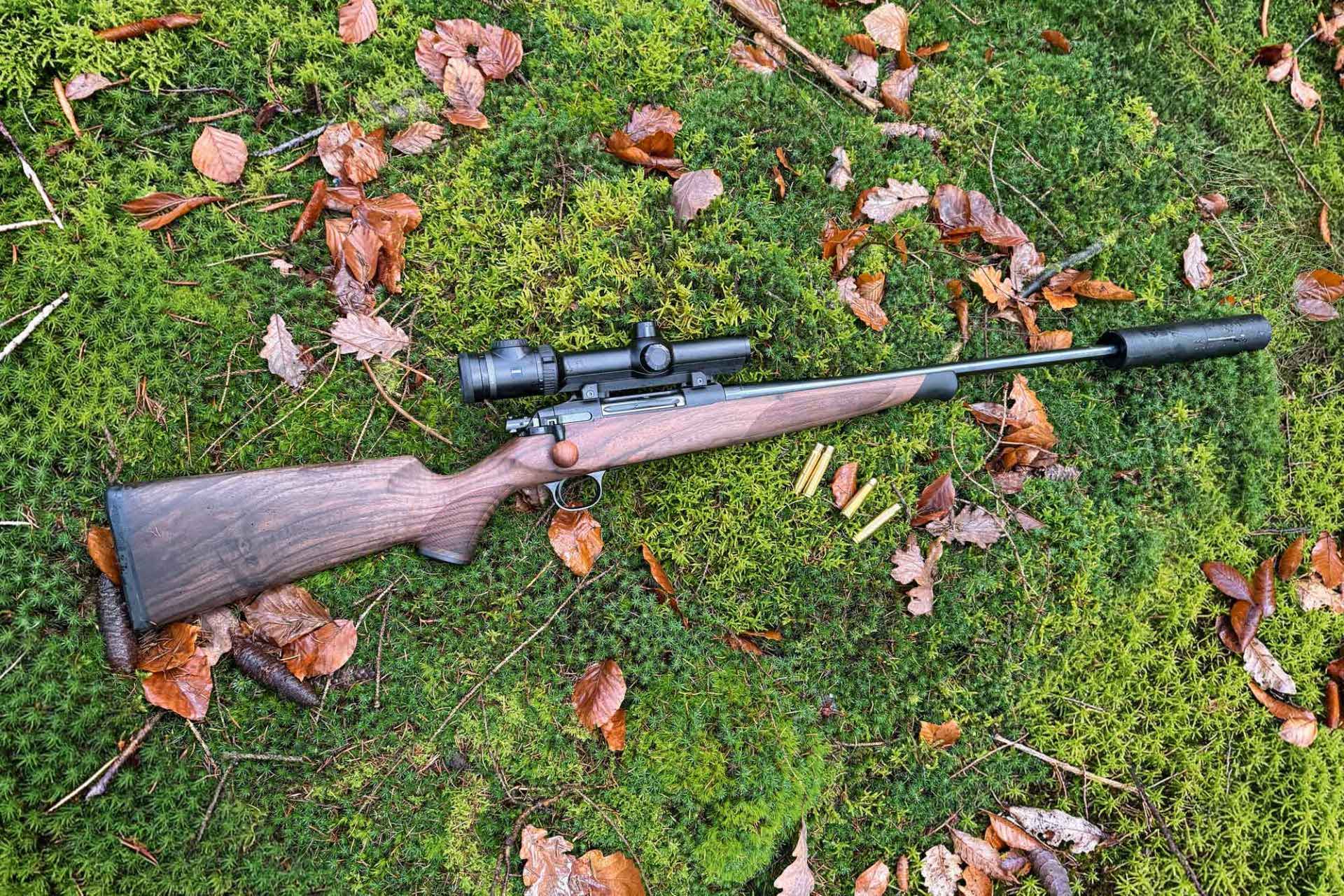
For the German manufacturer Steel Action, which specializes in straight-pull hunting rifles, the name says it all: the action of its rifles is made of steel. Because the extremely rugged design of the action made their rifles appear too heavy for some hunters, they redesigned it to meet customer requirements. And so they also slimmed it down where this was possible without compromising reliability.
We already took a closer look at the overall design and technology of the straight-pull bolt action rifle in an all4hunters article on the Steel Action HSL. There are two action sizes, with the Hunting Short (HS) model for calibers such as .223 Remington, .243 Winchester, 6.5 Creedmoor and .308 Winchester, and the Hunting Medium (HM) for longer cartridges such as .30-06 Springfield, 8x57, 9.3x62, 7mm Remington Magnum or .300 Winchester Magnum. With the 2025 market launch of the HSL, which is around 500 grams lighter, it also became clear that the HM model would also receive a corresponding update. We were particularly pleased that we were able to test the new Steel Action HML extensively before its market launch.
The Steel Action HML straight-pull rifle in detail: Differences to and similarities with the HSL model
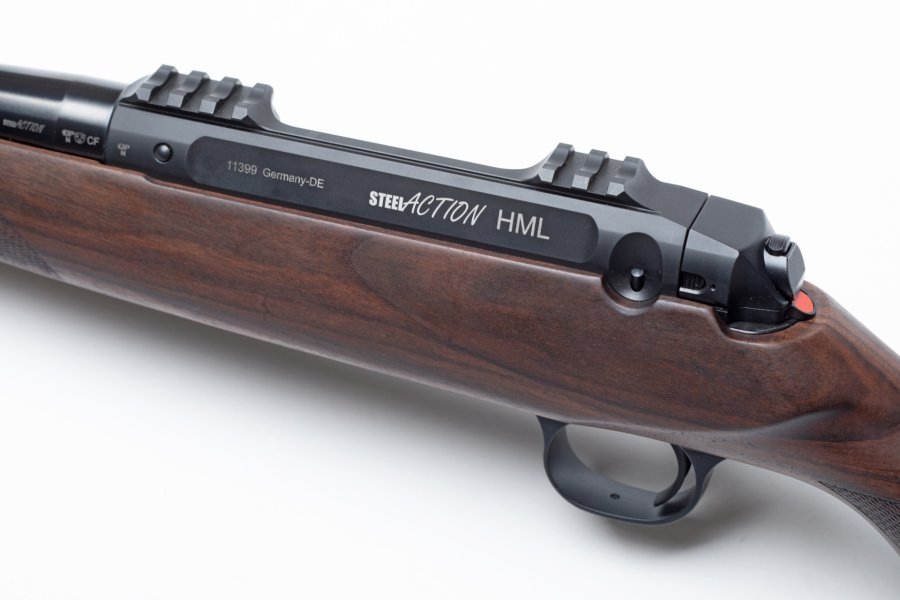
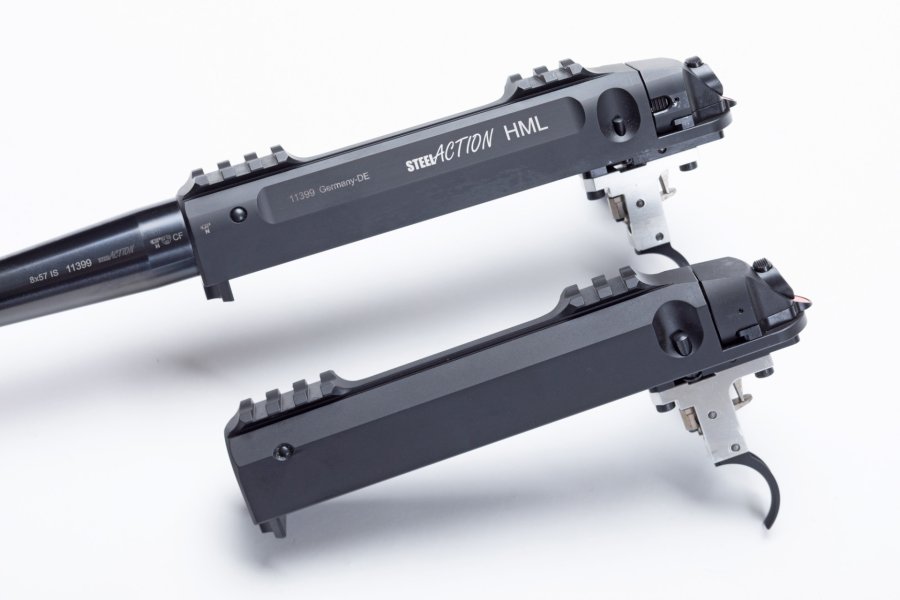
The design of the action, bolt carrier and magazine frame of the new HML is based on the shape that already impressed with the HSL. Here too, the manufacturer has provided the left side of the action with a long, flat bevel on which the markings are placed. Visually very stunning, it creates an elegant transition from the action to the stock. The tried and tested mounting bases in the form of two Picatinny rails integrated into the steel action in accordance with STANAG 4694 have remained unchanged. The longitudinal grooves in the bolt carrier have been minimally modified. Where they are visible, they begin and end in the ejection port. The locking mechanism has not changed – the bolt still has its three locking lugs with a 90 mm² surface area as well as the identical, safe and easy-to-operate manual cocking mechanism. A barrel changing system has been deliberately omitted; the barrel is firmly screwed into the action.
As with the HSL, the new catch lever has also been introduced here, which makes it easier to remove the bolt. Where the lever on the HS/HM models still had to be operated with the fingertip, it is now longer and has a ribbed operating surface. This makes it very easy to remove the bolt from both the HML and HSL models: open the bolt, hold the bolt handle with your index and middle fingers and push the lever with your thumb. This turns the bolt head from its "open" position to the "closed" position. This positions the clear space between two locking lugs in such a way that the trigger sear can now pass here. Now press the pin on the left side of the action together with the trigger, pull the bolt out to the rear – done.
While the action width of the HSL model could be reduced from 33 mm to 30.6 mm, the action width of the HML model remains at 33 mm because the width of the largest magazine in .300 Winchester Magnum could not be changed for design reasons. The weight reduction of the receiver and bolt was correspondingly lower. Only a milled section on the underside of the receiver was found to reduce weight. However, as the manufacturer uses 17-mm Lothar Walther barrels as standard instead of the previous 19-mm ones and the same stock as the HSL model, the result is a rifle that is around 270 grams lighter. A rifle chambered in 9.3x62 or .300 Win. Mag. should probably not weigh much less than 3.3 kg, even with accessories such as mounts, scopes, and suppressors.
The stock made of beautifully grained grade 3 walnut has a continuous line from the trigger guard to the fore-end, which features an ebony tip. The pistol grip is slightly flatter and more classic in design, but still offers very good control when shouldering the rifle. It also ends at the bottom with an ebony cap. The manufacturer deliberately chose this approach, avoiding any unnecessary black plastic trim. The straight comb rises towards the rear – an advantage with strong cartridges and "pushing" recoil. The long fore-end makes it possible to take aim and shoot with a forward-positioned grip, which can be an advantage on driven hunts. As with the HSL stock, the practical Halder Push & Go sling swivels are also fitted here. They are located in the classic position on the buttstock and on the front of the fore-end, so that they do not interfere when shooting with a forward-positioned grip. The standard stock length is 370 mm, and a cleanly finished 12-mm Wegu plastic butt plate closes the stock. Incidentally, the barrel bed is ready for both barrel contours, so the HML can certainly also be ordered with a barrel with a 19-mm outer diameter. When asked, Steel Action confirmed that high-quality woods and a carbon fiber stock will also be used. We can certainly look forward to it, especially since the carbon fiber stock is expected to bring another significant weight reduction, which could be a sensible option, especially in more moderate calibers such as 6.5x55 or .30-06.
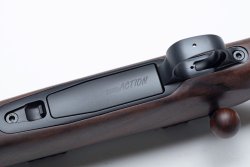
As with the HSL, the magazine frame has lost its two "ears" and fits flush into the stock. The sheet steel box magazines with a capacity of five cartridges in standard calibers and four cartridges in magnum calibers are identical to the HM model and can be removed using the magazine release at the front. The operating element is positioned so that the magazines land in the hand when the lever is operated. The lever is recessed in a trough and designed to prevent unintentional actuation. The only part of the rifle made of plastic is the signal-red follower.
As with the HSL version of the straight-pull rifle mentioned above, the list price of the Steel Action HML in the wooden stock version shown here is €3,449. Other stock variants, such as thumbhole and carbon fiber stock models, are to follow shortly.
Field test: The Steel Action HML in 8x57 IS on a driven hunt
When testing the 8x57 IS test rifle, we used both lead-free and leaded ammunition. The lightweight 560-mm barrel with its 17-mm external diameter proved to be quite accurate with 3-shot groups from under 20 to 28 mm. However, it is only suitable for longer shooting sessions to a limited extent, as it is a hunting rifle and not a match rifle. When using the in-house Model One silencer, mirage in the scope becomes noticeable already after the fourth shot. This is a well-known problem that all suppressors share. The trigger pull weight of the in-house designed trigger group can be adjusted from 500 to 2,500 grams. The direct trigger has a crisp characteristic and the factory-regulated trigger pull weight was 850 grams.
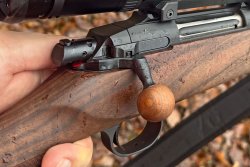
At the end of 2025, the opportunity arose to take the new HML on a driven hunt between the Eifel and Hunsrück regions. Unfortunately, the HML had to be hidden from the eyes of other hunters in a loden case – it was all still a secret. But the gun's performance has nothing to hide. On the range, the magazine is quickly inserted, securely locked, the cartridge slides smoothly into the chamber and the striker remains uncocked. Thanks to its slim shape, the fore-end is so easy to grip that you don't have to think about the "right" position for your hand: it intuitively finds the ideal place all by itself. The ergonomically almost perfect pistol grip allowed the shooting hand to be positioned exactly where the thumb can reach the cocking slide – and cocking when moving to the firing position was also automatic. After several sightings of fox and roe deer, a pack of wild boar finally came down the slope behind me to the stream, less than forty meters away. The last boar fell with a bang, the sow picked up speed and leaped over the stream. The five or six piglets following all came tumbling in a heap. But the last one, the only one free, had the crosshairs on the target (the boar’s snout, in hunting parlance) — at that distance, the perfect lead. And then it all happened very quickly: let the bullet "fly", watch the hit, cycle the action, catch up with the last piglet again using the red dot, overtake it, let it fly, cycle the action, catch up. The result: four piglets from one pack dropped instantly, eight to ten behind each other – the 8x57 IS worked and did a really clean job with the Nosler Partition bullet. Thanks to the barrel length of 56 cm and the "perfect" driven hunt distance of around 30 to 35 meters, the lead was minimal and the wild boar on the bright beech leaves were clearly visible with excellent contrast through the 1.1x magnification driven hunt scope on the rainy but bright morning – what more could you want? And so the hunt was a complete success and delighted the hunter's heart long after the hunt was over.
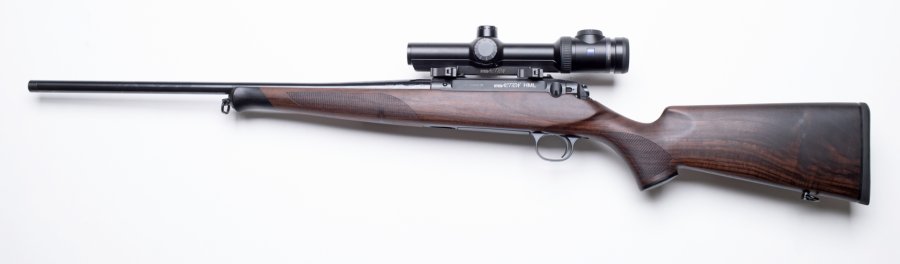
Steel Action HML straight-pull rifle with wooden stock: Technical specs and price
| Model: | Steel Action HML |
Caliber: | 8x57 IS |
Capacity: | 5+1 rounds |
Barrel Length: | 560 mm |
| Trigger: | Single stage |
Trigger Pull Weight: | Adjustable from 500 to 2,500 g (here set to 850 g) |
Safety: | Manual |
| Overall Length: | 1,075 mm |
| Weight: | 3,300 g |
Price (RRP): | 3,449 euro |
Design/equipment: | Straight pull rifle with three-lug bolt, walnut stock (class 3) with ebony tip and grip cap, anti-rotation sling swivels, Picatinny mounting bases, M15x1 muzzle thread. |
First test summary of the new Steel Action HML
The straight-pull rifle from the Rhineland is a rock-solid working tool for the hunting ground, which also impresses with its classically elegant appearance. The new Steel Action Hunting Medium Light (HML) also leaves nothing to be desired in terms of safe, fast handling, functional reliability and shooting performance. You can find out more about the technology, choice of calibers and options on the manufacturer's website. The price is the same as for the HSL model, at a fair €3,449 (RRP) in view of the features and the usual high quality.
Further information on the new HML straight-pull repeater model can be found on the Steel Action website.