
When looking at the years 1943–44, anyone examining the German development of fully automatic weapons chambered for intermediate cartridges will encounter a veritable chaotic jumble of designations: initially, such firearms were termed "Maschinenkarabiner" (machine carbine), then "Maschinenpistole" (machine pistol), before finally receiving the designation "Sturmgewehr" (assault rifle) — scholars still debate exactly who coined the term: Adolf Hitler or Erich Jaschke, then General of the Infantry in the Army High Command (OKH). In any case, in October 1944, a Führer Order — countersigned by the Office of the General of the Infantry in the OKH — mandated that the MP 44 was to replace the Karabiner 98k rifle as the standard infantry weapon and receive the designation "Sturmgewehr 44" — a name undoubtedly more evocative from a propaganda standpoint. Known by the abbreviation "StG 44," this weapon is regarded as a milestone in the history of infantry arms, both in terms of design and production engineering. This is not to say, however, that no improvements were undertaken — albeit at the very last minute — with a view to the manufacturing simplification that became increasingly necessary, particularly toward the end of the war; indeed, they were. And one such design originated from the very place where the StG 44 had first been brought into existence: namely, the Suhl-based firm of C.G. Haenel and the dominant figure there — serving as both authorized officer and designer — Hugo Schmeisser (1884–1953). A prototype based on this optimized Haenel design has survived to this day. However, its history and technical features can only be fully understood when viewed in the context of the development trajectory of the StG 44 itself.
View of the predecessor of the Haenel Sturmgewehr 45: the STG 44
In May 1938, the Haenel company received an official contract to develop an automatic weapon in 7.92 mm caliber, capable of both semi-automatic and full-automatic fire at ranges of up to 800 meters. After some back and forth and several revisions of the requirements, Hugo Schmeisser began designing the new weapon at the beginning of 1939. At the same time, Magdeburger Polte Armaturen- und Maschinenfabrik OHG, one of the world's largest ammunition manufacturers at the time, received an order to develop a short 7.92x33mm cartridge, the first samples of which Haenel received at the end of 1939. Schmeisser completed the first two prototypes of his automatic weapon in 1940. Although they were still machined, they were already designed for sheet metal stamping. This task fell to the Merz-Werke in Frankfurt-Rödelheim. As an experienced manufacturer of typewriters and office machinery, they were tasked with refining the new weapon and preparing it for mass production. Due to the high degree of precision required, however, this process took until the end of 1941. In January '42, a specimen of the "Heavy Submachine Gun 42" was sent to Polte for ammunition testing.

The developments regarding the Haenel weapons did not go unnoticed by the Walther company either. Consequently, in 1940, they began designing their own weapon chambered for the short cartridge, utilizing a stamped sheet-metal construction; the blueprints for this design were submitted to the Ordnance Office as early as January 1941. This was followed by a small series order for comparative field trials. When testing the weapons, now called "Maschinenkarabiner Mkb 42(H)" and "Mkb 42(W)", the Döberitz Infantry School involved in the trials favored the model marked "H", i.e. the one from Haenel. It was more rugged, easier to disassemble, featured a longer sight radius, and its mechanism was less susceptible to dirt. This paved the way for series production, and gave the infantry a truly groundbreaking weapon. Over the course of time, further improvements changed the shape of the gun and (as indicated above) its designation: from "MP 43", "MP 43/1" and "MP 44" to "Sturmgewehr 44". Production went into overdrive, and by mid-1944, the combined monthly output of all manufacturers temporarily exceeded 50,000 units.
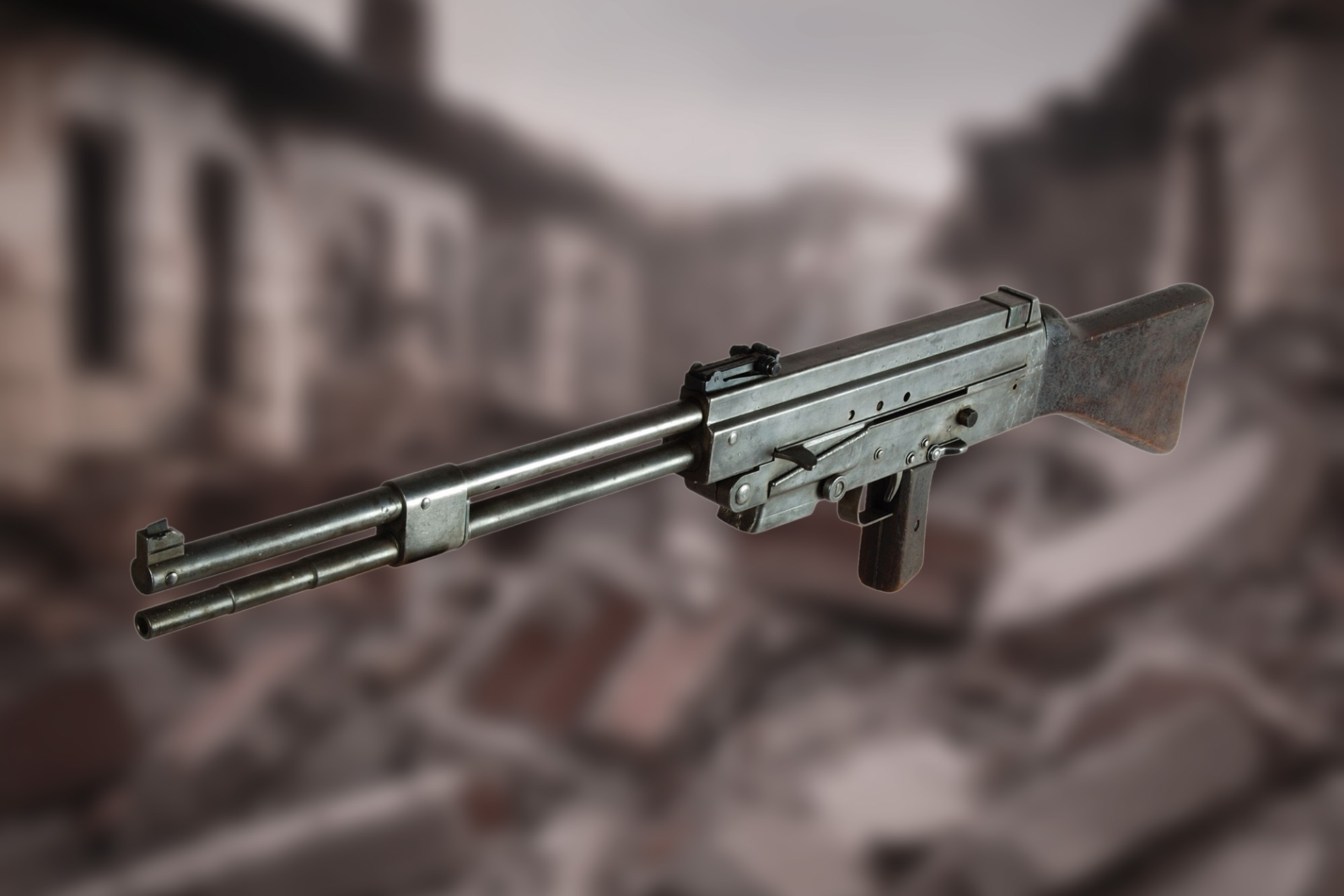
The course of the war also forced further savings on materials and labour. Minor changes were incorporated into ongoing production, but a more radical solution was needed for the future. At its fourth meeting on 12 and 13 December 1944, the Special Commission for Infantry Weapons (SKInfWaffen) gave C.G. Haenel permission to have Hugo Schmeisser produce a newly designed weapon for test purposes. The number of guns produced is not known. However, one such weapon has survived the test of time. It was "liberated" by US troops from the Haenel facility sometime after April 3, 1945, and sent to the US state of Maryland, more precisely to Aberdeen Proving Ground, the oldest development and research facility operated by the US Army. Today, this unique piece resides in the collection of the Springfield Armory National Historic Site Museum in Massachusetts.
Haenel's one-off: the Sturmgewehr 45...
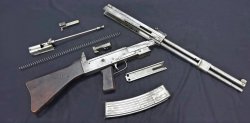
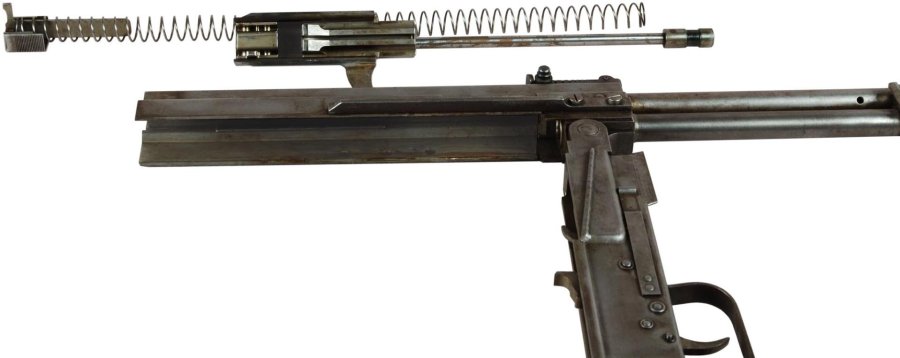
...bears no markings, but can be found in the old Aberdeen files as "StG 45(H)". At first glance, it resembles the Mkb 42(H) due to its long gas tube, but like the StG 44, it is an open-bolt gas-operated firearm, featuring a locked tilting bolt system. The receiver of the unique Haenel model is sheet metal with smooth sides without stiffening ribs. A hinge attached to the front of the receiver allows the lower assembly — comprising the trigger unit and wooden buttstock — to be pivoted downward. This means that the moving parts (bolt carrier with gas piston, bolt and recoil spring) are accessible in the upper receiver and can be easily removed. Thanks to this design, there is no longer a need for a detachable buttstock secured by pins that are prone to being lost. Furthermore, the separate pistol grip assembly found on the StG 44 was eliminated; the trigger mechanism is integrated directly into the lower receiver, which features only a simple pistol grip fitted with wooden panels. The fire selector, safety lever and sliding rear sight come from the StG 44, but in this case they are mounted directly on the receiver without a separate base.
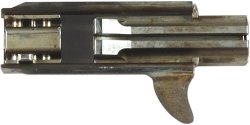
Internally, the milled components have likewise been reduced to a minimum. The bolt carrier consists of a stamped sheet-metal part featuring an integrated, hook-shaped charging handle. Thanks to its flat profile, the guide slot on the left-hand side of the receiver could be kept very narrow to minimize the ingress of dirt. There are no guide grooves or rails; the bolt simply slides along the receiver walls. When in the forward position, the bolt carrier also covers the ejection port. This design allowed for the elimination of a dust cover such as that found on the StG 44. The simplified gas piston, one of the few remaining milled parts besides the bolt, is screwed to the front of the bolt carrier using a hexagon nut and lock nut. Even the shape of the bolt itself has been simplified.
Another consequence of rationalization was the distinctive feature of a long, smooth gas tube with a small front sight mount base and blade. This eliminated the need to manufacture a separate front sight block and mount it directly onto the barrel. The gas block assembly was also significantly simplified and now featured smooth side surfaces. The prototype lacks a handguard like the StG 44, but this element may simply have been lost. At the very least, providing a means to protect the shooter's hand from the hot barrel would have been a sensible design choice. The magazine catch consists merely of a strip of spring steel instead of a classic coil spring. The gas tube length is particularly interesting in view of the requirements stipulated for the previous assault rifle models: specifically, that a rifle grenade launcher be fully compatible with the weapon. The launcher’s clamp-style mount with two jaws was placed around the barrel and screwed together behind the front sight block. On the StG 44, this same mounting system also served to attach other accessories, such as the curved barrel attachment and the sound suppressor. None of these accessories could be fitted to the new Haenel weapon
Overall, with this assault rifle the company C. G. Haenel achieved a much simpler design compared to the StG 44, one that would have saved a lot of time and material in production. Field stripping was also easier thanks to the hinged receiver. However, the weapon arrived too late for troop trials. In Aberdeen, too, it likely went straight into storage: there is no documentation of a more detailed examination or firing tests.
Text: Michael Heidler and Matthias S. Recktenwald
Thanks to: Alex MacKenzie of the Springfield Armory NHS Museum.