
The new PROOF Exponential Twist barrel technology, or PXT, addresses one of the key limits of conventional barrel design: the severe stress generated when the bullet first engages the rifling. Instead of forcing the projectile into full rotational speed almost immediately, PXT uses an exponential twist profile and refined rifling geometry to deliver a smoother, more controlled transition through the bore. By reducing stress at ignition and softening initial bullet engagement, PXT improves consistency across ammunition types, enhances recoil control, and supports long-term performance. The result is measurable improvement in consistency, accuracy, and barrel life without sacrificing downrange performance.
PROOF Exponential Twist: A video introduction
PROOF Exponential Twist, a pretty long story
Progressive rifling, aka gain-twist rifling – that is, gradually increasing twist rate from the breech toward the muzzle – is not a new idea, being first developed in the 19th century. The PXT story began around 2018, when the U.S. military sought greater performance from existing weapon systems. That work led PROOF into medium-caliber cannon barrel development and prompted a complete rethinking of rifling profiles, twist rates, chamber pressure, projectile behavior, and barrel manufacturing. By the early 2020s, the same concepts had moved into small arms, from 5.56mm up to .338 caliber. "In a conventional barrel, the bullet is forced forward, abruptly engages the rifling at roughly a 6° angle, and begins rotating at full speed within the first quarter inch of travel,” they explain at PROOF Research. “This creates a sharp pressure spike, accelerates barrel wear in the first two inches of the barrel, and places significant stress on the projectile. With PXT, we’ve reduced that initial engagement angle by approximately 95–98%, dramatically softening initial bullet engagement, reducing pressure spikes, and minimizing throat wear."

Where traditional barrels may begin with twist rates of 1:7 to 1:10 at the breech, PXT starts far more gradually, often around 1:250 to 1:500, then progressively accelerates through the bore. PROOF also reengineered the rifling profile. Conventional sharp-edged rifling is efficient to manufacture and bites aggressively into the bullet jacket, but it can increase wear and deform the projectile. PXT uses a proprietary, smoother-edged profile that reduces engraving force by approximately 30%, limiting projectile deformation, reducing land wear, and enabling a more gradual twist progression. The result is also 30–100% longer barrel life. There are gains in consistency and accuracy, too: across multiple ammunition types and lot variations, controlled testing has shown repeatable group-size reductions of 20–50%. Moreover, thanks to the reduced rifling lead angle and smoother projectile engagement, PXT barrels are less sensitive to bullet jump and powder-charge variation.
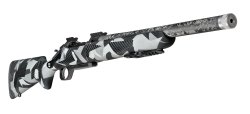
At present, PROOF Research is offering PXT Bolt Action Blanks, PXT AR-Style Barrels, PXT Pre-Fit Barrels, together with two complete bolt-action rifle platforms: the Elevation FDX and the Elevation MTR (Mountain Tactical Rifle) FDX, priced at $3,499 and $3,799 respectively, and chambered in 22 Creedmoor, 6.5 Creedmoor, 6.5 PRC, 7mm PRC, 7mm Backcountry, or 300 PRC.