
Introduced last year, Inforce's new ARC series of professional tactical flashlights has been available for a few months now, and I have received the four models currently available to try them out exclusively. Given the features of these flashlights, specifically designed for LE, the military and professional users, let's take a small step back.
I had already tested the WML-series Weaponlight tactical weapon lights from the historic US manufacturer Inforce, which has been used by many US government agencies, police departments and military units since 2008. I had an excellent impression of them, so much so that I bought one of the flashlights that was sent to me for testing, the WMLx IR Gen II white-light and IR version, which is still mounted on my Steyr AUG.
In a way, with the ARC series Inforce returns to more traditional designs and materials – unlike the professional WML models, now in their third generation, which used composite materials. In fact, the ARCs are based on an a full 6061-T6 aluminum construction with MIL-SPEC type III anodised finish and, above all, they adopt a modular design: the thread pattern, both head and tailcap/switch, as well as the mounting interface, are compatible with the Scout standard. This makes it is easy to customize the tactical light using e.g. remote control tailcaps, IR or Weaponlight heads, specific mounts – e.g. Picatinny instead of the included M-LOK mount.
The ARC range is certified IPX8 waterproof up to 20 metres and meet MIL-STD-810H standards.
The ARC series includes four models (six, if you count the two PRO variants of the weapon light models, which offer a richer package, with a second M-LOK mount and the tailcap with DA Switch remote control): two come with integrated gun mounting lugs, and are differentiated by the type of battery used and consequently the brightness of their beams; and two are exactly the same but come with no mounting lugs, and thus are for "stand-alone" handheld use.
The two basic models are the ARC 350 and the ARC 650, the difference being in the main body that accepts a Li-Ion 18350 or 18650 rechargeable battery, respectively. In the case of the ARC 650, the rechargeable battery can be replaced with a pair of CR 123As if needed.
The interesting thing about the ARC series is its modularity: apart from the main body, every other component is the same for all models – even the LED head, which, depending on the battery voltage, provides 1,200 lumens when mounted on the ARC 350 or 1,400 lumens on the ARC 650.
The same goes for the two models with Scout footprint and thread pattern for weapon mounting.
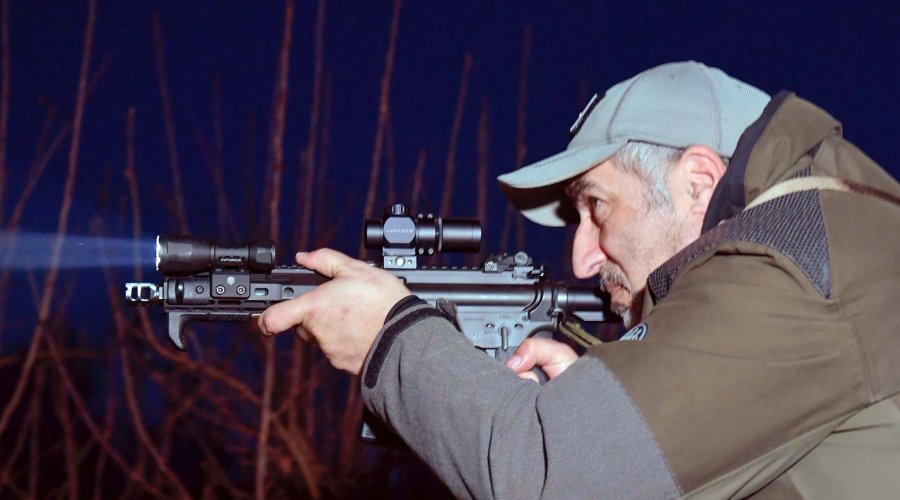
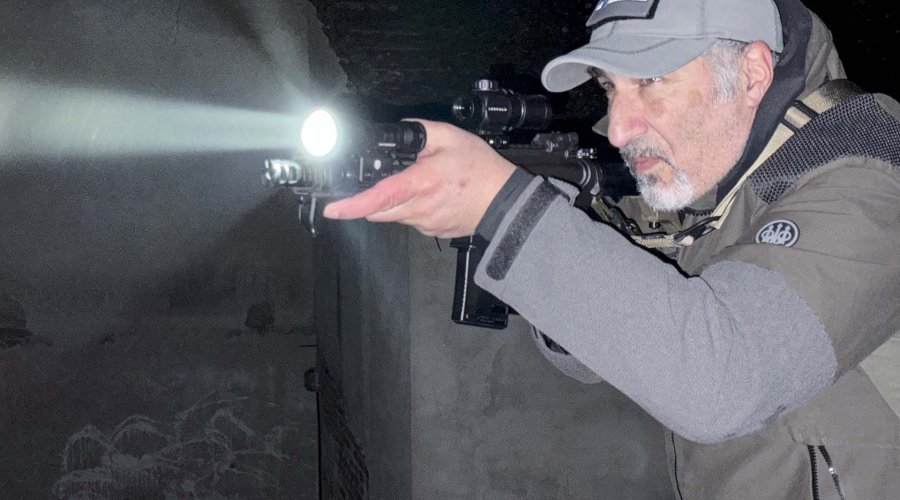
I tested the tactical lights in the mountains and in urban areas to evaluate the output quality, ergonomics of use and overall performance. The gun on which I mounted the ARC 350 LR-M is a DR15 M4-PDW with a 7.5" barrel in .300 BLK with M-LOK handguard; the suffixes LR and M stand for Long Range illuminating head and M for M-LOK as the mounting interface, respectively.
The ARC is mounted on the left side of the handguard to use the "compact" C-clamp grip in which the thumb of the left hand operates the flashlight, acting on the tailcap button. It must be said that all ARC-series lights offer neither a strobe function nor a low-brightness setting. The beam pattern is well defined, with a gradual fall-off from the center circle that allows excellent environmental awareness without losing power in the hotspot, with a very homogenous pure white light. The ARC 350 version has a 75,000-candela hotspot and a max beam distance of up to 529 metees, while the ARC 650 has a 90,000-candela hotspot and a range of up to 600 meters.
The light output is well designed for the specific use as a weapon light, but it remains a little underpowered compared to the competition when considered in stand-alone mode, where the lack of brightness setting options affects it a little.
The package contains the flashlight, an appropriate rechargeable battery, a charger with USB C port, and in the case of the ARC 650, an adapter tube for CR123A, plus instructions; the Weaponlight versions add two Allen keys and an angled M-LOK mount for weapon mounting.
Those looking for a no-frills, high quality, simple and effective weapon light (you can't break what is not there, just like with the WMLx) with the great advantage of compatibility with Scout footprint/thread pattern and the considerable availability of accessories and spare parts for that standard, will not be disappointed. Prices start at $199.97 for the ARC 350 handheld model.