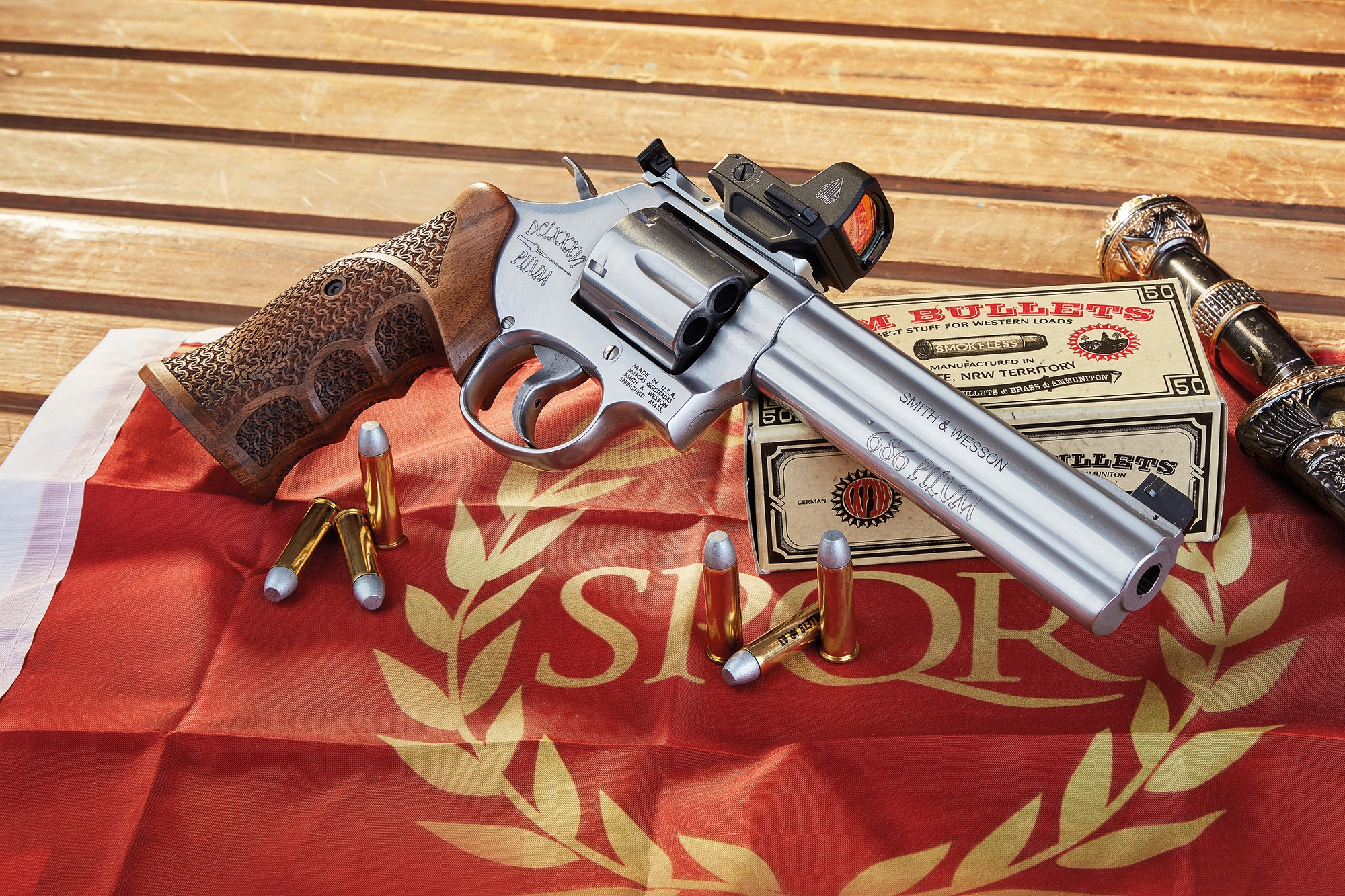

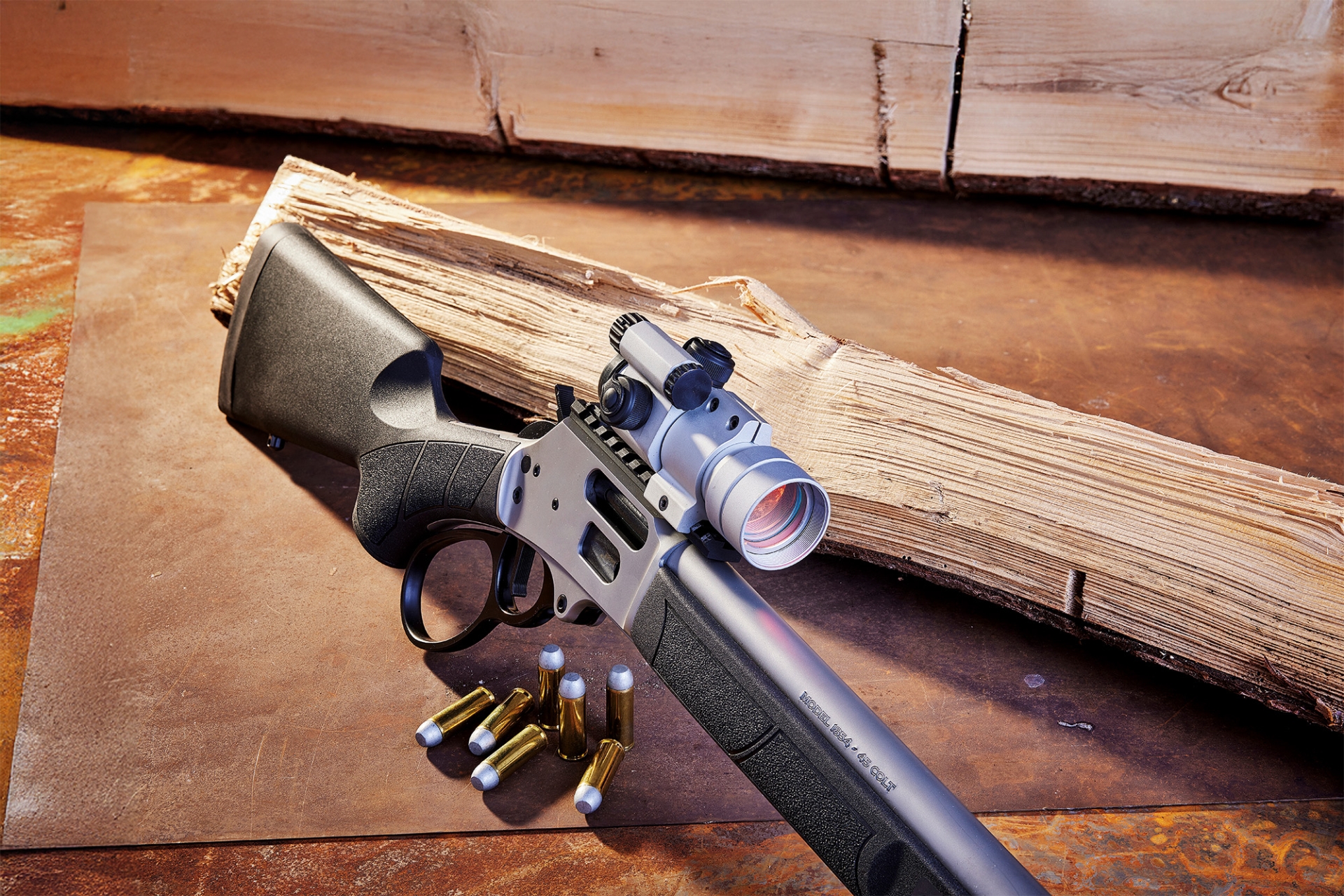
They can make revolvers – this has been the core competence of the US company Smith & Wesson since the middle of the 19th century. Like no other company in the world, the manufacturer in Springfield, Massachusetts, has shaped wheelguns. But S&W is also capable of other things: before the First World War, the factory began producing semi-automatic pistols, later adding bolt-action and semi-automatic rifles, and submachine guns. Rifles are therefore not a new field for S&W, as in some respects the manufacturer is picking up where it left off. That is, in the field of lever-action guns, where the company founders Horace Smith and Daniel Baird Wesson were among the pioneers: their first company made the early Volcanic-type lever-action pistols in 1854/55, for which the inventor duo received US patent no. 10,535 on 14 February 1854. The manufacturer followed up on this date 170 years later by introducing the Lever Action Model 1854.
For just over two years, the factory has been manufacturing 1854s in three different versions, as well as making these rifles for several revolver calibers, namely .357 Magnum/.38 Special, .44 Magnum/.44 Special and .45 Colt. In the summer of 2025, the first variant followed in the chambering most commonly found worldwide in high-performance lever-action rifles, namely the .45-70 Government. A second rifle caliber, the .30-30 Winchester, which is probably the most typical lever-action cartridge, was recently added. However, experience shows that the introduction of a new American product in the USA usually takes place at a different time than its debut in the Old World.
Smith & Wesson Model 1854 lever-action rifle in detail
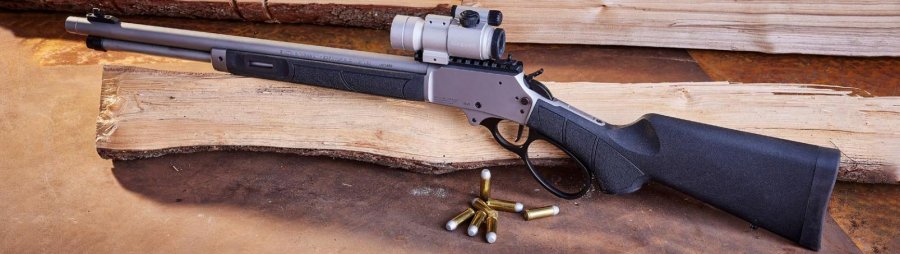
The stock parts are made of black polymer, the grip surfaces textured with stippled patterns and the fore-end features three M-Lok slots at the front, two on the sides and one at the bottom. Stainless steel (in this case, the tried-and-tested 416 grade) dominates the metal components. The Torx screws, as well as the functional and operating parts are in black. This applies to the bolt, safety, lever, hammer, trigger, the screwed-on front sight with gold-colored bead and the Picatinny rail, which, in line with the current trend, is fitted with an integrated XS Sights aperture sight, which is adjustable in elevation and windage. From a purely external point of view, this 1854 version differed significantly from the .44 Magnum version we had already tested, which came with walnut stock and black metal parts finished using the Armornite process (also known as Melonite). And it differed from the Model 1854 Stealth Hunter because its 16.3-inch barrel is shorter than the 19.25-inch standard of the series, not to mention the aluminum handguard with its 15 M-Lok mounting slots.
Technology of the S&W Model 1854: old and new
With the Model 1854, S&W is treading familiar paths that have been optimally developed by two designers from another US company. These are the engineers Lewis Lobdell Hepburn and Thomas Robinson, who had a significant influence on Marlin rifles. Hepburn was responsible for the side cartridge case ejector, which is also found on the Model 1854, and the two-part firing pin for safety reasons. On this basis, Robinson developed the Marlin Model 336 presented in 1948, and its mechanics also formed the foundation for the Model 1854. S&W is not the only company to rely on this design principle: Rossi's R95 and Henry's Big Boy also work in this way.
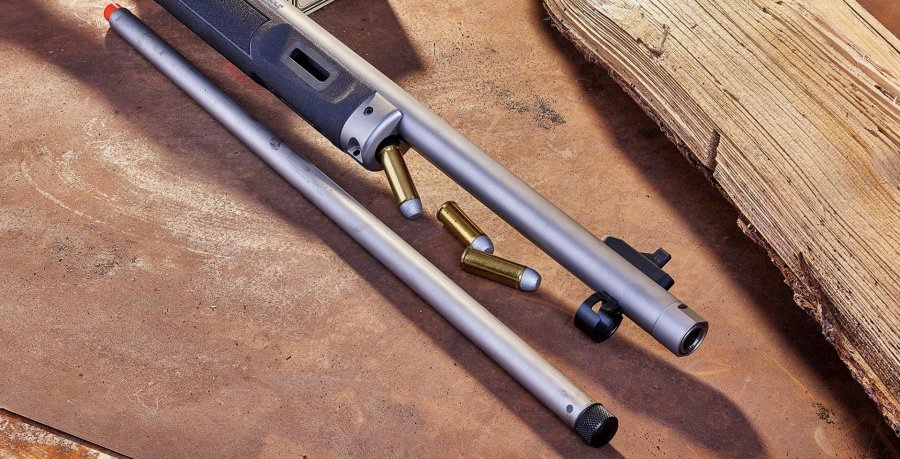
This doesn't mean that the guys at Springfield are simply copying: the Model 1854 offers a technical option that, until now, has only been available on this model series. It concerns the loading/unloading system. The standard procedure for many lever guns is to insert the cartridges directly into the magazine tube through a loading gate on the right-hand side of the action. Alternatively, cartridge after cartridge can be loaded through a loading gate in the magazine tube by pulling out the inner magazine tube, which is inserted in the outer tube together with the feeder to the front. However, if you want to unload unfired rounds, the Western-style, cumbersome method is to cycle the action without reloading. This is where the S&W innovation comes in: you can empty the magazine tube by releasing the twist lock at the end of the tube and pulling the tube out to the front from beneath the barrel (preferably after activating the hammer block cross-bolt safety). Now all you have to do is tilt the gun forwards so that cartridge after cartridge can slide out gently. This is quicker than with any other lever gun and it is always gentler than forcing the ammunition backwards through the magazine and receiver and then catapulting it into the open by spring force.
Smith & Wesson Model 1854 tested in the field
In terms of workmanship, the test sample was at the upper level of American series products: everything was tidy, even if, as is so often the case, there were some obvious gaps between the metal and plastic parts. And as with the .44 Model 1854 Tradition Walnut, which has already been reviewed, there were no objectionable factory marks to be found inside. The same applies to the sharp corners on the hammer spur and the all-too-clearly perceptible edges on the lever loop, which can be found on many lever guns: although they were not completely round-ground here, they were broken to a more than acceptable degree and therefore pleasant to the touch (more on this in a moment). The 3,165-g rifle could be comfortably fired by testers between 1.75 and 1.90 meters tall and also proved to be slightly heavier than comparable guns from other manufacturers. This benefited the balance and reduced muzzle flip without compromising comfort. Once again, S&W earned praise for the extremely grippy texture of the grip surfaces and the deliberately "fat" design of the fore-end and buttstock, which offered the hands plenty of contact surface. This is another welcome change, particularly compared with slim lever-action guns in the old-style design.
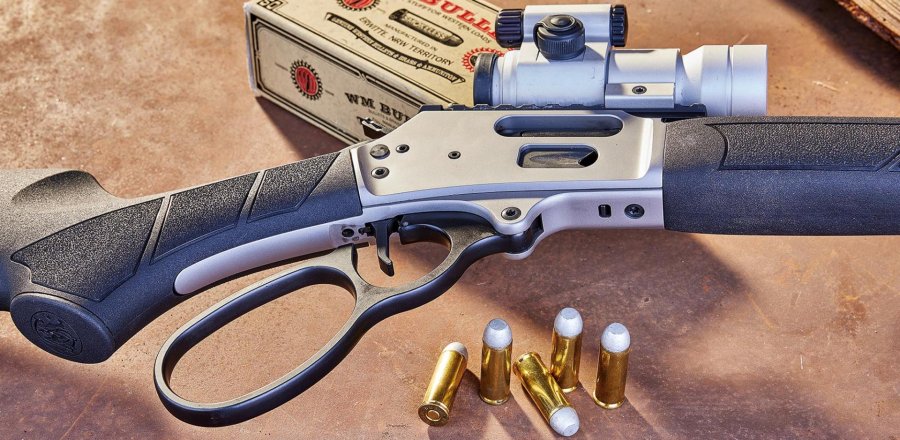
Nevertheless, it was not without some grumbling: no tester was able to operate the cross-bolt safety without noise or creaking. Okay, even in the USA the .45 Colt is not a classic hunting cartridge, but rather something for recreational target shooting, so the noise-related features can be tolerated. The test shooters described the trigger pull weight as acceptable: several checks with the Lyman Trigger Pull Gauge resulted in an average trigger pull weight of 2,177 grams. However, this quite robust value shows how precisely S&W works, as the 1854 Traditional Walnut achieved 2,350 grams. In both cases, the trigger broke cleanly after a noticeable, but negligible, initial creep with no overtravel, although index fingers accustomed to target rifles might find the pressure on the trigger with its straight edges somewhat harsh. This also describes cycling. With rifles in the 336 Marlin series, there are a few decisive points for rough or hard interaction: firstly, when the bolt goes over the hammer when opening in order to cock it. This could certainly be made softer by removing a small amount of material at the rear bottom of the bolt or the top of the hammer – hold on, dear basement tinkerers, don't go filing it down yourself. That should be done by someone with expertise. Secondly, there's the spring-loaded lug integrated into the rear of the trigger guard, which engages at the bottom of the receiver when the lever is closed: it should also be possible to soften the action without compromising the safety and without it continuing to creak like the door to Dracula's crypt. In practice, it became apparent that the gun required a hard hand to feed and eject safely. However, this sometimes resulted in very intensive contact with the lever edges. Nothing that could not be significantly mitigated by a sensible leather or paracord wrap. Or by precise and careful material removal.
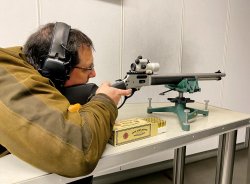
The accuracy test: with the iron sights, the aperture and bead produced a sight picture with a lot of air around it, too much for accurate aiming. So an Aimpoint CompC-SM (7 MOA) was placed on top of the rail. Even though the Swedes have discontinued this red dot model in the meantime, this does not mean that this optic no longer works. It did so without any problems. As far as ammunition was concerned, the testers had the problem that .45 Colt cartridges are not available everywhere and at short notice. So we used what could be gathered from various stocks of different loads, some of which were obsolete. The testers fired four lead flat-head types suitable for tube magazines from the brands WM Bullets, Winchester-Western, CCI Blazer and O&C, the lightest bullet being the WM Bullets one with 245 grains, the heaviest the CCI Blazer and O&C with 255 grains. The rifle coped best with the latter, delivering a five-shot group of 62 mm at 50 meters. That is within the acceptable range and more than enough for dynamic target shooting. And the fun factor? Well, you don't need to tell the testers twice to try it out. In other words: as long as there is lead, it should go downrange. Nine rounds in the magazine, the tenth in the chamber, and then empty the magazine as quickly as possible with the gun firmly held and the red dot on the bullseye. Even if the fingers hurt afterwards, everyone involved was happy.
Smith & Wesson Model 1854 in .45 Colt technical specs and price
Model: | Model 1854 |
Caliber: | .45 Colt |
Capacity: | 9+1 rounds |
Running Length: | 487 mm (19.25") |
|
Overall Length: |
915 mm
|
Barrel Twist: | 1:504 mm (1:20") |
Trigger Pull Weight: | 2.177 g |
Weight: | 3,165 g |
| Price (MSRP in the US): | $1,279 |
Equipment: | Lever-action rifle with tubular magazine and external hammer, synthetic stock with M-Lok slots, textured grip surfaces and rubber butt plate, metal parts made of stainless steel; front sight with gold-colored bead, fully adjustable ghost ring rear sight integrated in 12-cm long Picatinny rail. |