

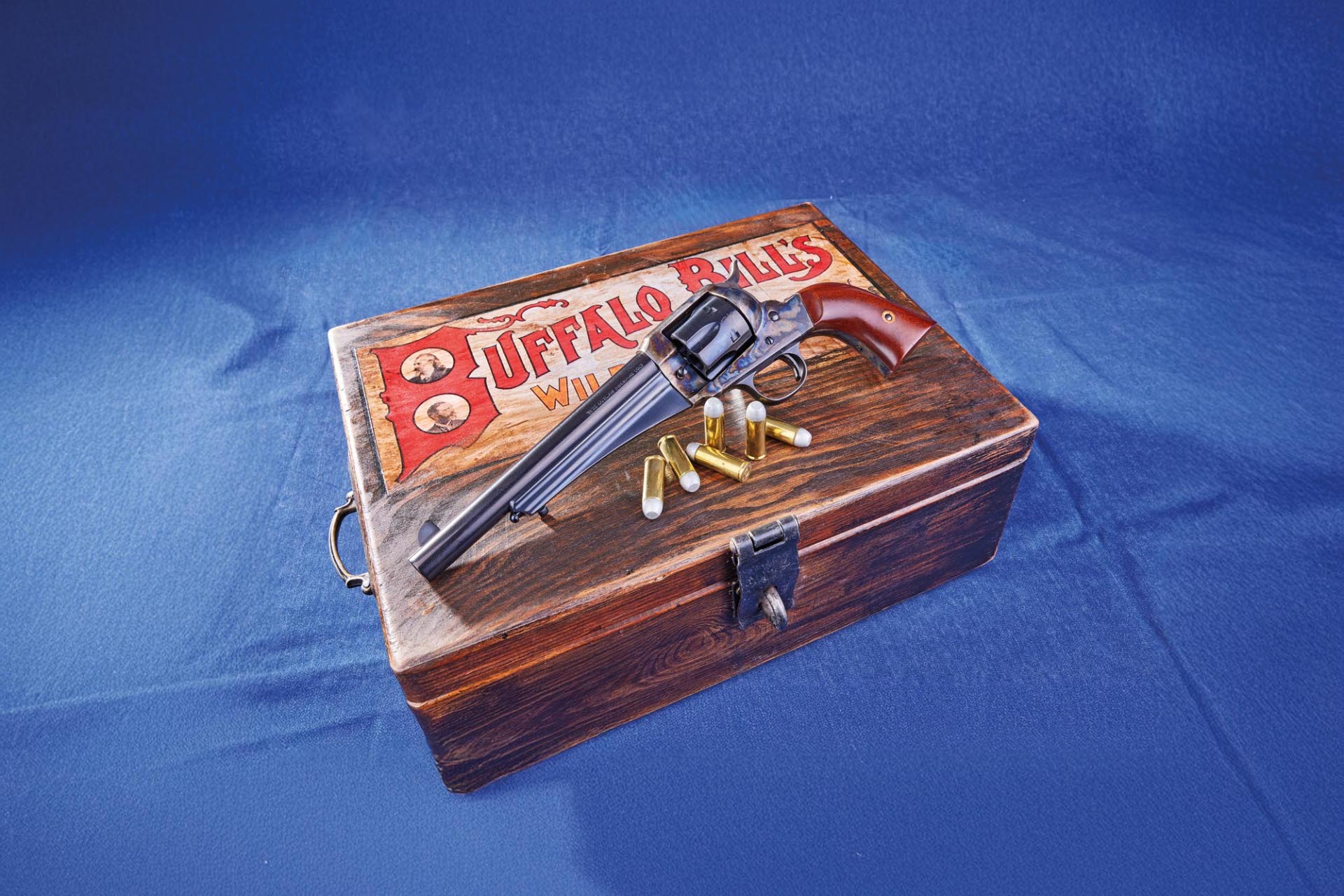
At the time, he was considered one of America's most famous outlaws: no wonder people paid attention when Alexander Franklin "Frank" James (1843-1915) turned himself in to the authorities in Missouri's capital Jefferson City in 1882. Accompanied by doctor Allen Howard Conkwright (1837-96), the bandit with a lifelong passion for Shakespeare presented his narrow cartridge belt and simple Slim Jim holster to Governor Thomas Theodore Crittenden (1832-1909) in a theatrical gesture. James had cut the holster deeper so that he could get his thumb and forefinger on the hammer and trigger when drawing the revolver. However, the leather holster contained neither one of the Colts practically ubiquitous in the West nor one of the popular Smith & Wesson break-action revolvers, but a Remington M 1875 in .44-40 Winchester. Why? Frank James: "The Remington is the hardest and surest shooting pistol made." Today, Western enthusiats can access the replicas marketed as "Outlaw" by the Italian brand Uberti. When they try out the Outlaw, they will see that the Remington design introduced in 1875 has some practical advantages. But first things first.
The construction of the Uberti 1875 Remington Outlaw
Anyone comparing a revolver like the "Remington Improved Army Model," aka "Remington No. 3 Army," or "Remington Single Action Army" with a Colt SAA will find similarities: both are six-shotsingle-action revolvers with curved backstraps and solid, closed frames that hold the screwed-in barrels. The cylinders are loaded chamber by chamber via a side loading gate and unloaded using an ejector attached lengthwise to the barrel. But that's where the similarities end. The Colt design developed by engineer William Mason (1837-1913) is based on a three-part construction consisting of the frame, backstrap, and grip front strap/trigger guard. It takes a whopping six screws to join all of these components together. If, instead of the original one-piece wooden grip, two panels (made of hard rubber, bone or — horrible to say — mother-of-pearl) are fitted, then a seventh screw is added in the grip frame area. Sooner or later, they will all come loose during use.
The Remington and the Uberti Outlaw, on the other hand, are based on the design that Fordyce Beals (1806-70) had created for large-frame Remington muzzleloaders like the New Model Army, and which was now adapted for a breech-loading revolver. The core component is a one-piece element that comprising the gun frame and the grip frame (occasionally fitted with a large lanyard ring). There are three screws, one for the grip panels and two for the separately attached trigger guard: undoubtedly, this design is inherently more robust, both in the original Remington and in the modern Uberti replica.
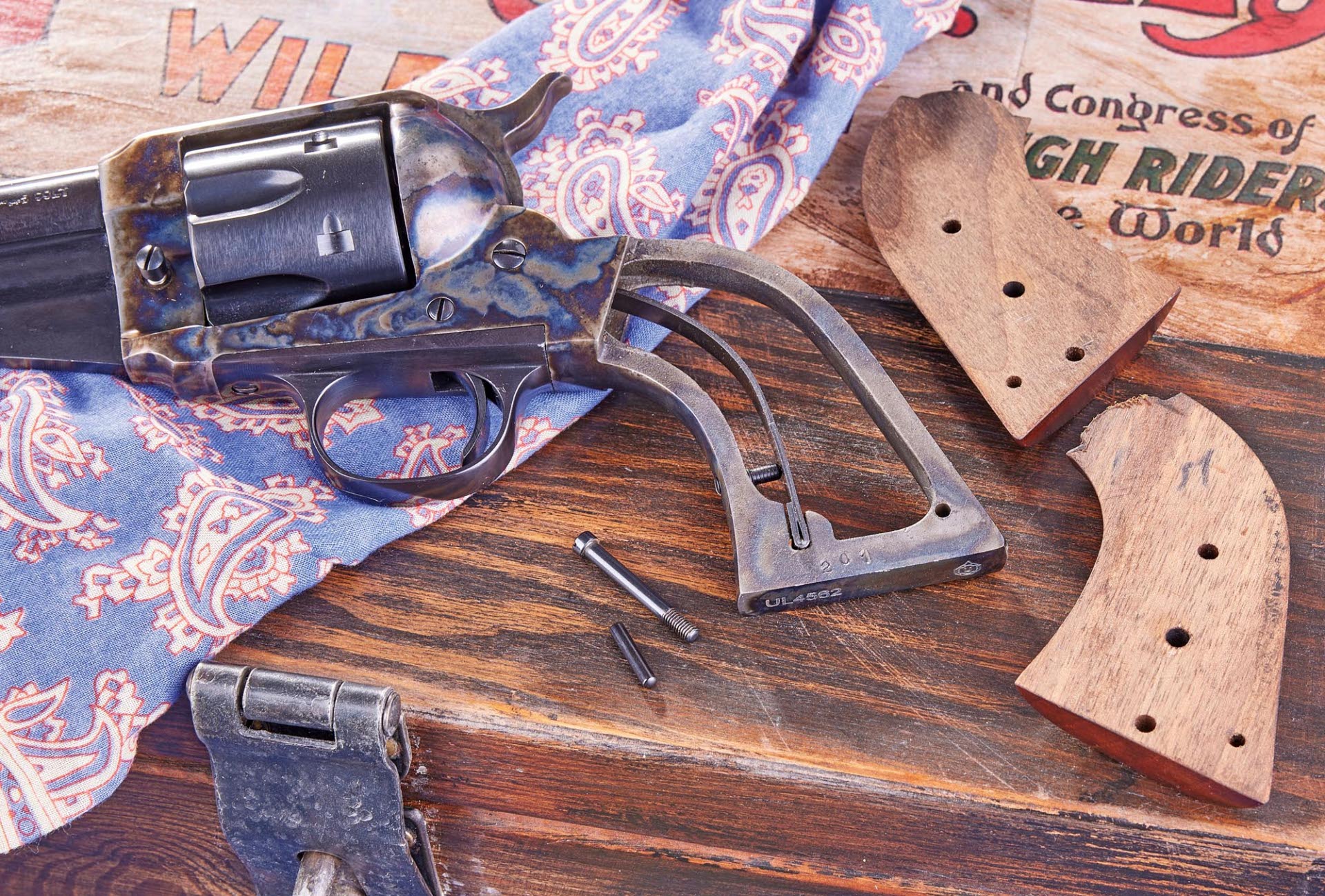
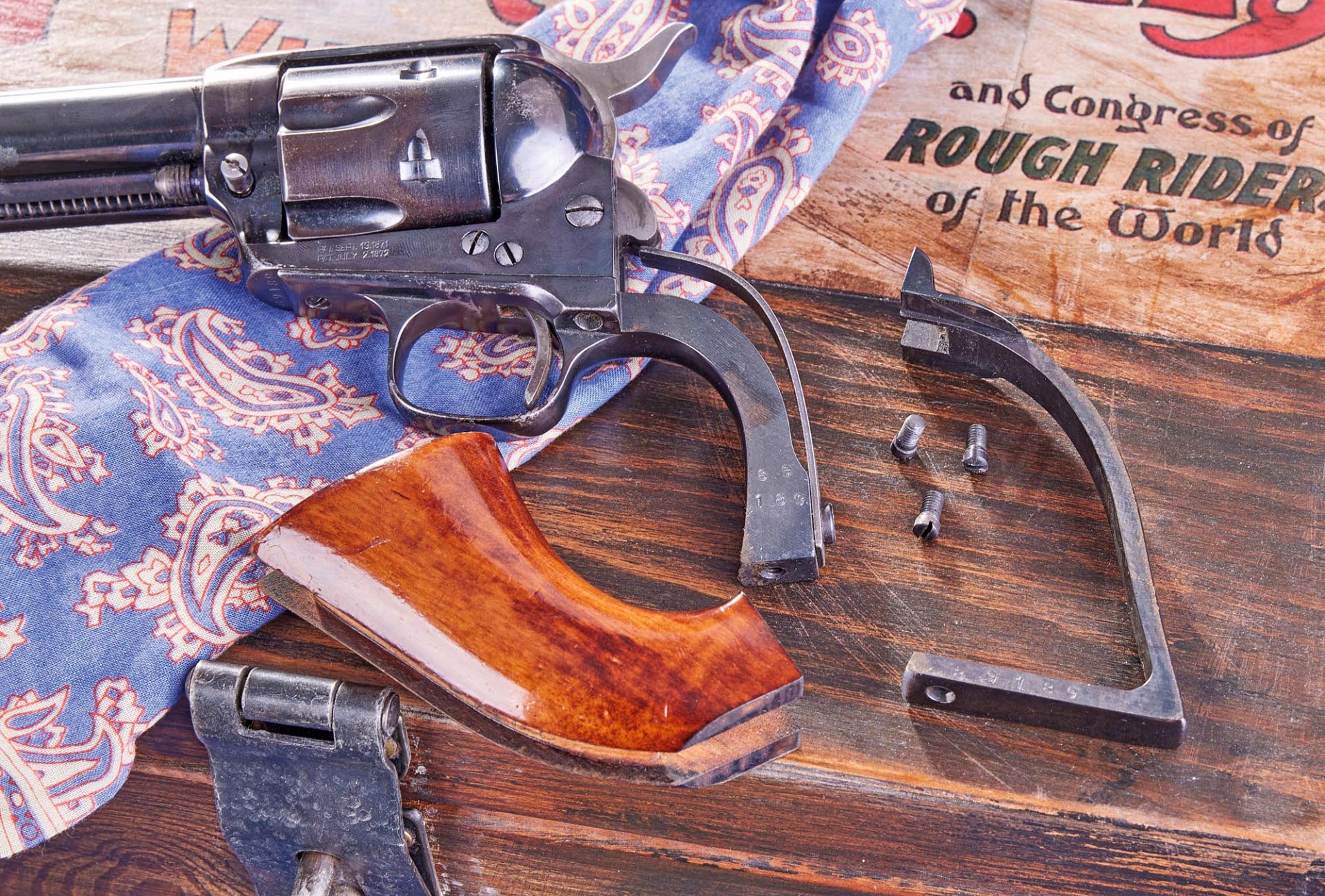
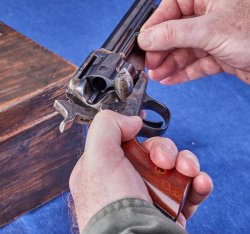
The next plus point of the Remington-style revolvers is the ejector type, which the engineer William Algernon Sydney Smoot (1845-86) devised for a pocket revolver in the early 1870s. As with the Colt SAA, the "ejector" is located lengthwise on the right-hand side of the barrel, but the head for operating the rod is on the outside rather than the inside. This eliminates the need to reach under the gun to eject spent cartridge cases, although the "inside versus outside rod head" debate continues among Western enthusiasts. The grip design is undisputed: Remington & Sons clearly did their homework and optimised the design when transitioning from the New Model Army to the Model 1875. As a result, today's users of an Uberti Outlaw have an advantage if they have large hands: here, the distance from the backstrap to the trigger is a good centimeter longer than with the Colts and their clones. For all those cowboy action shooters who rely on speed, it's essential that the gun is perfectly aligned when aiming, without the index fingertip having to find the right position on the trigger. Oh, and even the most striking element of the Model 1875 design also has its purpose. This is the triangular "sail" under the barrel. What looks like a reminiscence of the loading lever of older muzzleloaders actually improves the balance of the gun and serves as a guide when it is holstered.
Commercial success of the M 1875: he who comes too late...
Anyone who remembers the Russian politician with the red birthmark on his bald head will know what happened next. In any case, the fate described by Mikhail Gorbachev with these words also befell the Remington M 1875 — it was "Johnny come lately": when the model made its debut, customers found it too similar to the already established Colt SAA. They felt the Model 1875 lacked something really new. Moreover, its new .44 Remington centerfire cartridge failed to gain traction in the USA. Only a few models were chambered in the popular .45 Colt caliber; however, versions in .44-40 Winchester appeared in the 1880s. Remington initially hoped for a large order from Egypt. Apart from a handful of pieces, however, this failed because the country on the Nile could not pay; as a reminder of this, the nickname "Egyptian Model" remained for the Model 1875. Official orders remained scarce: a batch of approximately 1,000 guns went to Mexico (stamped with "RM" for "República Mexicana"), another 1,300, mostly nickel-plated guns, to US government agencies. According to US antique firearms specialist Norm Flayderman, 639 of these ended up with Native American police officers working on reservations, including Tacankpe Luta, also known as Marcellus Red Tomahawk (1853-1931), who shot and killed the famous Hunkpapa chief Sitting Bull (born around 1831) in December 1890. By then, however, production of the Model 1875 had been discontinued for about a year. The series totalled around 25,000 to 30,000 units, mostly with 7 1/2-inch and quite rarely with 5 3/4-inch barrels. This doesn't mean that Remington's production of large-caliber single-action revolvers was over: the successor, basically a Model 1875, arrived in 1890, only available in .44-40 with black rubber grips and without the holster guide. As a result, the 1890 model resembled the Colt SAA even more than its predecessor — the customers were uninterested and after just over 2,000 units, the end came in 1894.
An Outlaw from Italy: the Uberti Remington 1875 Outlaw
Anyone wanting to own such a rifle for shooting will inevitably come across Uberti: over the past half-century, the Brescia-based factory has made variations of the Model 1875 "Outlaw" and Model 1890 "Police" in .357 Magnum, .44-40 Winchester, .45 Colt, and even .45 ACP, in blued-case-hardened, nickel-plated, or white finishes, engraved or artificially aged. And they did so for a longer period than the original models, and likely in greater quantities. As a result, the M 1875 has appeared in countless films. One was featured at the beginning of the first Indiana Jones movie, as well as in Wyatt Earp with Kevin Costner and in Tombstone with Kurt Russell, though the latter lacked the added cylinder pin latch (more on that later). When Timothy Olyphant played one of the main roles, that of lawman Seth Bullock, in the TV series Deadwood, he also carried an Uberti 1875.
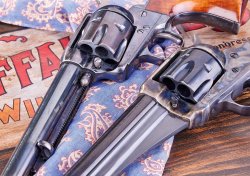
Of course, Western shooters also turn to these neo-classics. In practice, they perform just as well as the Colt SAAs or the Ruger Vaqueros that are widely used in cowboy action. Loading them is also virtually identical. What you have to live with is that the originals did not have the cylinder cross-pin latch of the Ubertis, which the factory adopted from the Colt SAA. The reason for this lies in US product liability and customs law. This is why the Italo-Remingtons also have an additional hammer safety notch and block, which is typical of Ubertis. And while all the metal parts around the frame and grip of the original were made of steel, some Ubertis were fitted with brass trigger guards — Robert Urich used one such example (also adorned with mother-of-pearl grips) in the TV western classic Lonesome Dove. But that's where the differences end. If you want to get it completely correct, you might hope to find one of the 1875s made by Hartford Armory (HA) a few years ago. As a US company, this firm was able to disregard some regulations concerning safety features that applied to imported goods. The result was incredibly authentic, well-made – and even less profitable than the original: the HA is now only available as an antique. Uberti's 1875, however, is enjoying a revival, especially since it's affordable and of acceptable quality. The test gun was decently made, its timing was accurate, and trigger pull was set at 1,640 grams from the factory. It remains to be seen how it shoots.
Handling, loading, shooting: the Uberti Remington 1875 Outlaw in practice
The hammer has three positions: safety, loading and cocked. The safety allows six cartridges to be held in the chamber. For loading/unloading, the hammer is placed in the loading position, then the cylinder can rotate freely. The loading gate can always be opened, regardless of the hammer position. To remove the cylinder: open the loading gate, move the hammer to the loading notch, press the spring-loaded release button at the front of the frame, and pull the center pin forward. The cylinder is quite short at 39.6 mm – for comparison, the cylinder of an older Ruger Vaquero measures 43.5 mm. This means that cartridges for the Model 1875 must not be too long. Cartridges with a length of 40.8 mm will fit, but loads with a length of 41.5 mm would block the cylinder's rotation.
Loading was explicitly not about maximum accuracy and optimal loads. Instead, the test was intended to show that the Outlaw shoots well with whatever bullets and handgun powder available. Hardly anyone can afford to buy a specific powder for every firearm. Rather, most shooters have a few bullet types suitable for many firearms, along with a powder type that is as versatile as possible. And the Lovex S020 powder fulfils this requirement. It can be used to create to make precise loads in all standard handgun calibers from .32 S&W Long to .45 ACP, as well as for lever-action rifles in handgun calibers. The testers used these for nitro loads. There was also one load each of Hodgdon HS6 and Swiss black powder No. 2 (3 Fg). The cases were from Starline, fired with CCI Large Rifle primers and the bullets were two lead variants, each weighing 250 grains, with two grease grooves in the black powder load, which were also lubed accordingly. The testers fired the Outlaw in a seated position with a sandbag support and measured the groups from hole center to hole center. The cartridges with 8.8 and 9.3 grains of S020 as well as those with black powder felt powerful, the revolver rotated in the hand – Western fans appreciate this because it is part of the feel of the gun, as is the gentle bite from the hammer spur when cocking. The accuracy is perfectly adequate for the usual distances and target types in cowboy action shooting. Out of the box, the hits at 25 m were in the lower third of the target and about 2 to 5 cm off the center line. Malfunctions? Lead fouling? None of the above.
Uberti Remington 1875 Outlaw single-action revolver technical specifications and price
Model: | Uberti Remington 1875 Outlaw |
Caliber: | .45 Colt |
Cylinder Capacity: | 6 rounds |
Barrel Length: | 7.5"/190 mm |
Cylinder Gap: | 0.2 mm |
Sight Radius: | 202 mm |
Rear Sight: | V-notch, 2 mm wide |
Front Sight: | Barleycorn, 1.5 mm wide at the top, 2.5 mm wide at the bottom |
Trigger Pull Weight: | 1,640 g |
| Dimensions (LxWxH): | 335x42.5x125 mm |
Weight: | 1,190 g |
| Price (RRP): | $749 |
Equipment: | Single-action revolver with loading gate and side ejector, frame and loading gate color case-hardened, barrel and cylinder black blued, grips made of lacquered wood. Fixed V rear notch and front sight. |
Bottom line: conclusion on the Uberti Remington Model 1875 Outlaw
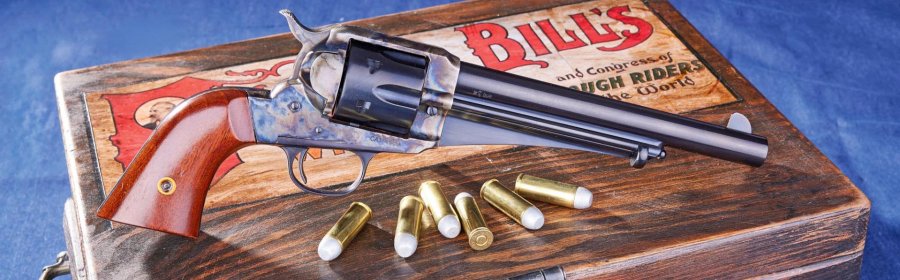
The Uberti Remington 1875 Outlaw presents itself as an impressive western revolver that offers an unmistakable silhouette thanks to its holster guide under the barrel. Available at an affordable price, this neo-classic works, shoots, hits, is fun to shoot – what more could a late-blooming pistol enthusiast need to be happy?
Text: Wolfgang Finze and Matthias S. Recktenwald
Loading data mentioned in the article without guarantee. Every reloader acts on his own responsibility according to the law!
Further information on the Uberti 1875 Remington Outlaw can be found on the Uberti website.