
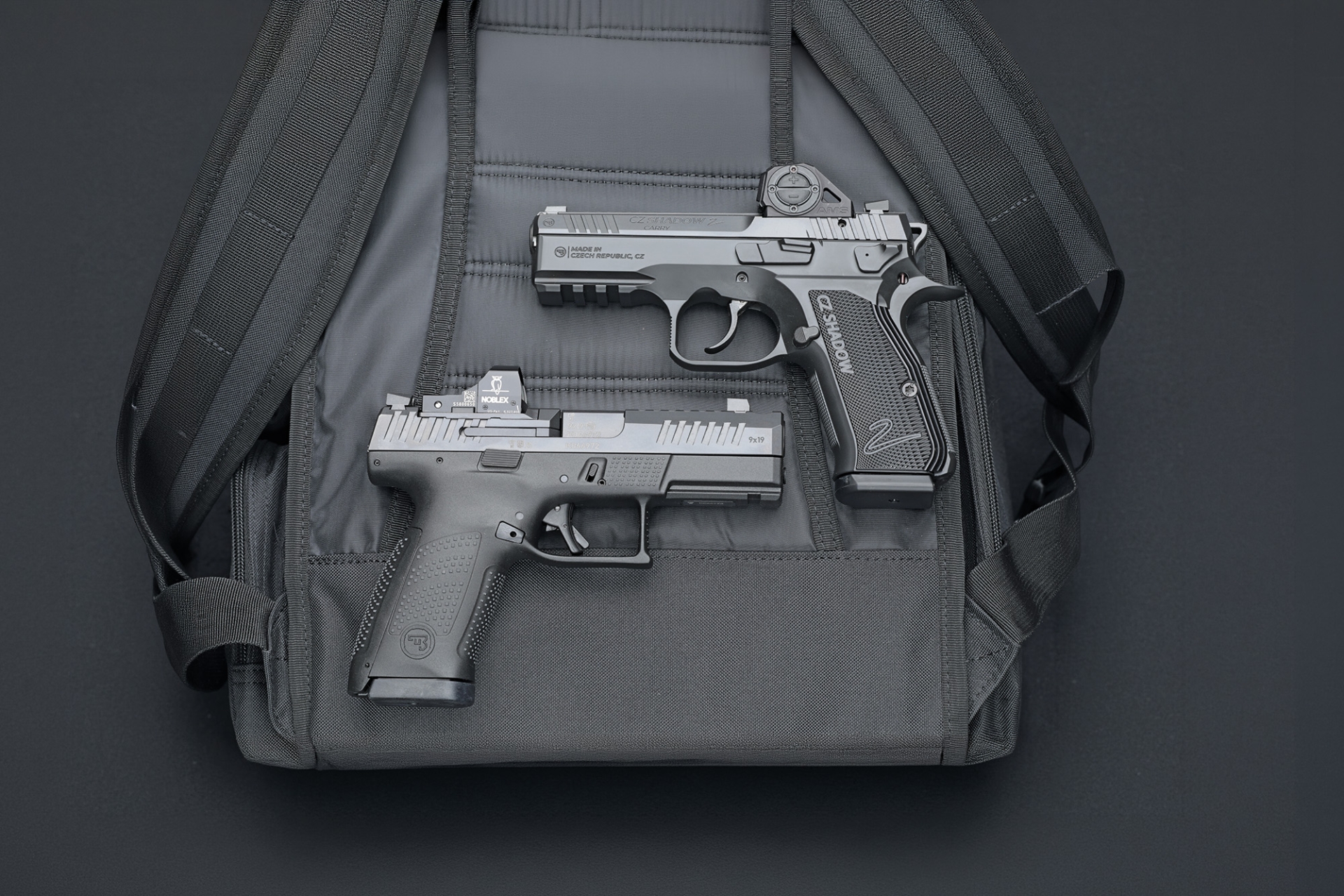
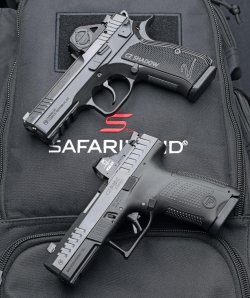
There is no doubt that the new CZ Shadow 2 Carry is closely related to the Shadow 2 Compact, which we presented back then. In contrast to the successful all-steel Shadow 2 full-size pistol, the Compact version is based on an aluminum frame and, in keeping with its model designation, has smaller dimensions with a barrel that has shrunk from 120 mm (4.7") to 102 mm (4"). This results in a weight loss of a whopping 400 grams, which is clearly noticeable when carrying. Anyone who already owns a fully-fledged Shadow 1 or 2 can also benefit from the familiar handling characteristics of the smaller Compact or Carry in terms of trigger characteristics. In the 1990s, the so-called "Wonder Nines" – i.e. high-capacity 9mm pistols with DA/SA trigger and metal frame – were still common, but today they have become a rare species.
The polymer frame, which is easier to manufacture, and the striker-fired system with consistent trigger pull weight and trigger travel from the first to the last shot have taken over the market. For those who prefer an "old school" approach, CZ has the perfect solution with the Shadow 2 Compact. However, nothing is as constant as change, and so they've followed it up with the Shadow 2 Carry.
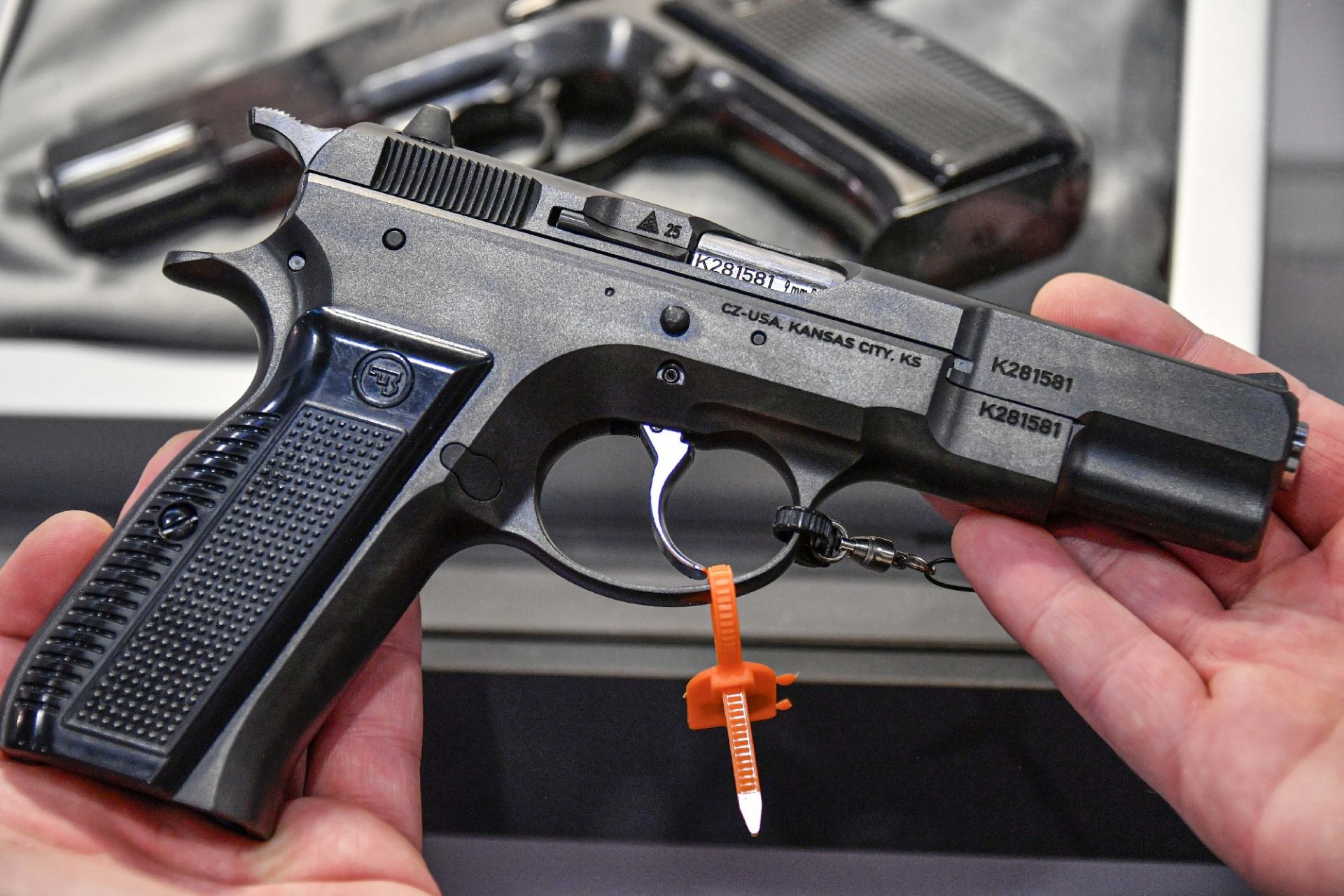
CZ Shadow 2 Carry, with decocker instead of thumb safety
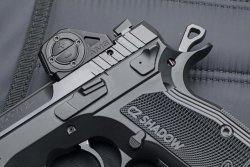
The main difference is that the Shadow 2 Carry has a decocker instead of a thumb safety. Pressing this control element releases the hammer, which is much safer than holding the hammer with your thumb and index finger and then releasing it by pressing the trigger. Under stress or with cold, wet fingers, the hammer can easily slip. The author of these lines is personally aware of two incidents in which this type of decocking resulted in unintentional firing. This technology is not new for CZ: the decocker function was introduced several years ago with the 75 Omega model. When decocking operating the lever provided for this purpose, the hammer rests in the safety notch and thus has no contact with the firing pin. There is also a trigger-controlled firing pin block, which is not found on the regular Shadow 2 Compact. Better safe than sorry. A positive side effect of the safety notch is that the trigger pull travel is slightly shorter.
Shield footprint: CZ Shadow 2 Carry does not require adapter plates
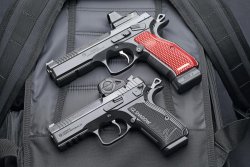
For the next modification, you have to make an effort to lift the cover plate on the top of the slide. The red dot cut is designed for the Shield RMSc footprint, so that the optic is mounted particularly low and there is no need for an additional adapter plate. This means that all Mini Red Dot Sights (MRDS) that share the Shield footprint and are no longer than 40 mm can fit directly. The reason why CZ has chosen this not exactly the most popular footprint may have to do with the rather short cut in the slide, as the rear sight and the horizontally movable firing pin block also need their installation space. The British manufacturer Shield Sights offers a wide range of red dot sights, from super-compact models to sports versions with a large lens for particularly fast target acquisition, to enclosed models for tough operating and climatic conditions. The factory-fitted mechanical sights come with luminescent dots and are even serrated, a feature normally only found on sporting guns. Whether they can be used as a back-up depends on the height of the MRDS. We measured the trigger pull weight at an acceptable 4,800 grams and in single-action mode with the pre-cocked hammer it was around 2,300 grams. The CZ Shadow 2 Carry costs €1,849, while the CZ Shadow 2 Compact is priced at €1,889.
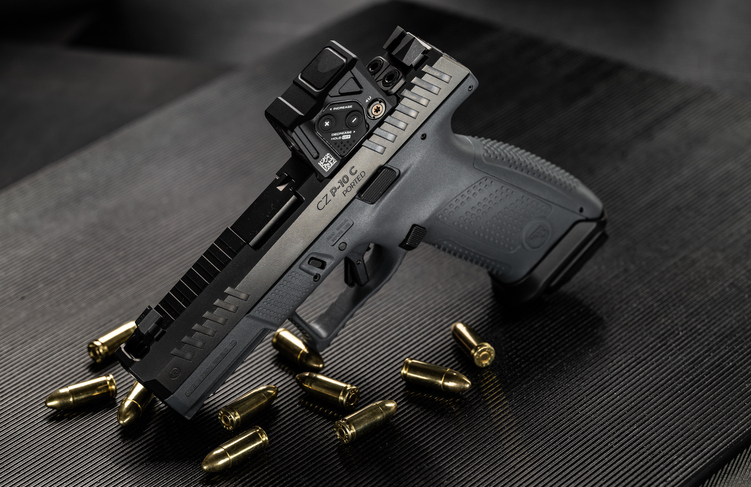
Second pistol in the test: the CZ P-10 C Ported
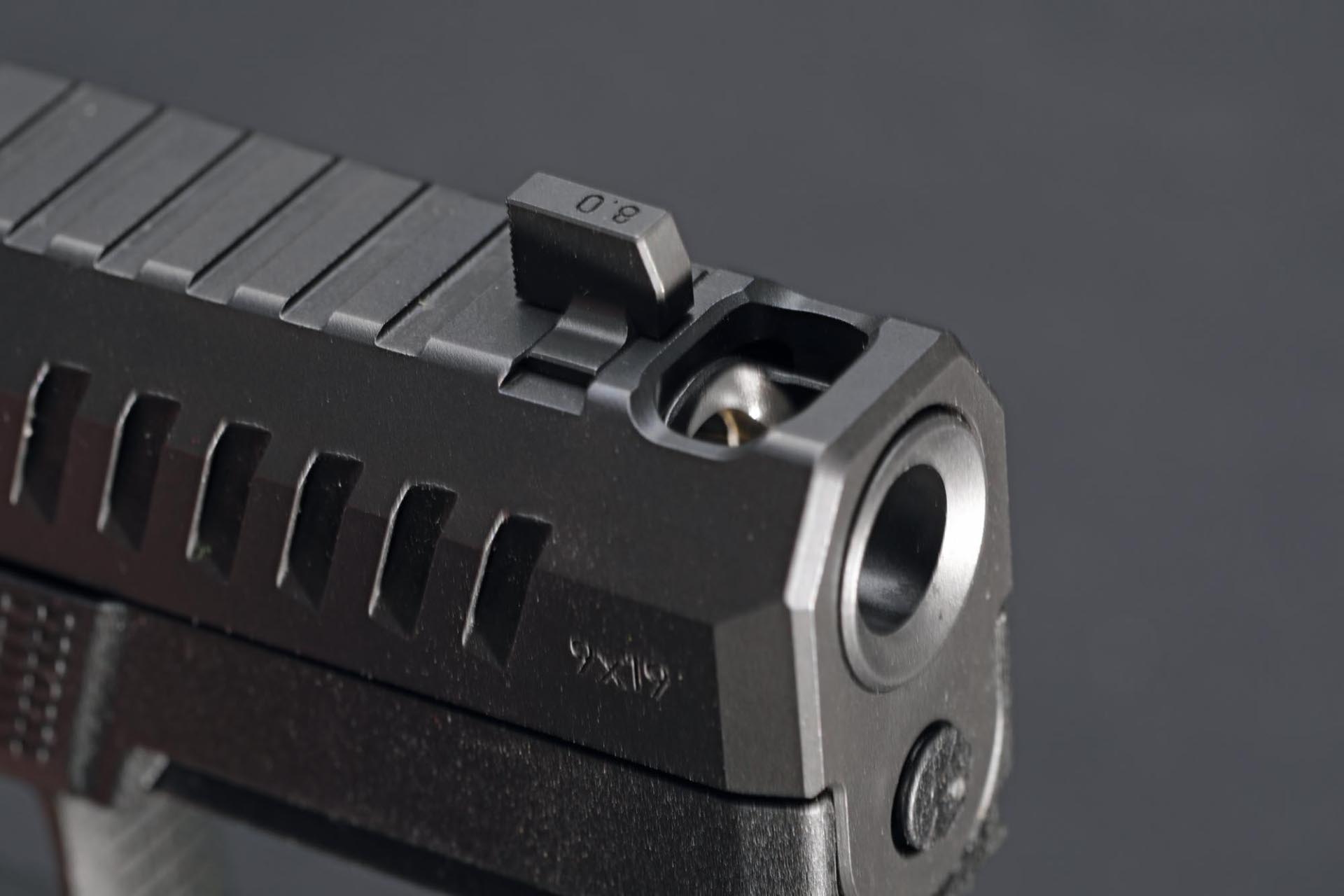
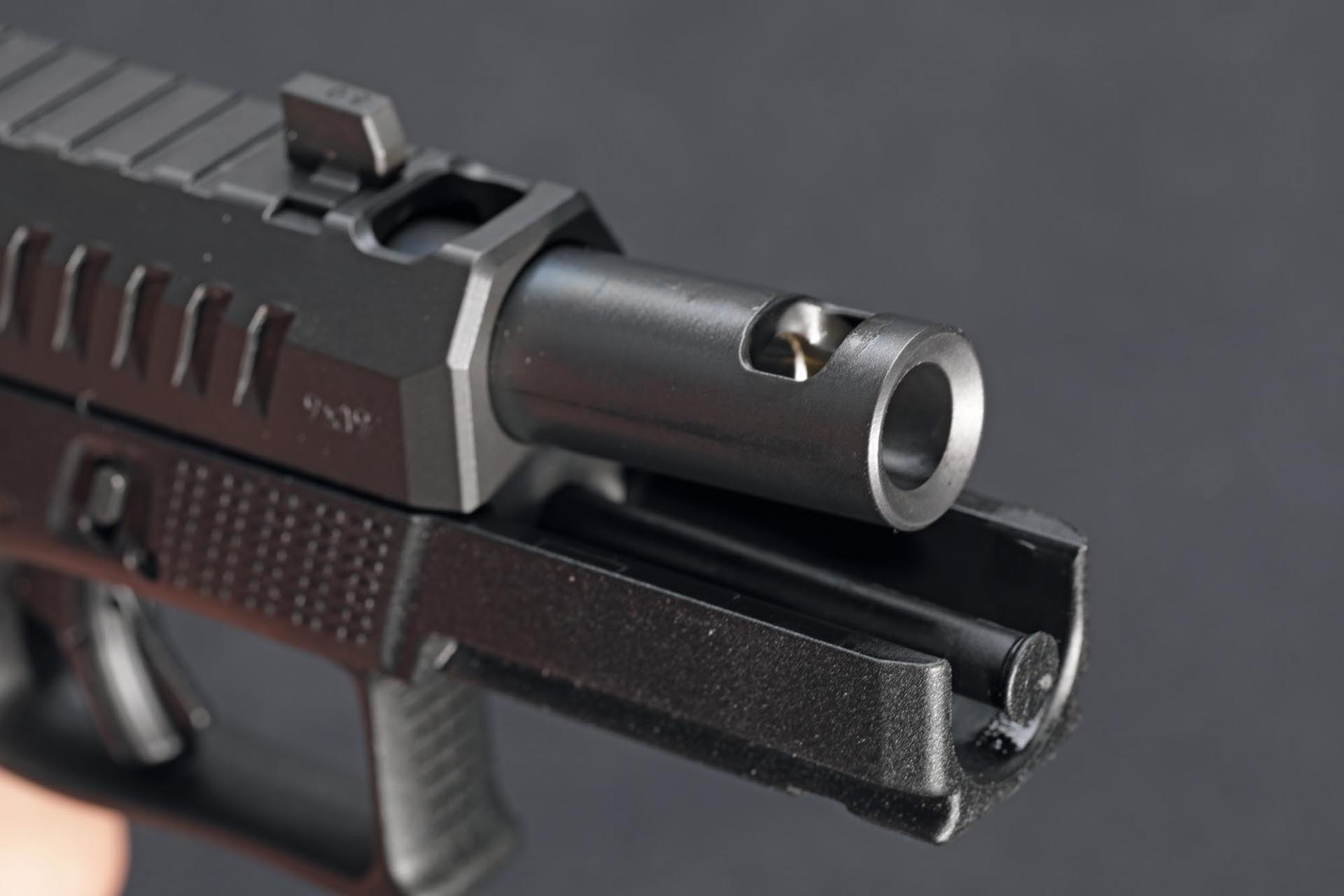
Compensators on service or self-defense pistols in compact and subcompact format for concealed carry are rightly the subject of controversial debate. Some view them as a means to better manage muzzle rise and thereby achieve faster follow-up shots; others, however, dismiss them as nothing more than an overrated gimmick designed merely to boost the "cool factor." The fact is, however, that the compensator partially directs the muzzle flash upwards. This can not only cause temporary blinding but also propel unburnt powder particles backward. While this poses no problem in a sporting context – provided one is wearing safety glasses – it is certainly not something one would want to face in a real-life critical situation without eye protection.
The CZ P-10 C Ported in detail
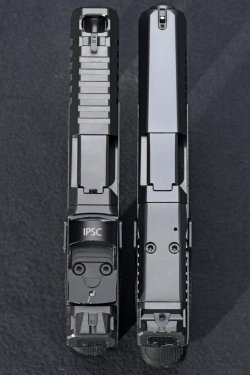
Ultimately, everyone has to make their own decision for or against the compensator. The idea of equipping the barrel of a lightweight polymer-framed pistol with gas relief holes to increase shot control is not entirely new. The class leader in the realm of polymer pistols, GLOCK, took up this concept back in the 1990s, albeit with limited success, and these models have since been removed from the range. Nevertheless, there is a whole range of small-series manufacturers and gunsmiths, especially in the USA, who offer GLOCK-based complete pistols, conversion kits, or barrels with compensators. In line with this boom, a "tacticool" polymer-framed pistol nowadays typically features a skeletonized slide, a compensator as well as a red dot sight and a weapon light or a light-laser module on the duster cover accessory rail.
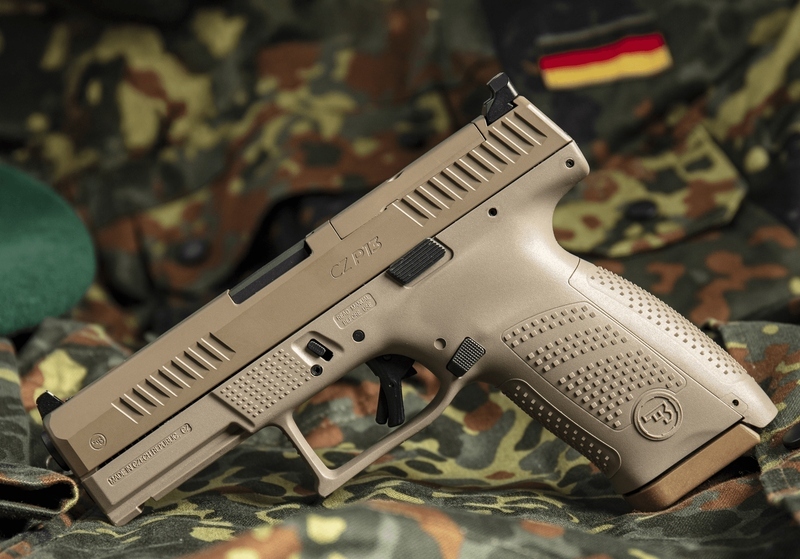
With the CZ P-10 Ported, the Czech manufacturer is now also getting involved in this market segment. We remember that the P-10 C, which saw the light of day around ten years ago, was CZ's first foray into launching a lightweight polymer-framed pistol with striker-fired action. Some saw this as a rather late move, as other competitors had already launched their lightweight service pistols on the highly competitive market. Nevertheless, the series has now visibly established itself on the market, which is emphasized not least by the fact that the optics-ready, non-ported P-10 C OR is being introduced as the new service pistol P13 in the German armed forces. In addition to the compact C version with a barrel length of 102 mm and a capacity of 15+1 cartridges, there is now also a full-size version with a barrel length of 114 mm and a magazine capacity of 19 cartridges as well as a sub-compact version with a barrel length of 90 mm and a capacity of 12 cartridges.
In order to keep the overall length of the test gun in the form of the P-10 C Ported as compact as possible, the Czechs probably decided against a screwed-on compensator, which would have been the simpler solution. Instead, the barrel was fitted with a gas relief port in the muzzle area and the slide with a 14-mm wide and 8-mm long window on the top, so that the system acts as a single-chamber compensator. This integral solution gives the compact pistol a very attractive overall appearance. It is known from the sports sector that shooters in the IPSC Open Division also like to use compensators to keep the gun quieter when firing. However, two to four expansion chambers are used here in order to achieve more effect. A single-chamber compensator therefore appears to be a compromise between reduced dimensions and effectiveness. With such a short barrel length of 102 mm, a gas pressure of up to 600 bar can be assumed at the port; a visit to the shooting range should show how this is noticeable in practice.
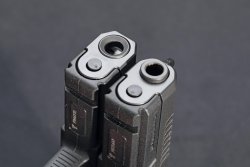
But that's not all: the developers at CZ resorted to another means of countering muzzle rise that is unbeatable in its simplicity – more mass. The barrel of the P-10 C Ported is around 1.5 mm thicker than that of the standard P-10 C and therefore weighs 14 grams more. Not much, but something nonetheless. The front sight naturally had to be moved to the rear, which reduces the sight radius by 14 mm. However, this should not be a problem for typical shooting distances. As the pistol is only available as an OR (Optics Ready) version with the option of mounting a red dot sight, the mechanical sights may only serve as a back-up if the primary sight should fail. The mechanism is a fully pre-cocked single-action trigger in combination with a safety integrated in the trigger blade and an automatic firing pin block. The trigger pull weight was 2,300 grams. The 15-round sheet steel magazines are fitted with the distinctive red follower found on all P-10 models and are easily recognizable even in poor lighting conditions. Of course, the 19-round magazines of the full-size version can also be used. At €849, the compensated version costs only €130 more than the standard version.
Compact pistols from CZ on the shooting range: Shadow 2 Carry and P-10 C OR Ported
As both pistols are not intended for sports shooting, they were to prove their accuracy at a distance of 15 meters. The Shadow 2 Carry also fits perfectly into the Ransom Rest blue grip adapters for the full-size version, so we were happy to accept the help of the Ransom Rest testing machine. All seven loads delivered groups of up to 50 mm, which is sufficiently accurate for the intended use. With the tightly loaded 147-grain subsonic load from Magtech, we even managed a 10-shot group of 24 mm. More important, however, is the functional reliability and there was nothing negative to report. From 108 grains to 147 grains, sometimes with flat-nosed bullets, the Shadow 2 Carry cycled flawlessly. The new gun from the Czech Republic was also great fun to shoot freehand. Thanks to its aluminum frame, the gun offers excellent ergonomics and tactile feel; moreover, its increased weight – compared to pistols with polymer frames – has a noticeably positive effect on recoil management. If you have limited grip strength or a "limp wrist", lightweight polymer-frames pistols in combination with moderate ammo loads can sometimes lead to malfunctions. In a recoil-operated firearm, a lack of sufficient counter-resistance during recoil often manifests as a spent casing trapped in the ejection port, as the slide is unable to cycle fully open. In this case, pistols with an aluminum grip frame inherently provide greater inertial mass and, consequently, superior operational reliability.
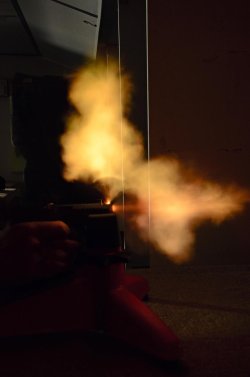
The P-10 C Ported was tested for shooting performance in a sitting position using a shooting rest, because polymer pistols can't be clamped in a testing machine as a matter of principle. Here too, seven different loads from 91 to 147 grains were used. All cartridge types achieved groups under 70 mm, which is certainly enough for the intended purpose. There were also no complaints in terms of functional reliability. Things got more exciting when we shot the compensated version alternately with a standard version in order to better assess recoil and muzzle flip behavior. With standard loads with 124 grains or even more bullet weight, there was hardly any noticeable effect. Only the fast Magtech 95 grains, which also delivers a lot of gas volume with a lot of propellant, showed a slightly reduced muzzle raise. However, this did not really translate into faster shot-to-shot times. A proper grip with the supporting hand and a stiff wrist can counteract muzzle rise far more effectively. What we liked during the dynamic drills were the full-surface serrations on the slide, which would also look good on the standard version. Finally, we were interested in the performance losses to be expected with the integral compensator. After all, the effective barrel length is reduced from 99 mm to approximately 84 mm. With the 95-grain Magtech, the velocity dropped by around 16 m/s. With the Top Shot with 124-grain FMJ bullets it was just 7 m/s. There was no noticeable difference in velocity with only 1 m/s with the 147-grain Federal American Eagle. Amazing! Would you have guessed it?
CZ Shadow 2 Carry & P10-C Ported technical specs and prices
Model: | CZ Shadow 2 Carry | CZ P-10 C OR Ported |
Caliber: | 9mm | 9mm |
Magazine Capacity: | 15 rounds | 15 rounds |
Frame: | Aluminum | Polymer |
Slide: | Steel | Steel |
Barrel Length: | 100 mm | 99 mm |
Rear Sight: | 3.5 mm notch, side driftable with luminescent dots | 3.0 mm notch, side driftable photoluminescent dots |
Front Sight: | 3.5 mm, with luminescent sot | 3.5 mm, with luminescent dot |
| Sight Radius: | 152 mm | 158 mm |
Safety: | Trigger-controlled firing pin block | Trigger safety, trigger-controlled firing pin block |
Trigger Pull Weight (Average of 10 Measurements with the Manthei Trigger Scan System): | DA: 4,810 g; SA: 2,300 g | SA: 2,320 g |
Weight (incl. Magazine): | 860 g | 749 g |
Dimensions: | 220x37x147 mm | 220x37x147 mm |
| Equipment: | Hard case with one spare magazine | Hard case with one spare magazine |
Wrapping up
The CZ Shadow 2 Carry is particularly interesting for all those who already use a sporty all-metal version on the shooting range and thus want to carry a lightweight compact version with the safety-enhancing additional benefit of the decocker. Opinions are divided when it comes to the P-10 C Ported. In our opinion, the integral single-chamber compensator is more of a cool gadget than a feature with practical added value. Nonetheless, it is a modern striker-fired polymer pistol with a very ergonomic grip and convincing handling characteristics.
Text: Tino Schmidt and Stefan Perey
Further information on the CZ Shadow 2 Carry and the CZ P-10 C Ported can be found on the CZ website.