
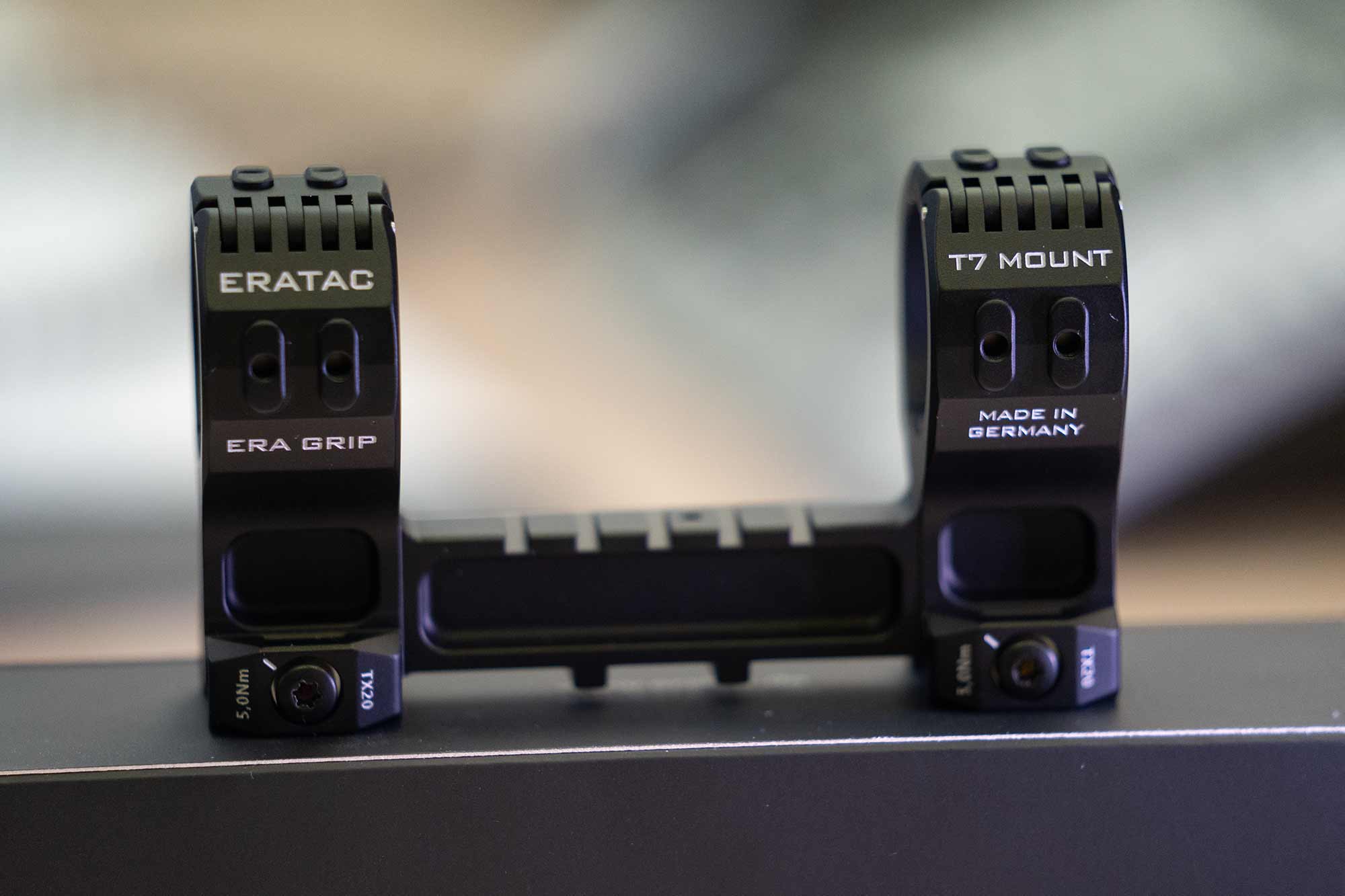
Anyone involved in tactical shooting – whether LE/military, sporting shooters or an ambitious long-range shooters – is familiar with the typical discussions surrounding mounts: does the scope slip? Do you have to glue it? How much torque is necessary and safe? And: how do I get accessories mounted cleanly without special solutions? These are precisely the issues that Recknagel ERATAC has repeatedly received feedback on from the market in recent years. The result: a completely rethought ERATAC one-piece mount assembly that is not only lighter, but above all more user-friendly, modular and safe.
Developed from real user feedback: the ERATAC T7 one-piece mounting system
In around 15 years, ERATAC has established itself as a fixture in the LE/military sector. It is often no longer just a question of "nice to have" features, but of clearly specified criteria in tenders. According to Managing Director Dr Moritz Fehrer, two aspects have been at the forefront recently: the lowest possible weight, which is becoming increasingly important in setups and procurement contracts, and 45° interfaces for accessories, enabling flexible mounting. The new one-piece assembly is the answer to this – and, according to ERATAC, a product that will characterize the coming years.
The core feature of the ERATAC T7: hinges instead of split rings
One of the most visible changes concerns the ring design: instead of the classic horizontally split ring caps, ERATAC has opted for hinges for the T7. This should make the clamping more defined and stable, speed up handling when inserting the optics and noticeably reduce the susceptibility to errors during assembly – in short: "more foolproof" overall.
However, the biggest innovation is inside the rings: ERA Grip Technology. Behind this are special inlays that significantly increase the coefficient of friction and should therefore alleviate a typical practical issue: does a scope need to be glued or "reinforced" with an intermediate material to prevent it from shifting? According to ERATAC's approach, the answer is no. A metal foil with diamond-like particles is used to fix the main tube very securely without glue, without makeshift solutions and without the risk of damaging the surface of the scope. Users who regularly change optics or want to resell a riflescope at a later date will particularly benefit from the concept: no adhesive residue, no damaged anodised coating and therefore no unnecessary loss of value.
Automatic alignment with the ERATAC T7: insert the scope, let it align
ERATAC also wants to simplify the mounting process during alignment: a ramp system is designed to automatically guide the riflescope into the horizontal position as soon as it is inserted. This allows the setup to be completed more quickly, typical mounting errors are reduced and the positioning should remain clearly reproducible. The optics are then fixed in place using two screws: ERATAC specifies 2.5 Nm as a guide value for this.
The specification of the rifle scopemanufacturer remains important here: if the manufacturer specifies a lower torque – around 2.0 Nm for very thin-walled main tubes – this specification should be adhered to. According to ERATAC, the grip should nevertheless be significantly better than with previous solutions thanks to ERA Grip and the design.
Wide rings, modular interface concept: details of the ERATAC T7
While many ultra-light concepts rely on the narrowest possible ring surfaces, ERATAC deliberately opted for comparatively wide rings for the T7. The larger support is intended to distribute the clamping forces better, grip the main tube more gently and reduce point loads. This is an understandable advantage, especially in heavy-duty use and with frequent scope changes, because the assembly brings less "stress" to the system and remains stable at the same time.
The T7 also relies on a consistently modular interface concept. In addition to the classic positions at 9, 12 and 3 o'clock, ERATAC offers additional 45° mounting options. This allows accessories such as a red dot sight, laser or rangefinder adapter to be positioned ergonomically where they are actually needed in the respective setup, instead of being tied to rigid specifications. In many cases, it should be possible to dispense with special intermediate solutions or custom housings. At market launch, the mount is planned in several diameters (30, 34 and 36 mm) and is therefore interesting both for classic setups and for many modern high-end optics.
ERATAC T7 one-piece assembly: loss-proof screws & no protruding parts
In practice, small details often determine whether a system is really "fit for purpose" – and this is precisely where ERATAC aims to score points with the T7. The screws are designed to be loss-proof, the Torx screws are recessed into the mount, and the overall design is intended to do without protruding elements. This reduces typical snagging on equipment such as chest rigs, slings or lines and thus prevents a problem that is repeatedly encountered with many mounting systems in everyday tactical use.
Conclusion on the ERATAC T7: A one-piece mount that solves old problems once and for all
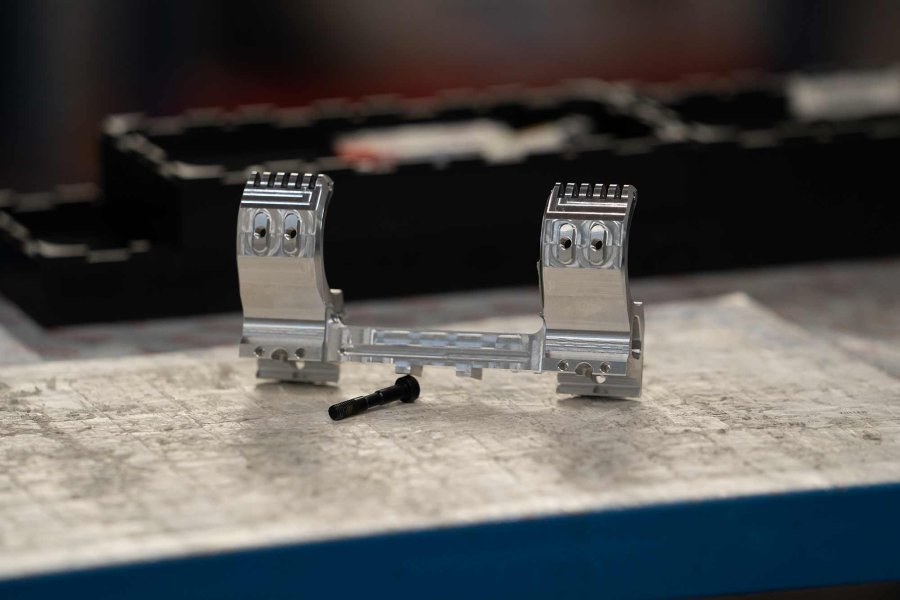
With the new ERATAC one-piece mount, Recknagel is targeting precisely the points that really count in practice: the ERA Grip technology is designed to make gluing and intermediate layers superfluous and at the same time provide a very secure hold. This is complemented by simplified assembly thanks to automatic alignment, a noticeable reduction in weight and a fully modular interface concept including 45° options. The whole thing is rounded off by a "clean" application-oriented design without unnecessary edges or snagging points. The bottom line is that the T7 is not just a new mount, but a real functional update for users who configure their setup professionally and with a focus on special applications.