
Columbia River Knife & Tool, better known as CRKT, has recently added to its Minimalist line a new product with an important name: Nessmuk. It is a type of fixed-blade knife of North American origin. The design is attributed to George Washington Sears (1821-1890), an American writer active in the second half of the 19th century who, from the pages of Forest and Stream magazine, contributed to the spread of the concept of outdoor recreation and environmentalism, at a time when much of America was still wild and hostile territory. Of puny build and weakened by tuberculosis, Sears compensated for his frail body with a great determination that led him on numerous solo canoe expeditions, adopting and popularizing the Native American way of life. As a young man, he befriended an Indian from the Narragansett tribe, who taught him the secrets of hunting, fishing and survival. The boy was called Nessmuk – "wood drake" (a type of duck), in the Algonquin language – and Sears decided to adopt his name as a pseudonym.
In his book Woodcraft and Camping, he introduced the concept of the "Nessmuk Trio": a set of cutting tools consisting of a two-bladed axe, a two-bladed folding knife and a knife with a deep-bellied fixed blade, ideal for skinning large animals. The Nessmuk knife can be considered a variant of the buffalo skinner, the approximately five-inch knife used for skinning American bison and popular in 19th-century America. According to Sears, the Nessmuk Trio was the perfect combination for the outdoors. Over time, the Nessmuk knife proved its great versatility in the hands of trappers, hunters and explorers, becoming a classic of American knifemaking: perhaps less well-known than the Bowie knife or theArkansas toothpick, but just as iconic.
The CRKT Minimalist Nessmuk under the lens
CRKT offers a compact version of the Nessmuk, with a D2 steel blade 73 millimeters long. Designed by Alan Folts, a Florida-based knifemaker who has been working professionally since 1992, this knife belongs to the Minimalist line, consisting of several variations on the theme, and with blade profiles ranging from cleaver to Persian. The Nessmuk seemed to us to be the one that manages best to reconcile versatility with a small size. It has to be said that all the knives in the Minimalist series are born (also) as neck-knives, intended to be worn with a lace around the neck; thus, lightness and a compact size are the two cornerstones on which the entire line is built.
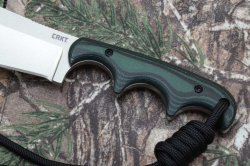
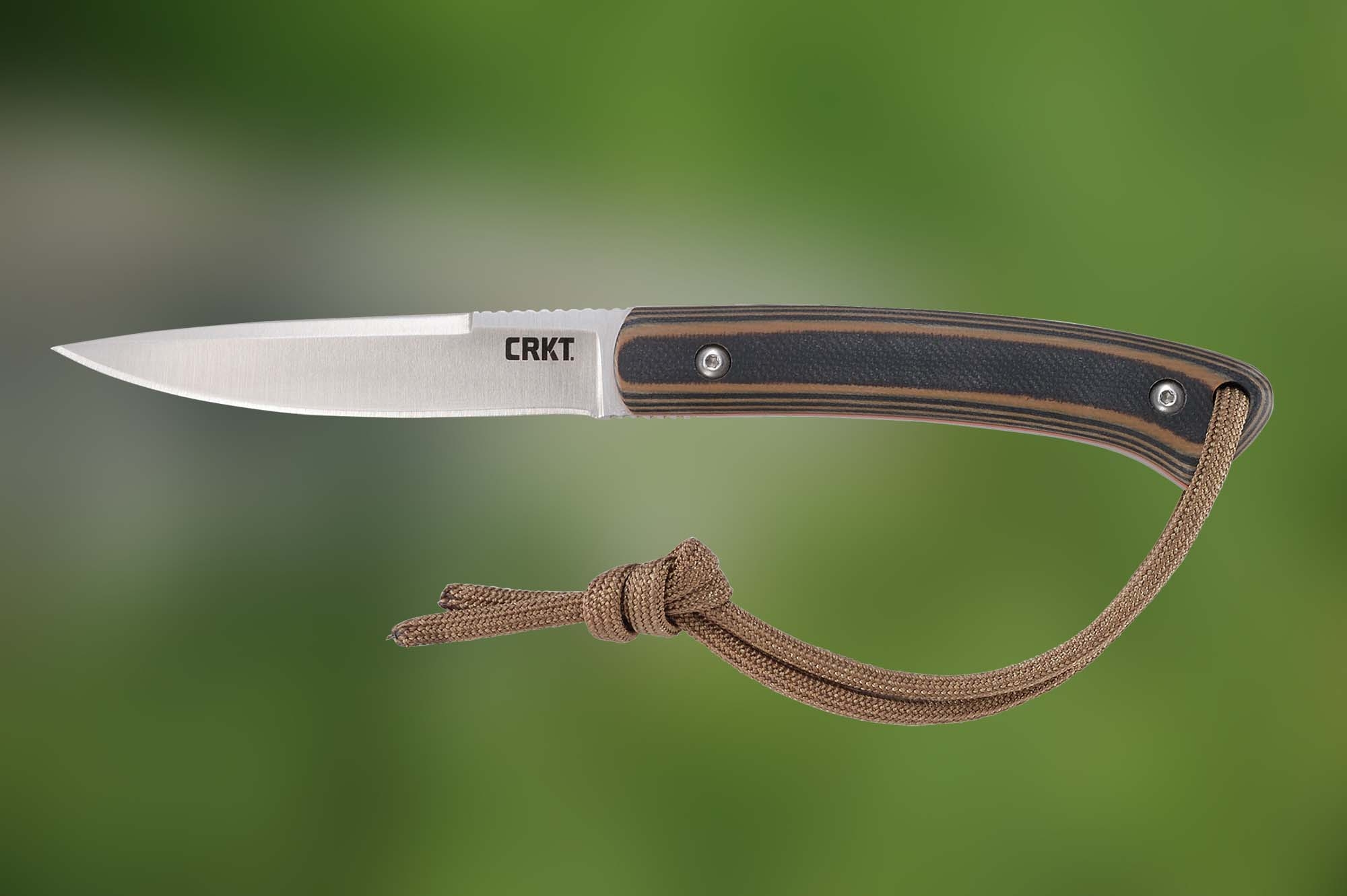
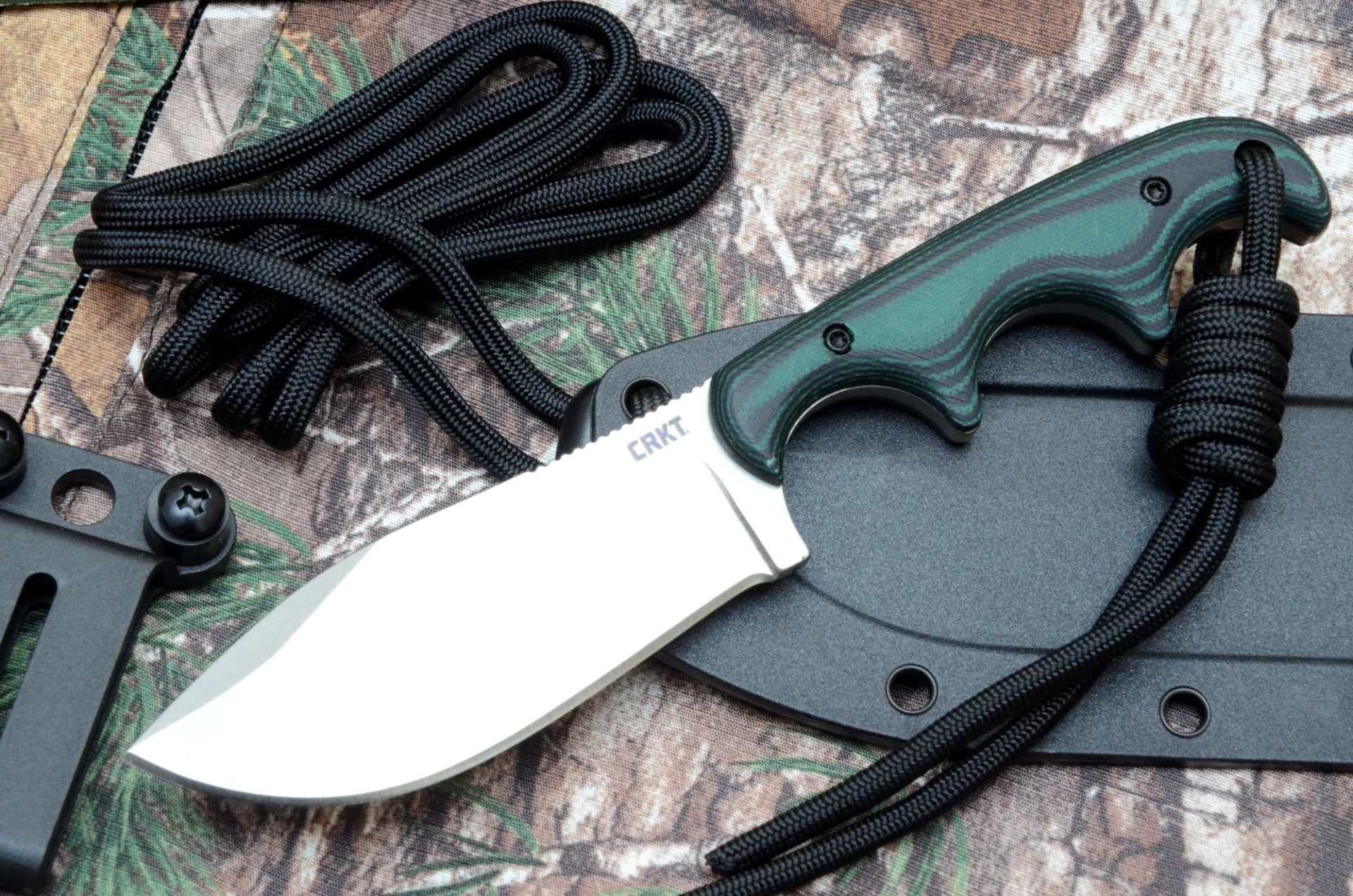
The CRKT Minimalist Nessmuk is a full tang knife that immediately strikes you with its proportions as soon as it comes out of the box: from the photographs it looks much larger than it actually is. The handle has three finger choils, which guide the positioning of the index, middle and ring fingers to improve control. The handle of the version presented here is made of multi-layer Micarta in a beautiful emerald green color, but there is also a version with a white handle. The surface of the handle is pleasant to the touch and the level of workmanship is excellent: the handle scales copy the tang contour quite precisely, without any steps or uncertainties. On such an inexpensive knife, this is not so obvious. Each scale is fixed to the tang with a pair of rather anonymous Torx grub screws.
While from an aesthetic point of view the Nessmuk's handle certainly makes an impression, our experience tells us that the slightly odd blade or handle profiles are also hardly versatile. Admittedly, the finger choils provide a very safe grip and allow the knife to be guided very precisely, but they make it very difficult to use the knife while wearing even thin gloves.
We now come to the blade profile itself, which could be described as a deep-bellied clip point type. Made of D2 steel with a beautiful and homogeneous stonewashed finish, it measures 73.5 mm with a thickness of 3.6 mm. The tip of the blade is decidedly robust and the hollow-grind factory sharpening is excellent. The knurling on the back of the blade provides a solid support for the strong hand's thumb, useful for tasks requiring extra strength and control, such as preparing a hunting trophy.
Although the production is outsourced to Chinese subcontractors, the blade surfaces show the typical CRKT workmanship, which is therefore excellent, and we must always consider that we are talking about a knife that costs $53. The main limitation of this knife lies in its short blade, but there is nothing we can do about that. However, we can say that for being only 73.5-mm long, the blade of the Nessmuk does its job. We must consider that knives of the size of the Nessmuk CRKT were made to be used as a backup or to be carried concealed, so we can't expect exaggerated performance from a cutting tool weighing less than eighty grams.
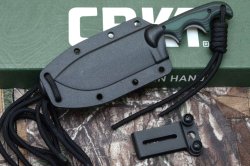
As with all knives in the Minimalist series, the Nessmuk comes with a vacuum-formed thermoplastic sheath, a neck lace and quick release belt attachment. Another section of lanyard passes through the hole in the handle and facilitates the extraction of the knife. Retention relies solely on the elasticity and tightness of the thermoplastic, and we found it to be very effective.
To sum it all up, the CRKT Minimalist Nessmuk lives up to its demanding name: it is minimalist, but not humble, and best fulfils its promise of versatility, even though the size severely limits the range of use. The sound sheath and low weight make it very pleasant to carry on the belt. Finally, the price of $53 makes it an inexpensive choice as well.
CRKT Minimalist Nessmuk technical specs and price
| Manufacturer: | CRKT |
Model: | Minimalist Nessmuk (2376) |
Designer: | Alan Folts |
Type: | Fixed blade knife |
Blade Material: | D2 steel |
Finish: | Stonewash |
Blade Length: | 73.5 mm |
Blade Thickness: | 3.6 mm |
Overall Length: | 152.4 mm |
Handle: | Micarta |
Grind: | Flat |
Weight: | 74 g |
Sheath: | Thermoplastic, with neckstrap and quick-release belt attachment |
Price: | $53 |