
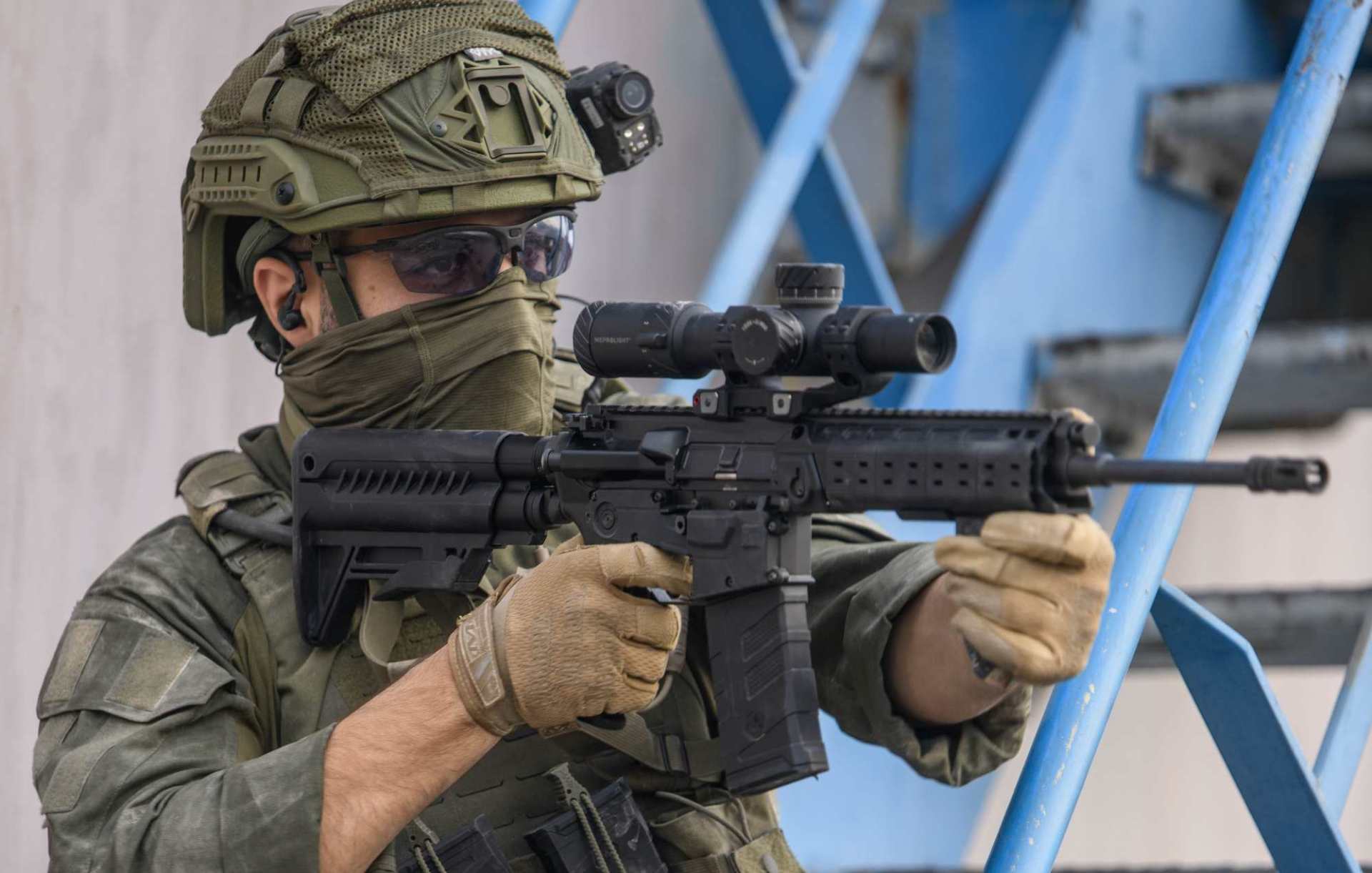
The starting point for our interview is the news from December 2025 that Meprolight, an Israeli company of the SK Group and a global leader in electro-optics for military, law enforcement and commercial use, has been awarded a contract to supply the armed forces of a Southern European country'with its advanced MVO 1-8x28 riflescopes. This new contract highlights the growing international demand for Meprolight's combat-proven optics and reinforces the company's track record for providing precision, reliability and durability in the most demanding operating environments.
MVO riflescopes deliver precision, clarity and reliability in a wide range of tactical and professional shooting scenarios. The MVO 1-8x28, a Low Power Variable Optic (LPVO) for short to medium range dynamic engagements, is built to MIL-SPEC standards, features a rugged 34-mm main tube and is fully waterproof and fogproof. SCHOTT premium German multi-coated glass offers over 92 per cent light transmittance, ensuring exceptional sharpness and contrast in low light, glare and mirage conditions. At the same time, advanced lens design offers consistent eye relief, a forgiving eye box and a wide field of view for enhanced situational awareness. Features include red and green reticle illumination with eight brightness settings, NVG compatibility, a 12-hour auto-shutoff, a smooth magnification ring with an optional throw lever, and precise windage and elevation adjustments verified through live-fire testing.

Armed forces in the country that have adopted the MVO 1-8x28 riflescopes will see their operators' accuracy, situational awareness and operational effectiveness increase in a wide range of mission scenarios. The MVO 1-8x28's low-power design allows for quick transitions between close- and mid-range engagements, supporting both target acquisition and shooting accuracy in complex environments. The robust construction and high light transmission optics of the MVO 1-8x28 scope ensure reliable performance during training, tactical deployments and actual combat operations. By integrating the scopes into their equipment, armed forces will significantly improve their ability to operate effectively in diverse and challenging conditions.
“Today's armed forces need optics that maintain clarity, stability, and reliability under extreme stress, and the MVO series continues to prove its effectiveness in these contexts,” the company says. “We are proud to support this partner in Southern Europe, offering a solution that ensures soldiers can operate with confidence and precision, even in the most demanding conditions.”
An interview with Golan Kalimi, Senior Vice President of Meprolight

We took advantage of the open communication channel with Meprolight to ask a few questions to Golan Kalimi, Senior Vice President, who was happy to give us very comprehensive answers.
Meprolight is a leading company in the field of sight systems. Unlike other subjects, it does not focus on a single type, but offers an extremely complete range, ranging from metal sights to night vision goggles, passing through laser designators and variable optics. How do you get involved in so many industries that are close but different, delivering top performance in all of them?
It is always a strategic consideration whether to focus on a single product category or to offer a broad product portfolio. At Meprolight, we made a clear decision to develop a wide, diverse range of products to provide comprehensive solutions for our customers. Many of our customers operate across multiple platforms – from handguns to rifles, from submachine guns to sniper rifles – and they are looking for a complete, integrated solution that addresses their full range of operational needs. Our objective is to deliver that complete package. Executing this strategy requires significant effort across the organization, including product design, engineering, manufacturing, marketing, sales, and field support. Our ability to manage this complexity is the result of an infrastructure built over many years, supported by skilled personnel and strong company capabilities. This foundation enables us to perform at a high level across multiple product categories. From a strategic perspective, this approach has proven successful and continues to guide our development roadmap. In parallel, as the OEM provider for our sister company, IWI, Meprolight supplies a comprehensive range of sighting solutions across its entire weapons portfolio, further demonstrating our ability to support diverse operational requirements. We believe this approach delivers greater value than focusing on a single product line. Rather than limiting ourselves to one category, we have built a broad portfolio that enables customers to rely on a single trusted partner – from metal sights and laser designators to advanced optics and night vision systems.
In your opinion, do metal sights still make sense to exist in the operational field, or are they just the reserve in case of malfunction of other more complex systems?
Metal sights continue to play an important role in operational environments. While advanced optics are increasingly common, not all users have them, often due to budget or logistical constraints. As a result, many customers continue to rely exclusively on metal sights on both pistols and assault rifles. At the same time, metal sights remain a trusted backup for more complex systems, valued for their simplicity, durability, and reliability. This combination of primary and secondary use means the market for metal sights remains active and relevant today.
In particular, do you recommend always mounting a red dot on the short weapon or, also according to the feedback you have from users, are there situations in which metal sights still maintain the primacy?
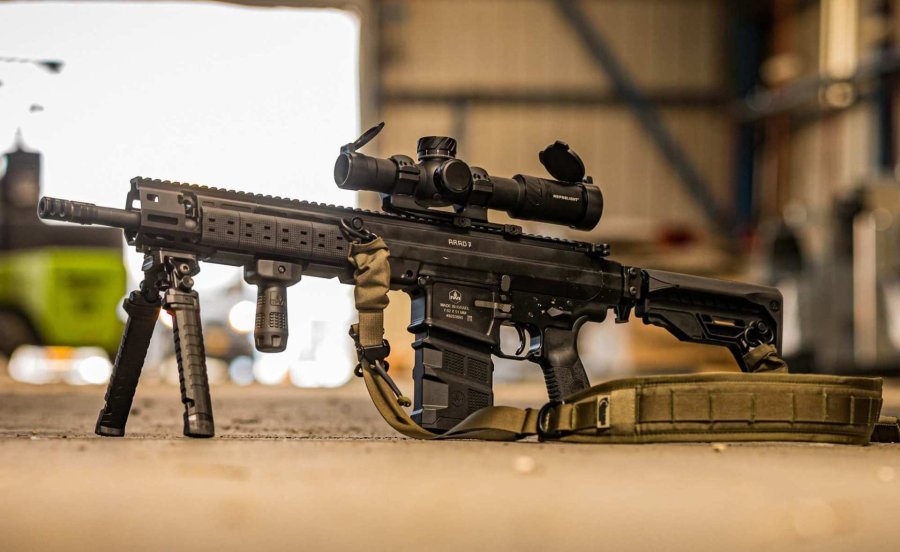
Our general recommendation for short weapons is the use of a red dot sight, primarily for faster target acquisition, ease of use and improved performance in both daylight and low-light conditions. Modern red dot solutions also provide excellent endurance. Passive models, such as the M21 and M22, operate without batteries and can function reliably for many years, while battery-powered models, such as the O2 and MCO, offer tens of thousands of operating hours, ensuring long-term readiness with minimal maintenance. That said, metal sights remain important in certain operational contexts, whether as a primary solution for some users or as a reliable backup. Based on current feedback and usage trends, red dot sights are clearly becoming the standard choice for short weapons.
In the case of red dots, there are currently two fundamental schools of thought: alone or co-witnessing with metal sights. Do you think one solution is superior to the other? Why?
Both approaches work, and it’s up to the user as to which they prefer.
You have many different sighting systems in production. Could you clarify for which users/applications do you recommend each type or combination of technologies?
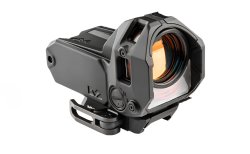
Multiple variables drive the selection of a sighting system. The primary consideration is the weapon platform, as pistols, assault rifles, designated marksman rifles, sniper rifles, and machine guns each have different operational and performance requirements. Additional factors include budget, as we offer products at varying cost levels, as well as environmental conditions such as climate, lighting, and operational terrain. User habits, experience and training preferences also influence the optimal choice of technology. By evaluating platform characteristics alongside environmental, operational, and cost constraints, we can recommend the most appropriate sighting system or combination of technologies for each application.
Do you manufacture also optics for sport shooting?
We do not offer sighting systems designed for sports use.
What's in the near future for Meprolight? Do you plan to expand to cover some other sector, or do you aim to consolidate the existing one?
We plan to expand, but within the field of electro-optics. Our focus is on introducing more advanced products in the areas where we already operate, building on our existing expertise and market presence. By advancing technologies within our current areas of operation and introducing more sophisticated electro-optical products, we can leverage existing know-how while continuing to improve system performance, integration, and operational capability in our core technological field.
For Meprolight, tritium and fiber lighting systems are your workhorse. However, the battery is still necessary. How does the solution to the need for batteries evolve in the future? Is solar charging a good alternative?

In the foreseeable future, batteries will remain a necessary power source for electro-optical systems. At present, there is no practical, widely available alternative, and this applies not only to Meprolight products but also to electro-optical systems across the industry. Accordingly, our development efforts are focused less on replacing the battery and more on reducing power consumption. We invest heavily in technologies that extend operating life, including high-efficiency LEDs, low-power electronic components, and optimized circuit architecture designed to significantly increase operational endurance. Battery technology itself is mainly outside the control of sight manufacturers, as external suppliers drive it. Our role is therefore focused on system-level optimization – similar to improving engine efficiency in a vehicle rather than changing the fuel source. As for solar charging, it is not yet considered a mature solution for military applications. Limitations related to environmental exposure, operational reliability, and compliance with military standards mean that, at present, it is not a practical option for most use cases.
You were pioneers in hybrid multi-channel optics, do you think these represent the future? Or will they still remain specialized tools, beyond the cost?
We strongly believe in integrated hybrid solutions. Hybrid multi-channel optics offer clear advantages by combining multiple capabilities into a single system, saving space, reducing weight, optimizing energy consumption, and improving overall ease of use for the operator. These benefits make hybrid systems increasingly attractive as operational requirements continue to evolve.
We would like to thank Golan for his time. If you would like to learn more about Meprolight products, please visit the company's official website: www.meprolight.com.