
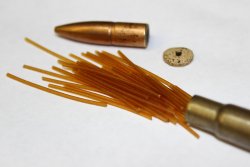
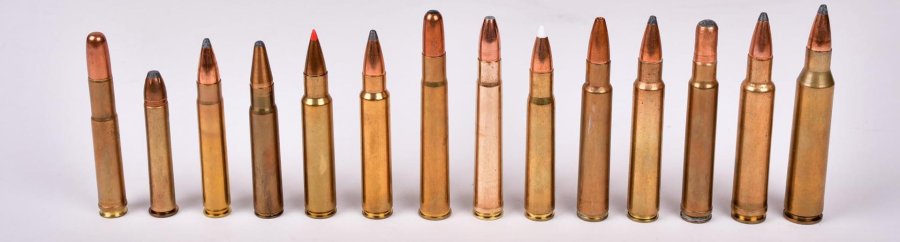
The .375 Holland & Holland Magnum cartridge has enjoyed great popularity since 1912. Even its name hints at its inventor: the British gunsmith dynasty Holland & Holland (H&H). At the time, it was fashionable to supply the company's own cartridge along with the firearm. This created a twofold bond between the customer and the company – first when purchasing the firearm and then when acquiring the ammunition. The .375 H&H Magnum can be considered the result of a competition. Originally, the 9.5x57 Mannlicher-Schönauer was "the" cartridge for the then-new smokeless powder. The leading manufacturers Westley & Richards and Eley quickly added that cartridge to their product line with the British designation .375 Rimless Nitro Express 2¼". Holland & Holland revived the .375 Cordite Express from 1899 and then countered in 1905 with the .400/.375 with 2½" H&H case, essentially a .400 case resized to .375. The designation of this cartridge is .375 Velopex. The case was the first to have a belted rim, which was intended to solve the annoying issue of headspace. With the introduction of the .375 H&H, the "Nitro Express" designation was changed to "Magnum". H&H worked closely with various powder and ammunition manufacturers. This brought the advantage of using high-energy cordite as a propellant in the .275 Magnum, which appeared in 1910. This made it possible to achieve velocities that were previously unthinkable. As the new cartridges required far less case volume compared to black powder, the case dimensions were correspondingly smaller. In order not to limit the distribution of this cartridge to H&H firearms (so-called "Proprietary Cartridge"), Henry Holland granted the Western Cartridge Company permission to distribute the cartridges as early as 1925. This ingenious move also contributed to the cartridge's widespread use. The German 9.3x62 had already been well established in the new colonies since 1905. From dik-diks to elephants, it was the ultimate all-round cartridge. The 9.3x62 was also available in the form of inexpensive bolt-action rifles instead of the high-priced double rifles that only very few people could afford. Based on the success of the 9.3x62 with the reliable and above all effective 286-grain bullets, H&H decided in favor of the 300-grain bullet in order to have almost the same sectional density as the Mauser cartridge. The same outstanding penetration with big game should then be achieved at a similar velocity. The cartridge was highly regarded even across the Pond. The author of many books and well-known hunter, Jack O'Connor, called it the "Queen of Medium Bore". Winchester also reacted quickly and offered rifles in this caliber as early as 1925.
Why were belted cartridges like the .375 Holland & Holland Magnum developed?
The often-cited explanation for reinforcing the case at that point is clearly incorrect. Rather, another way of headspacing was sought at the time. In the good old days, rimmed cartridges were primarily used. The rim determines headspace. Bottleneck cartridges, on the other hand, headspace on their case shoulders. Henry Holland wanted a headspacing similar to that of a rimmed cartridge. So what could be more obvious than to modify the rim of a rimmed cartridge and wrap it around the case like a belt? The headspace is thus perfectly defined. The small protrusion of the belt also meant that there were no problems to be feared when loading. To ensure that no-one could imitate this idea so quickly, Holland hastily filed patents for it. From then on, the belt was named as an outstanding feature in all H&H ammunition patents and, of course, all H&H cartridges were fitted with this belt. The aim was to create a reliable cartridge under all circumstances. According to the CIP, the shallow shoulder has an angle of 29° 55' 43" (maximum value). This was intended to reduce the chamber stress on thin-walled rifles. Furthermore, the selected case geometry with the slightly tapered case and the shallow shoulder should ensure that the case can be safely pulled out of the chamber without any problems both under high gas pressures and when there is dirt in the chamber. With belted cases that have almost cylindrical designs, such as the .458 Win. Mag., it can happen that the cases jam. The tapered case also facilitates loading into the chamber. With the shallow shoulder, it would have been difficult to headspace anyway. This is why the belt was introduced here. Furthermore, the tapered body points exactly in the direction of the feed ramp when the cartridge lies on the magazine follower. The British refer to this process as "self-loading" because the cartridge practically slides into the chamber. The belt at the base of the case provides the necessary headspace support.
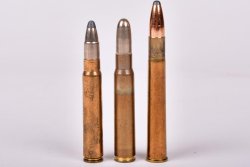
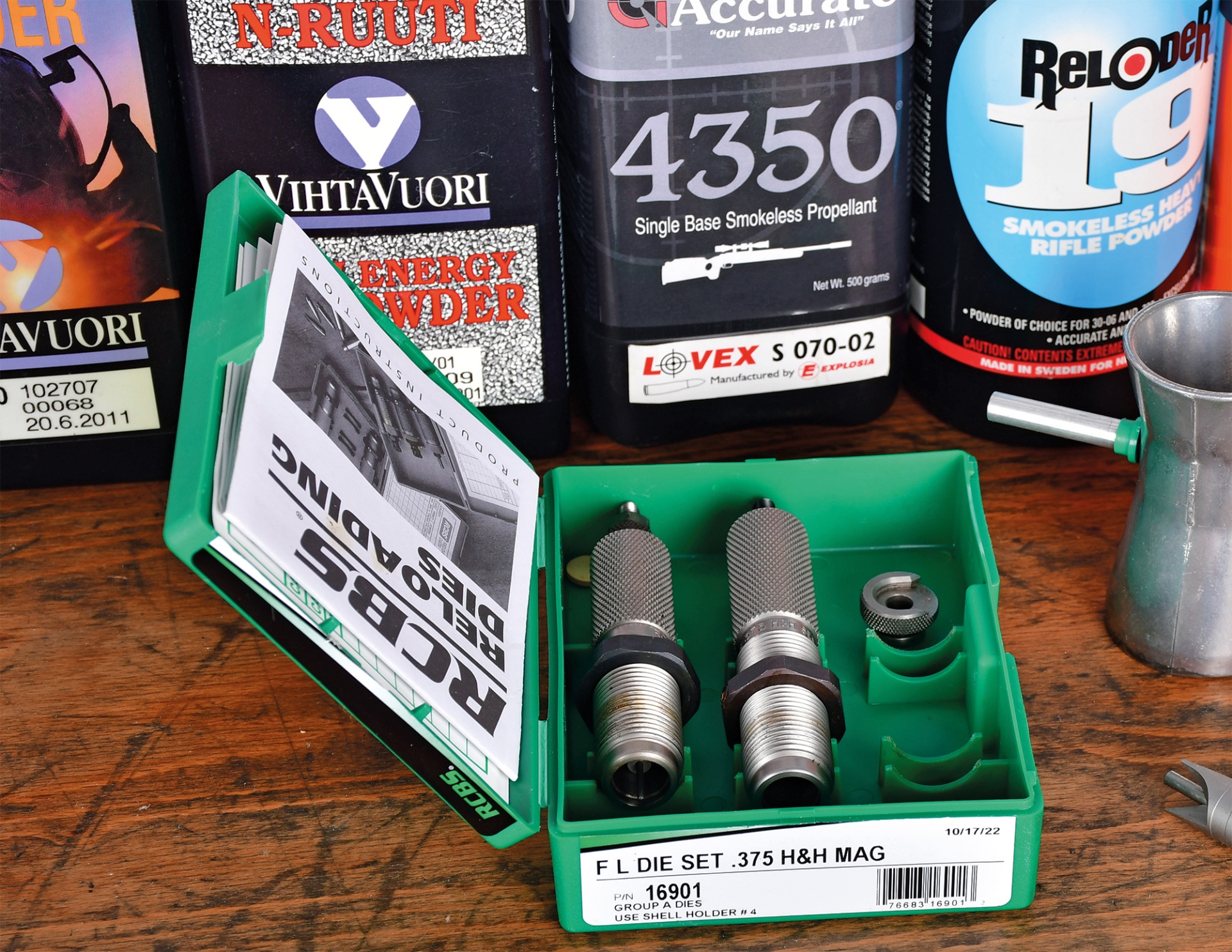
Ultimately, however, the belt is unnecessary, as the 9.3x62 and 9.3x64 cartridges prove. The cartridge rests against the chamber with the front edge of the belt. Depending on the manufacturing quality of the cases, the cartridge may not be centered in front of the barrel. This affects accuracy. Many manufacturers have therefore designed cartridges that eliminate this problem. Examples include the Remington Ultra-Mag and Blaser series. Both series shoot very accurately without any belt. Furthermore, especially with double-stack magazines, feeding can sometimes be problematic, as the incoming cartridge must first be guided over the belt of the adjacent cartridge. Also important, for proper function, the magazine box length must be adapted to the cartridge used. Belted cases tend to cut into and tear just above the belt during reloading. The only solution is to resize the case neck, but then there's the risk that the cartridge, depending on how many times it has been reloaded, will no longer fit in the chamber. It is therefore advisable to check each cartridge before every hunt, unless you are only using factory ammunition anyway. For safety reasons, the firing pin or striker should then be removed or not used. The cartridge effectiveness with 270-grain or 300-grain bullets is sufficient for almost any game. Accuracy is also good. The trajectory is similar to a .30-06, so hunters can rely on their experience with their .30-06 hunting rifle in terms of range. Only the bullet diameter has changed, and this is not relevant when calculating the trajectory. It is only with very light bullets (154 grs. to 225 grs.) that the twist rate may not be well-matched to the bullet weight, resulting in larger groups. This is likely the reason why no ammunition manufacturer uses these light bullets as standard ammunition loads. Due to the cartridge's popularity, all die manufacturers offer this caliber. Medium burn rate powders such as Norma 201, 202 and 203-B or IMR4350 are suitable as propellants. We have had good experiences with Vihtavuori N140 and N540. Maximum performance is achieved with Hodgdon H4350. Premium bullets are available from Barnes, Degol, Hornady, Nosler, Federal, Swift and Woodleigh. A new case from Norma currently costs €2.64. Die sets from RCBS or Hornady currently cost around €73 and €94 respectively.
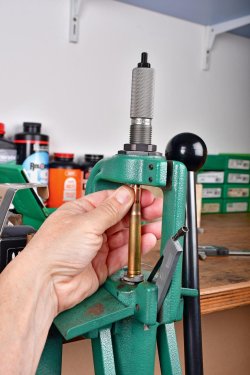
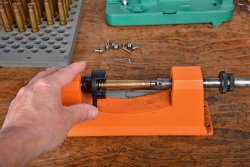
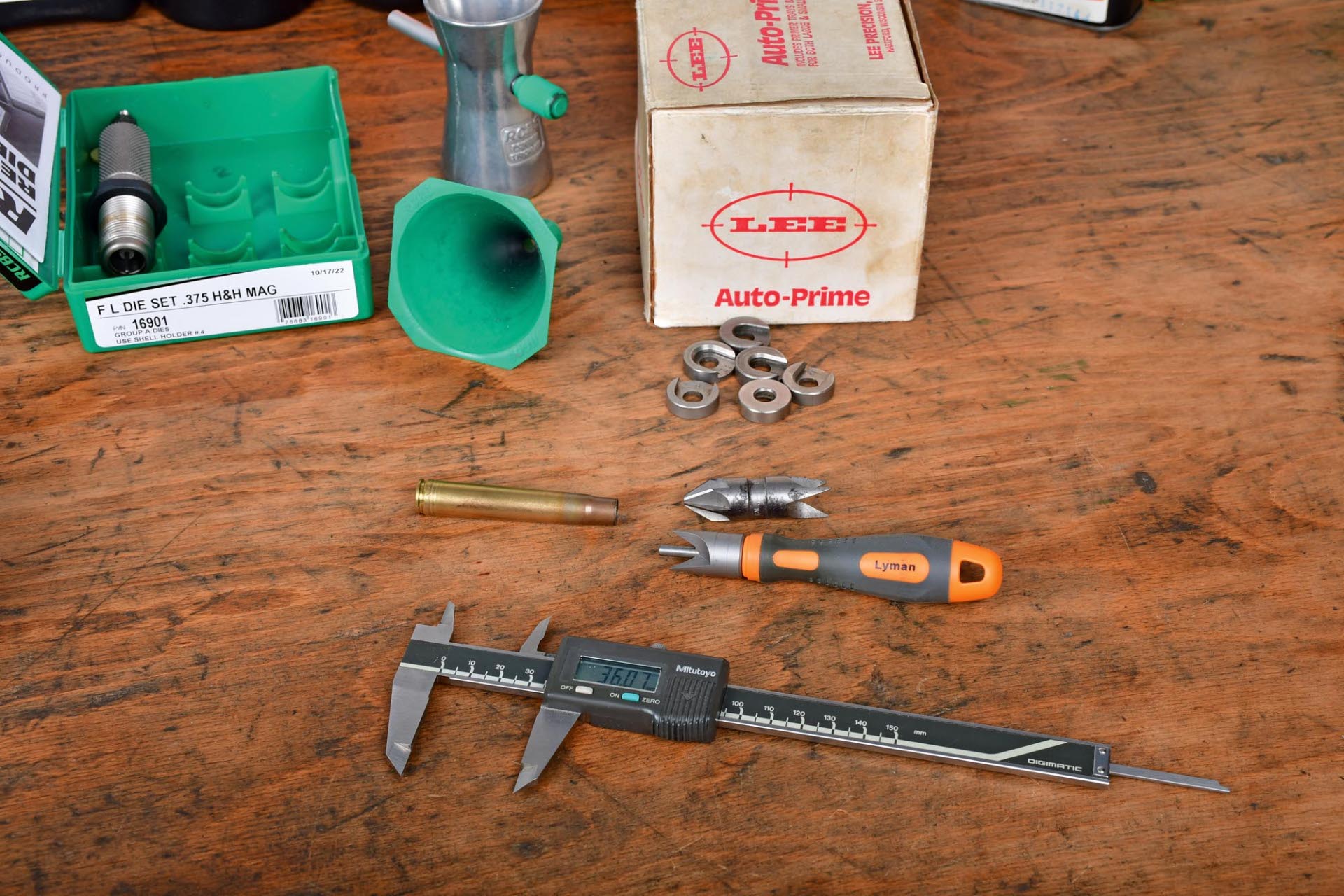
The Lee Factory Crimp is available for a reasonable 24.50 euros. With a maximum cartridge length of 91.4 mm, an RCBS Rock Chucker press is still sufficient. Another advantage is that the case still fits into standard case trimmers such as those from Lyman. If you don't want to load, you can also use factory cartridges from Barnes, Norma, Hornady, Swift, Federal, Kynoch, LFB, Nosler, Remington or RWS.
Bullets that are too light for the .375 H&H Magnum are useless
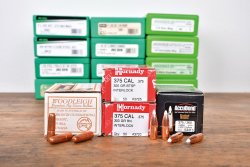
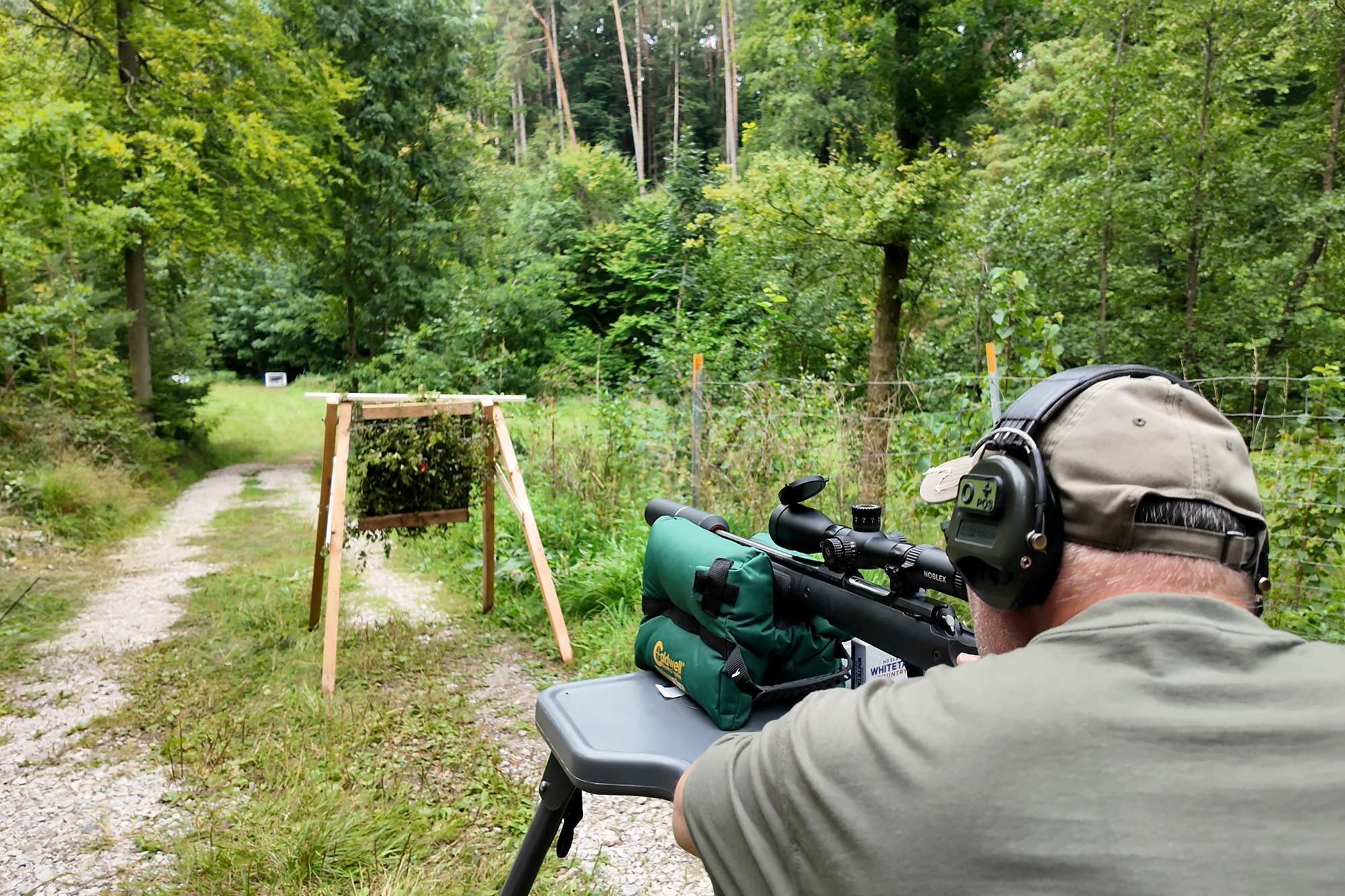
We decided to experiment and see if we could create a high-velocity version for hunting distant antelope on the steppe. We chose the 225-grain Hornady and the 250-grain Sierra soft-point bullets. N140 propellant, ignited by a Federal 215 primer, was used. A modified 98 Favorit bolt-action rifle was positioned on two leather rests at the 100-meter shooting range. The sprightly veteran achieved good results with 300-grain cartridges. However, as soon as the lightweights were put through the barrel, the results were sobering. The super-light Hornady load delivered the best 5-shot grouping with a modest 87 mm. The results with the 250-gr bullet were even worse. It was impossible to consistently hit even the proverbial beer mat at 100 meters. Given the respect for the animal, this makes its use on game unacceptable, especially since the point of impact was offset compared to the 300-grain version. This only leads to problems and unnecessary tracking during hunts.
It's clearly less stressful for the game, the hunter, and the professional hunter, especially if you're on an international hunting trip, to choose a load, zero in your rifle with it, and know the point of impact. Please don't just calculate it with a ballistics app, but try it out in real life at 100 m, 150 m or even 200 m with a live shot. With heavy bullets such as 350 grs or 380 grs, you should also check before buying whether the magazine of the gun you are using is long enough to accommodate those cartridges. It would not be the first time that the proud hunter in the bush has realized that the gun has been reduced to a single-shot rifle because the cartridges are too long. To also cover break-action rifles, the .375 Holland & Holland Flanged version was offered. It goes without saying that the gas pressure was 1,050 bar lower in the rimmed version in order to reduce the stress on the gun. Unfortunately, the rimmed version has since faded into obscurity and is now only rarely used as a special caliber upon request. Furthermore, a German competitor with comparable performance contributed to the .375 Flanged becoming a niche product: the 9.3x74 R. The .375 H&H Magnum can also be used in Europe. In Scandinavia, for example, for elk hunting, in the Carpathian Mountains for bear and heavy rutting stags, or for wild boar weighing over 300 kg in Eastern Europe.
The well-known professional and ivory hunter Harry Manners has successfully brought down around 1,000 elephants with this cartridge, including the fourth largest in the world. The latter fell to the sound of his Winchester 70 in the Milange district of Mozambique back in 1957. He also reportedly stopped 35 elephant charges with it. Other well-known users of this cartridge were Pete Pearson and George Rushby. However, it was not only a popular cartridge in Africa, but also in India. Between 1933 and 1940, Maharaja Joodha of Nepal shot the impressive number of 433 tigers with his rifle, manufactured by John Rigby & Co. in London and equipped with a Mauser action. An evaluation of the cartridges used by the visiting hunters was carried out by the competent hunting authority in Tanzania in 2003. The .375 H&H Mag. was the undisputed number one favorite among foreign hunters, with an impressive 35% share. Blaser, Mauser, Sauer, Heym and Winchester also put the cartridge in first place in the big game segment, with only the big ivory hunters clearly favoring much stronger cartridges. In their popularity category, the .375 is only in 11th place. 300-grain bullets are clearly far too light to stop a large bull elephant at close range. For double rifles, it is advisable to switch to the rimmed version of the cartridge. The belted version is a challenge for the gunsmith who makes the barrels. No other cartridge causes so many headaches when it comes to soldering the barrels in order to achieve a reasonable shooting performance. Due to the gas pressure, Heym, for example, manufactures its barrel bundles for the belted version somewhat thicker. Purists find this "wave" on the barrels of double rifles visually disturbing.
Ballistics: The effect of the .375 H&H Mag. big game cartridge
Over the years, a German professional hunter has compiled statistics from his clients who had all hunted buffalo. On average, five shots are fired with a .375, while hunters using rifles in a larger caliber (.416) only need two shots to bring down the animal. Of course, the larger diameter, the 100 grains of extra bullet weight, and the resulting higher sectional density provide greater stopping power. The much-discussed advantage of 9.5 mm over 9.3 mm can't be confirmed in terms of hunting or ballistics. If you want to be on the safe side here, you should contact your hunting organizer (not the agent). The German versions of 9.3x62 or 9.3x64 are often also approved for big game. One theory: The minimum caliber is .375 for big game hunting to prevent the German 9.3mm (=.366) cartridges, competitors from the continent, from gaining access to the British hunting paradises. Nevertheless, this minimum caliber requirement probably led to a real boom in the cartridge. Almost every manufacturer offers at least one rifle in this caliber, while the German equivalent, the 9.3x64, has completely disappeared from new rifles. Only RWS still manufactures ammunition and cases for it.
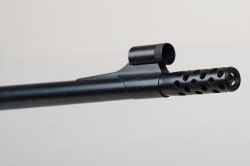
The .375 H&H, with an energy of around 5,880 joules, can be mastered by any shooter, as the recoil is relatively mild compared to some harder-kicking cartridges such as the .458 Lott. The recoil is more of a push than a kick. To summarize, it can be concluded that the .375 H&H Mag. is a successful cartridge. It is by far the most widely used all-round cartridge and is available almost everywhere should ammunition run out or even be lost in the bush. With an exotic caliber, the hunt would then be over. The large cartridge is also suitable for the smallest game species such as suni or red duiker. Simply select a full metal jacket bullet. At the SCI trade fair in the USA, Mr. 600 Nitro Express himself, Mark Sullivan, turned up at the stand of a German gunsmith. Within seconds, a crowd had formed around this polarizing big game hunter and the visitors paid homage to the master, more or less. One man took heart and asked whether his .375 H&H Mag. would be sufficient for Africa. Sullivan's answer: "My grandma uses a three-seven-five for plinking in the garden behind the house". That made for a big laugh.